
PFAS-Free Coatings for Film Applications: Technical Options and Performance Trade-Offs
As PFAS regulations continue to evolve, manufacturers are increasingly seeking coating technologies that reduce reliance on fluorinated materials while maintaining product performance.
For film applications, reducing reliance on fluorinated materials while maintaining product performance presents a significant challenge. Water and oil repellency, low surface energy, transparency, durability, and processability must often be balanced simultaneously.
As a result, PFAS-free coating technologies are attracting growing attention across industries including electronics, packaging, automotive, construction, and medical devices.
This article reviews the major categories of PFAS-free coatings, compares their performance characteristics, and discusses key considerations for film applications.
*The above information is as of October 2026.

Technical classification of PFAS-free coatings
PFAS-free coating technologies can generally be grouped into three major approaches:
• Silicone-based coatings
• Organic-inorganic hybrid coatings
• Surface-engineered coatings
These approaches are increasingly being evaluated as alternatives to fluorinated coatings across industries including electronics, construction materials, packaging, automotive components, and medical devices.
Performance requirements vary by application, but achieving water repellency, anti-smudge performance, durability, and optical transparency without fluorinated materials remains a common challenge.
In recent years, attention has increasingly shifted from material composition alone to surface and interface engineering to achieve desired functional performance.
Main technical approaches to PFAS-Free coatings
| Approach | Key characteristics | Typical applications |
|---|---|---|
| Silicone-based coatings | Low surface energy, water repellency, slip performance | Electronics, release liners, packaging films |
| Organic-inorganic hybrid coatings | Hardness, abrasion resistance, transparency | Display protection, electronic components |
| Surface-engineered coatings | Anti-smudge performance through surface design | Building materials, self-cleaning surfaces, functional films |
Silicone-based coatings
Among PFAS-free coating technologies, silicone-based coatings are currently one of the most widely used approaches. Due to their molecular structure, silicones exhibit relatively low surface energy, allowing them to provide water repellency, slip performance, and release properties without the use of fluorinated materials.
Because of these characteristics, silicone-based coatings are commonly used in anti-smudge coatings for electronic devices, release applications, and packaging materials.
However, silicone materials generally do not achieve the same level of oil repellency as fluorinated coatings. As a result, their suitability depends on the performance requirements of the target application. To address these limitations, recent developments have focused on combining silicones with inorganic materials or highly durable resins to enhance overall performance.
Key advantages
Proven and widely adopted technology
Excellent water repellency and release performance
Good processability for industrial production
Key challenges
Limited oil repellency compared with fluorinated coatings
Durability may require additional material design
Organic-inorganic hybrid coatings
Organic-inorganic hybrid coatings combine organic polymers with inorganic materials to achieve a balance of flexibility, durability, and optical performance. This approach leverages the strengths of both material classes, enabling performance characteristics that are difficult to obtain using a single material system.
For example, dispersing inorganic particles such as silica within a resin matrix can improve surface hardness and abrasion resistance while maintaining transparency. Material composition can also be tailored to optimize properties for specific applications.
As a result, organic-inorganic hybrid coatings are widely used in display protection, electronic component coatings, and other applications where both mechanical durability and functional performance are required.
Key advantages
High hardness and abrasion resistance
Good optical transparency
Flexible material design options
Key challenges
More complex formulation and manufacturing processes
Performance depends on particle dispersion and interface design
Surface energy control approach
In recent years, increasing attention has been given to surface engineering approaches that achieve anti-smudge performance through surface structure and interface design rather than relying solely on material chemistry.
By creating micro- or nano-scale surface features, the contact area between liquids and the surface can be reduced, making it more difficult for water, oils, and contaminants to adhere. Surface energy distribution can also be engineered to influence liquid behavior and improve surface functionality.
These approaches are being explored for applications such as anti-smudge building materials, self-cleaning surfaces, and advanced functional films. Because they can reduce dependence on fluorinated materials, they are considered a promising direction for future PFAS-free technologies. However, challenges remain in terms of durability, manufacturing scalability, and integration with existing production processes.
Key advantages
Reduced reliance on material chemistry alone
Potential self-cleaning functionality
Broad design flexibility
Key challenges
Manufacturing complexity
Long-term durability of surface structures
Scale-up for industrial production
Technical challenges of PFAS-free coatings
Although PFAS-free coating technologies continue to advance, replacing the unique performance characteristics of fluorinated materials remains a significant challenge.
For film applications in particular, properties such as oil repellency, optical transparency, and low refractive index are often difficult to achieve simultaneously without fluorinated materials. As a result, coating design typically requires balancing multiple performance requirements rather than simply replacing one material with another.
Oil repellency
One of the most significant challenges is achieving oil repellency.
Fluorinated materials possess extremely low surface energy, enabling them to repel not only water but also oils and other contaminants. This characteristic has made fluorinated coatings widely used in anti-smudge and easy-clean applications.
Most PFAS-free alternatives, including silicone-based and hydrocarbon-based materials, generally exhibit higher surface energy than fluorinated materials. As a result, achieving equivalent oil repellency can be difficult.
To address this challenge, current development efforts increasingly combine material selection with surface engineering, coating architecture, and interfacial design to improve anti-smudge performance.
Key challenge
Maintaining strong oil repellency without fluorinated materials remains one of the most difficult technical hurdles for PFAS-free coatings.
Transparency
For applications such as displays, optical films, and protective covers, transparency is a critical performance requirement.
Many PFAS-free coating systems rely on inorganic particles to enhance durability and surface functionality. However, particle size, dispersion quality, and refractive index mismatch can lead to light scattering and reduced optical clarity.
As a result, careful control of particle design, dispersion technology, and coating structure is required to maintain high transparency while achieving the desired functional properties.
Key challenge
Balancing transparency and durability often requires sophisticated material and process design.
Low-refractive-index design
Low refractive index materials are important for anti-reflective and optical film applications. Fluorinated materials have traditionally been attractive for these applications because they naturally exhibit relatively low refractive indices.
PFAS-free alternatives often require different approaches, such as porous structures, silica-based materials, or advanced composite designs to achieve similar optical performance.
These solutions must also maintain sufficient mechanical strength, durability, and manufacturing compatibility, creating additional design challenges.
Key challenge
Achieving low refractive index while maintaining durability and manufacturability remains a key development area for PFAS-free optical coatings.
Technical challenges for PFAS-free display films
Display films require a unique combination of optical performance, anti-smudge functionality, and mechanical reliability. Achieving these requirements without fluorinated materials remains a key challenge for PFAS-free coating technologies.

Transmittance and haze
High transparency and low haze are essential for display applications. PFAS-free coatings must maintain optical clarity while providing the required surface functionality.
Compatibility with AR/AG coatings
Display films are often combined with anti-reflective (AR) and anti-glare (AG) coatings. PFAS-free surface treatments must be compatible with these optical layers without compromising visual performance.
Abrasion resistance
Display surfaces are subject to repeated contact and cleaning. Therefore, PFAS-free coatings must provide sufficient abrasion resistance while maintaining anti-smudge properties and optical quality.
Long-term reliability
Display films must retain their performance over time under various environmental conditions. Long-term durability and stability are important considerations when developing PFAS-free coating systems.
How DNP addresses PFAS-free coating challenges
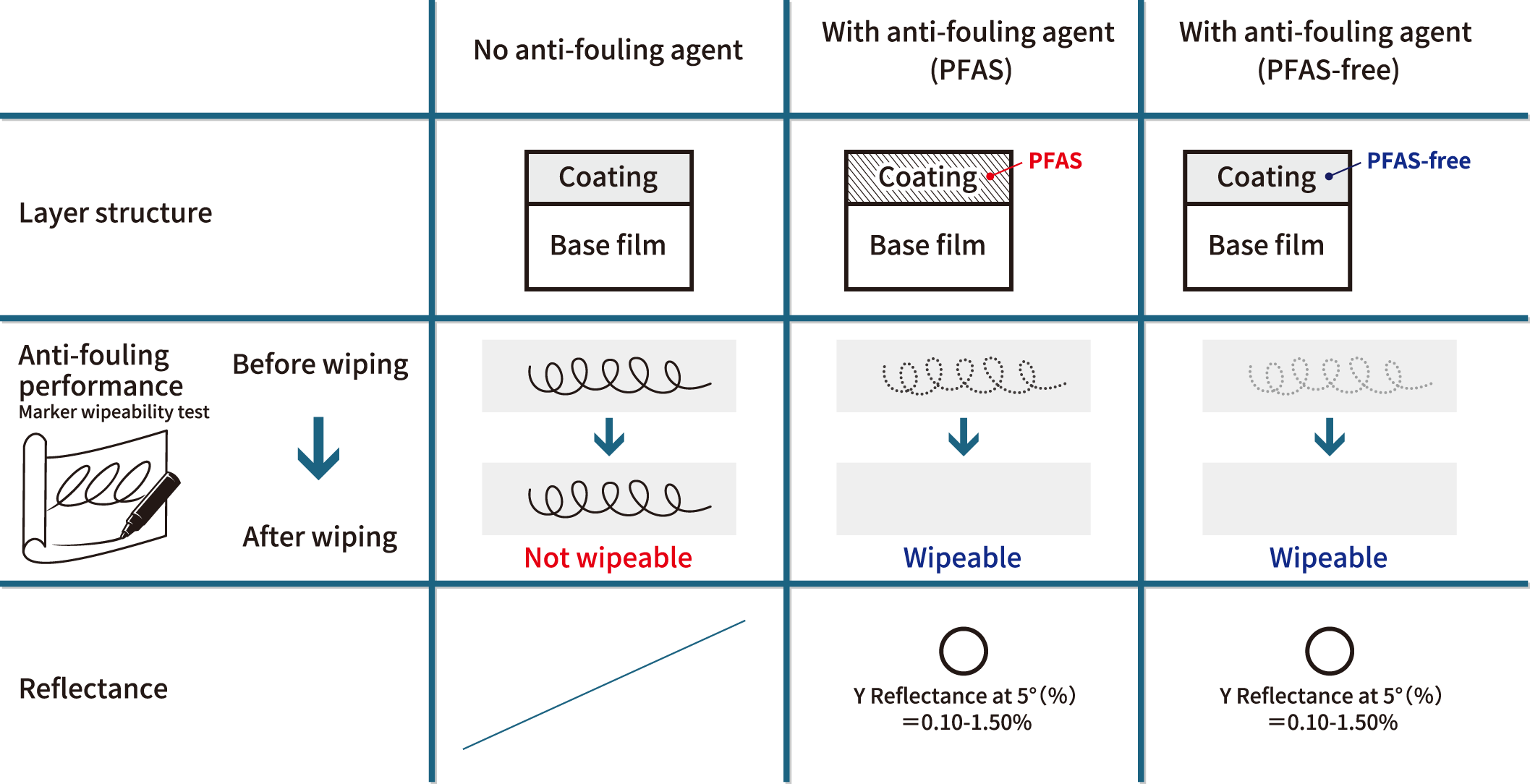
DNP is developing PFAS-free coating technologies by integrating material design, particle dispersion, and advanced coating process technologies. Through this approach, DNP aims to achieve anti-smudge performance without the use of fluorinated materials while maintaining the functionality required for demanding applications.
At the material level, DNP optimizes the balance between anti-smudge performance and durability through the use of silicone-based and organic-inorganic hybrid materials. In addition, surface engineering techniques are incorporated to achieve high levels of anti-smudge performance without relying on fluorinated compounds.
Achieving stable coating performance also requires precise control of particle dispersion and resin formulation. DNP's proprietary dispersion technologies improve material uniformity, enabling coatings that maintain high optical transparency even in optical film applications.
Furthermore, DNP optimizes coating and drying processes to precisely control coating thickness and surface structure. This integrated approach enables PFAS-free films that deliver performance comparable to conventional fluorinated coatings, making them suitable for display film applications where both anti-smudge functionality and optical performance are required.
PFAS-free coating with anti-smudge agent
FAQ on PFAS-free coatings
Q1. When should PFAS-free coating evaluation begin?
Ideally, PFAS-free material selection should be considered during the early stages of product development. Evaluating alternatives late in the design process can lead to additional testing, redesign efforts, and increased development costs. For products intended for global markets, many companies are incorporating PFAS-free solutions from the initial design phase to mitigate future regulatory risks.
Q2. Which performance characteristics should be prioritized when replacing fluorinated coatings?
Evaluation should consider multiple performance requirements, including water and oil repellency, anti-smudge properties, abrasion resistance, adhesion, and optical performance. For display and optical film applications, transparency and haze are often among the most critical factors.
Q3. Can PFAS-free coatings be implemented using existing coating lines?
In many cases, PFAS-free coatings can be processed using existing coating equipment. However, adjustments to coating conditions, drying profiles, or process parameters may be required depending on the material formulation and performance requirements.
Q4. How much oil repellency can PFAS-free materials achieve?
Current PFAS-free technologies may not always replicate the oil repellency of fluorinated materials using a single material alone. As a result, many solutions combine material design, surface engineering, and coating architecture to achieve practical anti-smudge performance.
Q5. Which regions are most affected by PFAS regulations?
The European Union is currently the primary driver of PFAS regulatory discussions. The proposed restrictions under evaluation by the European Chemicals Agency (ECHA) are influencing material selection and product development across multiple industries worldwide.
Q6. What are the benefits of adopting PFAS-free coatings?
One of the primary benefits is reducing future regulatory and compliance risks. PFAS-free solutions can also support sustainability initiatives, improve supply chain resilience, and help companies prepare for evolving environmental requirements.
Considering PFAS-free coatings for optical film applications?
PFAS-free coatings are gaining attention not only as a response to evolving regulations but also as a proactive strategy for addressing future material restrictions and supply chain risks.
At the same time, maintaining anti-smudge performance, optical clarity, and durability without fluorinated materials requires an integrated approach that combines material design, particle dispersion, and coating process technologies.
For optical film applications in particular, achieving the right balance between anti-smudge properties, transparency, and long-term reliability presents unique technical challenges. Careful evaluation of both material systems and coating technologies is essential when transitioning to PFAS-free solutions.
DNP offers PFAS-free coating solutions optimized for a wide range of optical and functional film applications. Please contact us to discuss your technical requirements and development challenges.
Please feel free to contact us with any questions about this column. We will respond within two business days.