DNP, Hanshin Expressway and Kurabo Develop Emergency Repair Sheet to Prevent Peeling of Concrete in Aging Structures such as Bridges
Facilitating repair works by integrating new adhesive and fibrous sheet
Jun 22, 2016
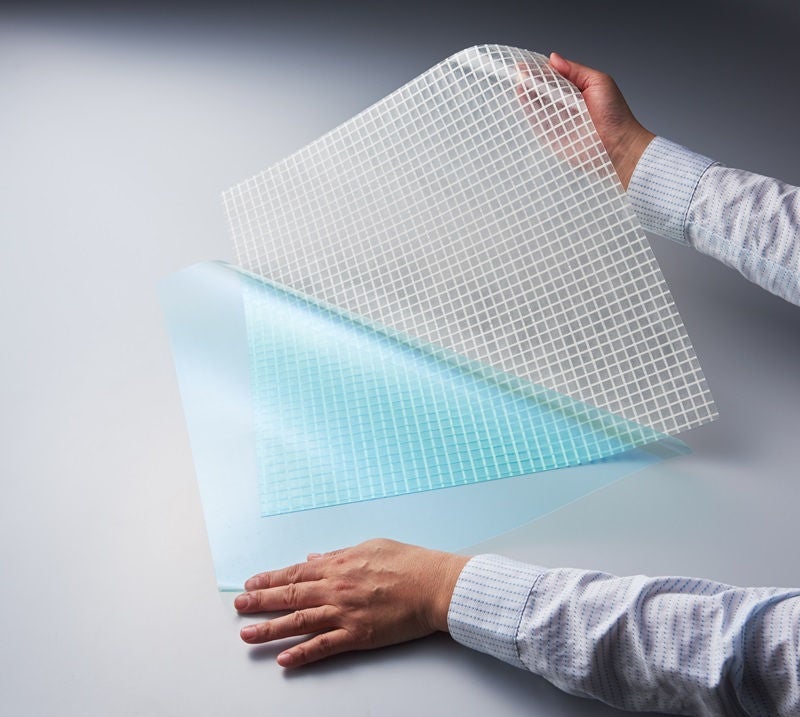
Dai Nippon Printing Co., Ltd. (DNP), Hanshin Expressway Engineering Company Limited (Hanshin Expressway), and KURABO INDUSTRIES LTD. (KURABO) have jointly developed emergency repair sheet capable of preventing peeling of concrete in aging structures. The newly developed product provides emergency repairs to concrete cracking or other defective areas, discovered when inspecting viaducts, tunnels, etc., and is used to increase safety until full scale repairs can be conducted.
Background
Japan is now facing the reality that much of the current infrastructure, such as the roads and railways constructed during the period of high economic growth, is now aging. Instances of accidents involving concrete peeling and falling have become a social issue. As a countermeasure, regular inspections of concrete structures, and in cases of cracking or other defects, the concrete in those and surrounding areas has been removed, and repairs made to prevent further peeling. As the risk of peeling remains throughout the period from inspection to repair works, there has been a demand for emergency measures to reduce concrete peeling.
The partners have risen to the challenge and developed sticky-back emergency repair sheet that integrates special adhesives with a reinforced fiber net.
[Product Features]
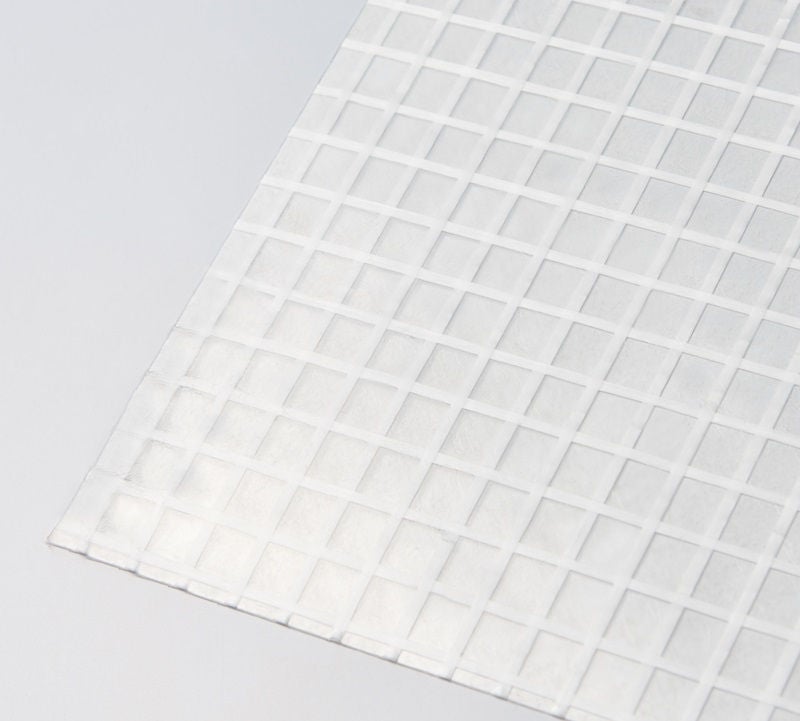
The newly developed product makes it possible to immediately perform emergency repairs on concrete cracks and other defective areas discovered when inspecting via ducts and tunnels. The new product is a sticky-back sheet with Crenette, the high strength polyethylene fiber developed by Kurabo, laminated on the adhesive layer as developed by DNP.
Major features
It is possible to perform repairs to defective areas in a simple manner, merely by stripping away the external polyester (PET) film, and adhering it to the concrete, following the uniform coating of the defective concrete surface with a primer to smooth it.
Curing of the adhesive agent can be performed via irradiation with ultraviolet rays found in sunlight or fluorescent light.
Current repair works (employing polymer cement mortar etc.,) require two days per square meter. By way of comparison, similar tasks involving the newly developed product take about 30 minutes only.
It is also possible to reduce risks in the period between the discovery of the defective area and the implementation of permanent repair works.
In load (punching) tests to assess prevention performance anticipating concrete peeling, the newly developed product achieved approximately 2.5 kN, in excess of the 1.5 kN minimum required value for repairs, and comprising the basic performance qualities necessary as an emergency repair material.
The repair sheet contains only a low organic solvent content in its materials including adhesive that can be the cause of environmental pollution, and is an eco-friendly product with no perceivable odor emitting.
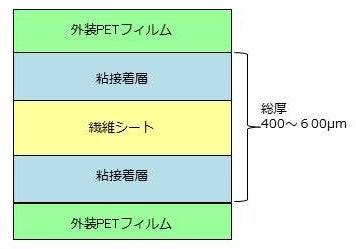 Layer composition
[Looking Ahead]
DNP, Hanshin Expressway, and KURABO will perform field tests, and use the assessments and knowledge obtained there for marketing activities, aiming to commercialize the newly developed product in FY 2016.
(Note 1) "DK-Pitatto Aid" is a registered trademark of DNP and Kurabo.
(Note 2) Compliant with Hanshin Expressway Co., Ltd.'s road structure repair guidelines.
Part 2 Concrete Structures, Part 2 Guidelines for Surface Protection of Concrete Structures (January 2007)
Surface protection work quality standard "Medium corrosion protection type C"