Shiny holograms can be found on a range of items such as credit cards, gift certificates, and branded goods. In addition to their design, they are effective in helping prevent counterfeiting thanks to advanced manufacturing techniques that cannot be replicated easily. Here, we will explore the cutting edge of holograms, not only for their strengths in design and security, but also as an emerging next-generation information display technology!
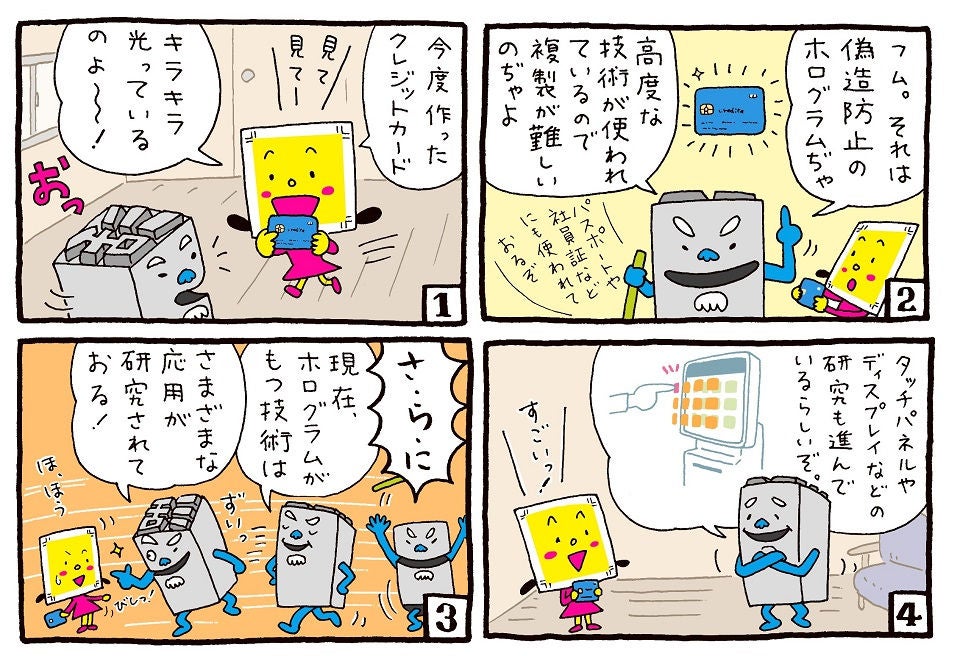
Characters

Katsujii... Kinzoku Katsujii is like a living encyclopedia: his career as a movable type spans more than 100 years. Here, he shares his extensive knowledge of the DNP Group, teaching all kinds of things with his many years of experience.

Tonbo-chan... A character born from the tonbo register marks* used to align printed materials. She has a meticulous personality, hates anything misaligned, and supports Katsujii with her careful attention to detail.
- Register marks: A printing term for registration in multi-color printing refers to the precise positional accuracy when overlapping color plates. This alignment is achieved using register marks known as "tonbo."
Holograms utilize advanced optical design and processing technology
The word "hologram" comes from the Ancient Greek words "holos" (whole) and "gramma" (something written or recorded) and refers to something that records all the light needed for humans to visually perceive an object. Along with advances in electron microscopes in 1947, holography, the technology used to create holograms, was developed.
Since hologram production requires advanced optical design and microfabrication technology, they are used to help prevent the counterfeiting of a wide range of items, including credit cards, gift certificates, branded goods, ID cards, packaging for cosmetics and pharmaceuticals, auto parts, and electronic devices. As online shopping continues to grow, the need for individual consumers to determine whether products they have purchased are genuine or not is also growing.
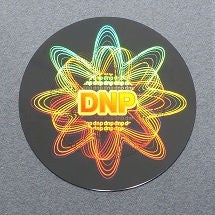
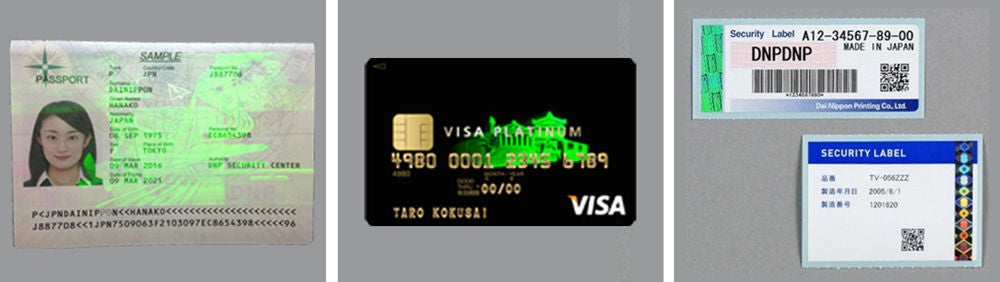 Holograms are used in things such as passports (left), credit cards (center), and security labels (right)
Recording light-based information to create vivid three-dimensional images and more
How are three-dimensional (3D) images recorded and created as holograms?
When we see an object, light hits it and the reflected light enters our eyes, allowing us to recognize the object. We perceive its shape and color based on the amplitude (intensity) and wavelength (color) of the light.
Images seen on TVs and computers are recognized based on the amplitude and wavelength of light emitted from the display, but because they lack depth, only two-dimensional images can be reproduced. Even when viewing a video of a three-dimensional object at an angle or from the side of the display, the image will simply appear distorted, not three-dimensional.
In contrast, holograms generate interference fringes, which are fine, striped patterns of light and dark. Along with the amplitude and wavelength of light, they also record its phase (direction of reflection), making it possible to reproduce three-dimensional images.
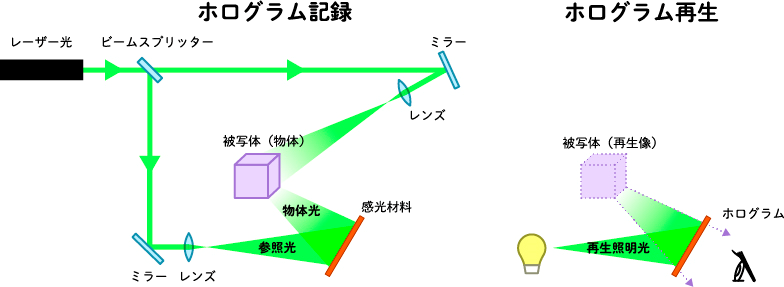 A laser beam is split in two directions: one is reflected off the object as the object beam, and the other is used as the reference beam. These two beams are then superimposed on a hologram's photosensitive material. This generates interference fringes that contain phase (directional) information, which are recorded onto the material. By illuminating light onto it, the object appears as a three-dimensional image.
There are several methods for recording the interference fringes of a hologram. The most common are the embossed hologram, which records the fringe pattern as a concave-convex surface structure on the photosensitive material, and the Lippmann hologram, which records it as a refractive index distribution within the material.
Embossed holograms offer high brightness, fine image detail, and are suitable for mass production. They are used across a wide range of fields for their security applications and advanced design.
Lippmann holograms can capture and display highly realistic, three-dimensional images with depth. They require special recording materials and advanced technology, and because specialized equipment is used for both recording and mass production, the holograms are extremely difficult to counterfeit. This makes them especially effective when used in security applications. DNP established a mass production system for Lippmann holograms in 2001 and remains capable of mass producing a variety of Lippmann hologram products.
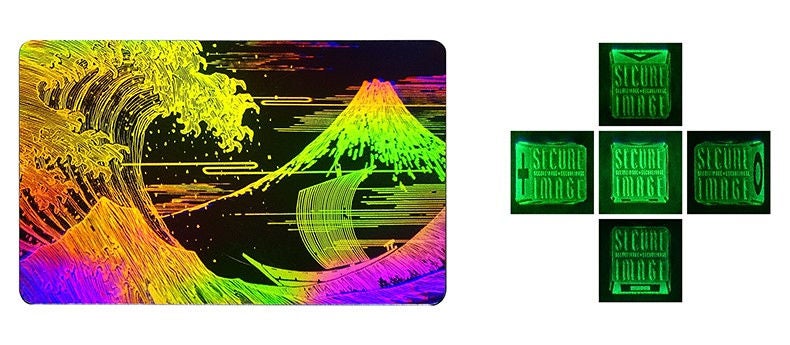 The high-brightness, high-definition embossed hologram (left), and the Lippmann hologram, which expresses three-dimensional depth both vertically and horizontally (right)
DNP has advanced the fine processing technology cultivated through its printing production processes to manufacture photomasks, which are the original plates for semiconductor circuit patterns, and is applying that same technology to the design and production of holograms. Based on its extensive hologram-related technology and expertise, DNP has developed many high-quality products and a track record of implementing them in a diversity of situations.
For example, we developed our own original hologram VIRTUAGRAM in 2003 by combining embossed holograms with electron beam imaging technology, creating holograms of virtual, three-dimensional objects using 3D computer graphics, rather than forming them by irradiating actual objects with laser beams. This technology was further advanced in 2017, allowing us to mass-produce high-quality, full-color embossed holograms from 3D computer graphic data. The result is vivid color expression, realistic textures, smooth motion, and depth.
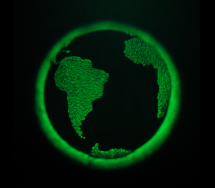
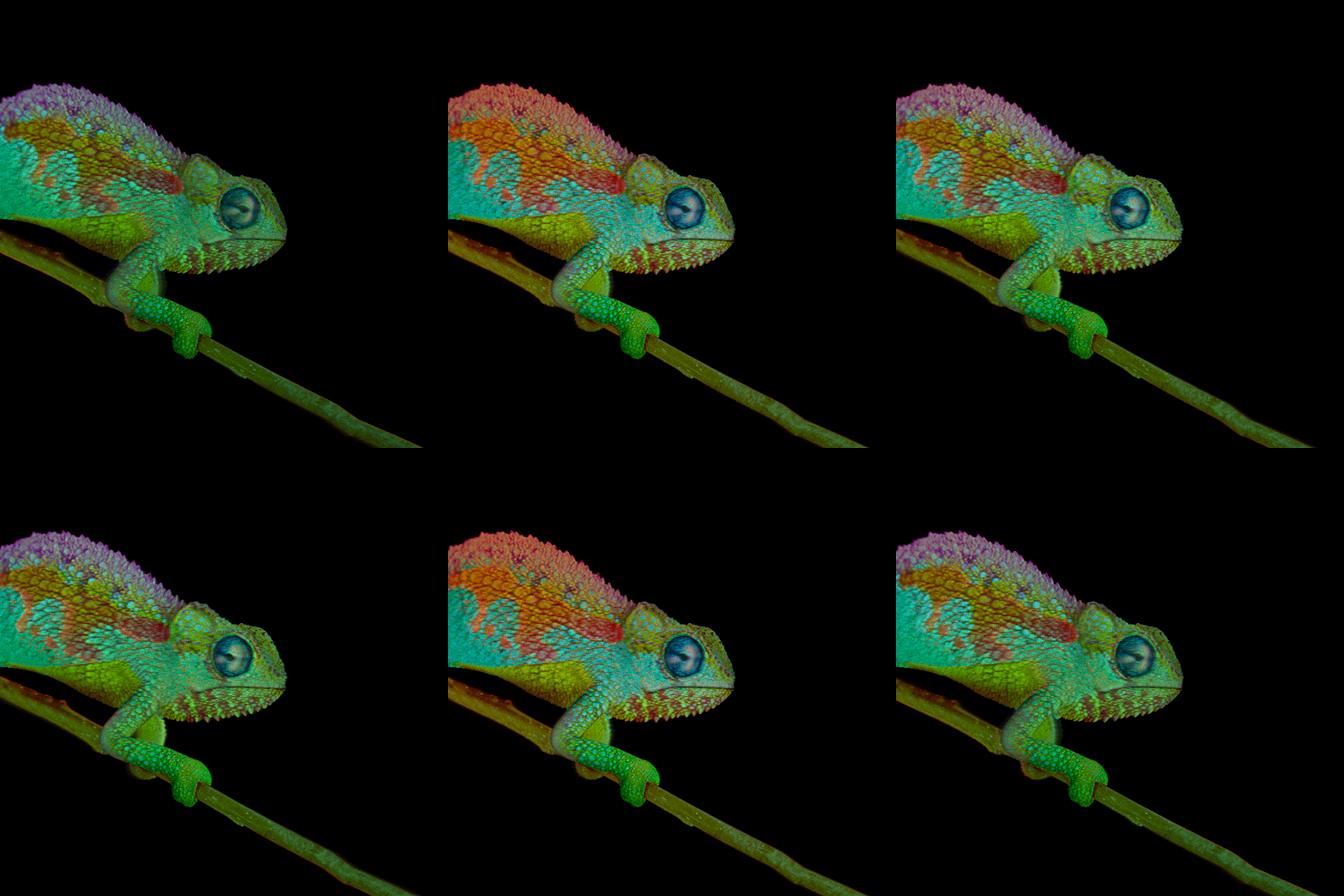 A full-color 3D computer graphic VIRTUAGRAM
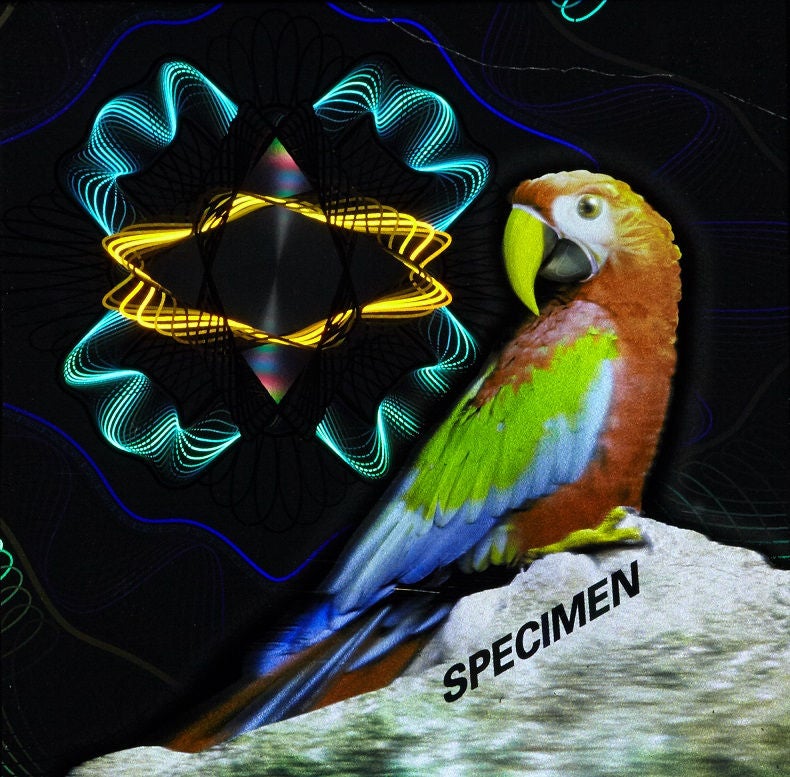 A full-color 3D computer graphic VIRTUAGRAM
In 2016, the company launched a user-friendly hologram that enables users to authenticate easily without the need for special equipment. When a handheld LED light source or a smartphone flashlight is directed at the hologram, specific letters or images appear if the product is genuine. The authentication can be photographed with a smartphone or other camera, and the image data can be emailed to share information remotely.
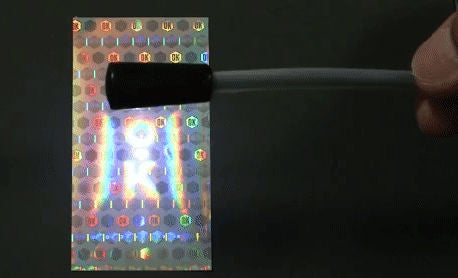 A hologram that can be authenticated using LED light.
In 2021, the company developed the "DNP Contactless Holo Touch Panel." By installing a sensor on the touch panel that detects its position in the air using infrared rays or other methods, and by making a hologram image appear in the same position as this sensor, it becomes possible to visually recognize the invisible detection area. This makes it easier to move your finger within the sensor detection area, allowing for easy operation without touching the touch panel screen.
※Discover DNP:社会ニーズに応える“触れないパネル”「DNP非接触ホロタッチパネル」
https://www.dnp.co.jp/media/detail/10161948_1563.html
New possibilities for holograms through dispersing and concentrating light
In recent years, research has advanced on new ways of using holograms in society by leveraging their ability to disperse and concentrate light. Examples include components for in-vehicle displays and optical elements for smart glasses. As technologies such as augmented reality (AR) and transparent screen projection continue to develop and enter practical use, the promise of holograms is gaining renewed recognition.
DNP is particularly adept with optical technologies and technologies for evenly and precisely coating substrates—such as film—with functional materials, which has earned us a top global market share in light-controlling film products. By combining this light-controlling technology with holograms, we are expanding the potential for new value creation.
Until now, holograms have mainly been known for their role in helping prevent counterfeiting and enhancing brand value. However, in response to changing lifestyles and advances in digital technology, a variety of research initiatives are being conducted through collaborations between industry, government, and academia. As a pioneer in hologram development since 1972, with a half-century track record, DNP is leveraging its strengths in printing and information (P&I) to create new value that will set future standards.

I always thought holograms were just sparkly and pretty, so I was surprised to find out they're used in so many different ways.

The promise of holograms lies in the fact that they are already widespread in society, holding potential for even further technological innovation. As a technology tied to human vision, they will likely continue to be used in a wide range of applications.
- Please note that the information contained in this story was accurate as of the publication date.
April 11, 2022 by DNP Features Editorial Department