
DNP Develops Non-Electric Dimming Blind Glass
April 6, 2016
Dai Nippon Printing Co., Ltd. (DNP) has developed a dimming glass that does not require electricity, and works by the manual manipulation of two sheets of glass to complete the transition from a transparent to a frosted or colored effect. DNP will launch sales of the new blind glass in April, 2016.
Ahead of the official sales launch, the newly developed dimming blind glass has been adopted at the Okegawa City Station West Exit Library, newly established in a commercial facility in Saitama Prefecture, an area neighboring Tokyo.
Background
We are seeing increasing instances of offices and public facilities using electrically-driven dimming devices that create a frosted or colored effect, in otherwise transparent glass, as a means of increasing privacy. Apart from the constant use of electricity, cabling is also necessary, making the installation process a time consuming effort.
DNP has once again risen to the challenge, and has leveraged its optical design and patterning technology, cultivated through the creation of optical film for LCD. And, by allowing users to manually slide two sheets of glass that combine a polarizing plate and retardation film, DNP has developed a dimming blind glass that facilitates shifts between transparent and frosted or colored views with just a flick of the wrist.
[Screen Features]
- The newly developed dimming blind glass makes it possible to take the optical film technology used in polarization plates, and control the passage of light. As a result, it is possible to manually switch between transparent and frosted or colored glass.
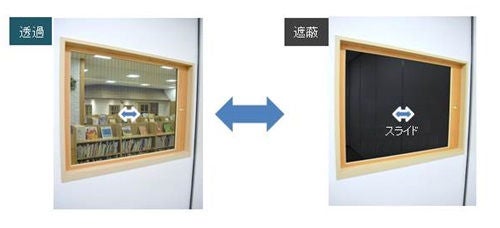
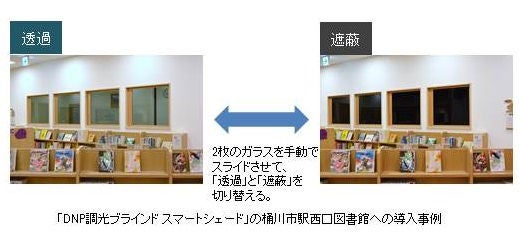
- Compared to existing electrically-powered products, the newly developed blind glass is non-electric, and hence, energy-saving. It can also be installed in a shorter time, as no complicated cabling is needed.
- As the new blind glass is based on a structure that combines a polarizing plate with retardation film, it is also possible to clean the surface with normal glass polisher. There is no need to go through the time consuming process of wiping off dust layer by layer, as in the case of standard blinds.The newly developed blind glass also frees users from the inconvenience of restricted vertical vision, and of the blind cords becoming entangled and dysfunctional inside the two sheets of glass, which happens in cases of currently marketed glass with built-in blinds
- The thickness of the new blind glass is 24mm, which isa lower profile than glass with externally attached blinds, making it possible to install in partitions and on windows.
- As the film is attached to the glass, the glass will not scatter even if broken.
- Apart from standard glass, it is also possible to use lighter resin-based glass, such as poly-carbonated glass.
- The current lineup includes black, blue, purple and yellow color variations.
- It is also possible to use the newly developed blind glass in spaces such as hospital operating rooms that require a clean environment, in place of cloth curtains that tend to collect germs.
[Looking Ahead]
DNP has positioned Knowledge and Communication, Food and Healthcare, Lifestyle and Mobility, and the Environment and Energy as business growth areas, and is engaged in the creation of new values. As part of those efforts, DNP is forging ahead with the development of new products that leverage film with a variety of functions, and is engaged in new product development that will reduce environmental burdens. DNP will market the newly developed blind glass for purposes including housing and office buildings, along with school, commercial and medical facilities, aiming for sales of 3.0 billion yen in FY 2020.
The DNP Light Control Blind Smart Shade will be exhibited at the DNP booth at the High-Performance Material World 2016 High-Performance Film Exhibition, to be held at Tokyo Big Sight from Wednesday, April 6th to Friday, April 8th.
- Product prices, specification and service contents mentioned in this news release are current as of the date of publication. They may be changed at any time without notice.