
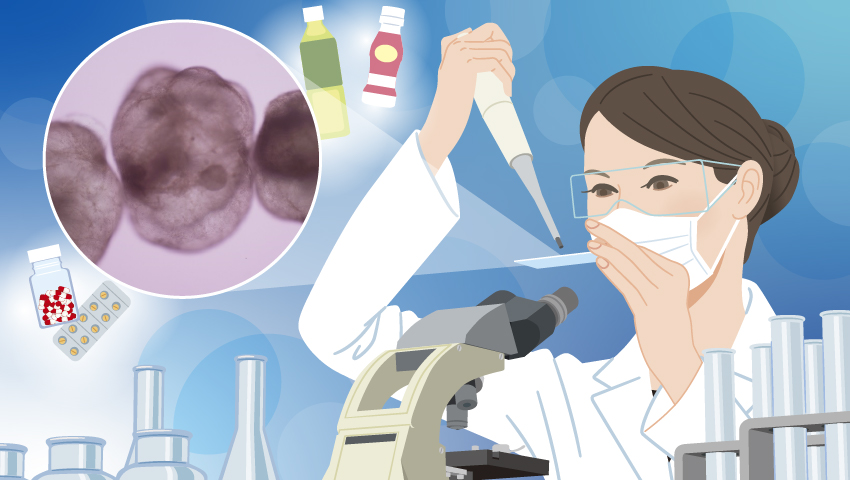
DNP has developed a miniature intestinal organ, “mini-gut,” derived from human induced pluripotent stem (iPS) cells. Although only about 1.5 millimeters in size, mini-gut exhibits functional characteristics similar to those of the human intestine. Leveraging our advanced microfabrication technologies, and in collaboration with National Center for Child Health and Development, a leader in regenerative medicine research, we successfully created this miniature organ. In this article, we introduce the mini-gut, which DNP began trial sales in December 2021 and continues to advance development toward full-scale commercialization.
The growing importance of human cell–derived mini-organs in response to global animal-welfare concerns and increasing development costs
In the early stages of developing new pharmaceuticals — particularly oral medications — as well as foods with health claims such as Foods for Specified Health Uses (FOSHU) and Foods with Functional Claims, it is essential to evaluate how candidate ingredients are absorbed in the intestine and how they behave within the body thereafter. Traditionally, such assessments have relied on animal studies. However, growing global awareness of animal welfare *1, has increased the demand for alternative evaluation methods. At the same time, the pharmaceutical and food industries continue to face rising development costs and longer development timelines. These challenges have made the need for viable, non-animal testing alternatives more urgent than ever.
- 1. Animal welfare: The principle of treating animals ethically, ensuring their health and well-being, and minimizing pain, stress, and suffering.
To meet the growing need for alternatives to animal testing, researchers are increasingly exploring the use of various organ-specific cells cultured from pluripotent stem cells, including human iPS cells, in the development of new pharmaceuticals. Among these approaches, miniature organs known as “organoids”— three-dimensional structures that exhibit functions similar to human organs — have gained significant attention. Organoid technologies are actively being developed across numerous research institutions.
Among human organoids, the intestinal organoid — known as the “miniature gut organoid” — which features complex structures and functions, has attracted particular attention. This organoid was jointly developed by DNP and the National Center for Child Health and Development. Trial sales began in December 2021, and efforts toward full commercialization are currently accelerating.
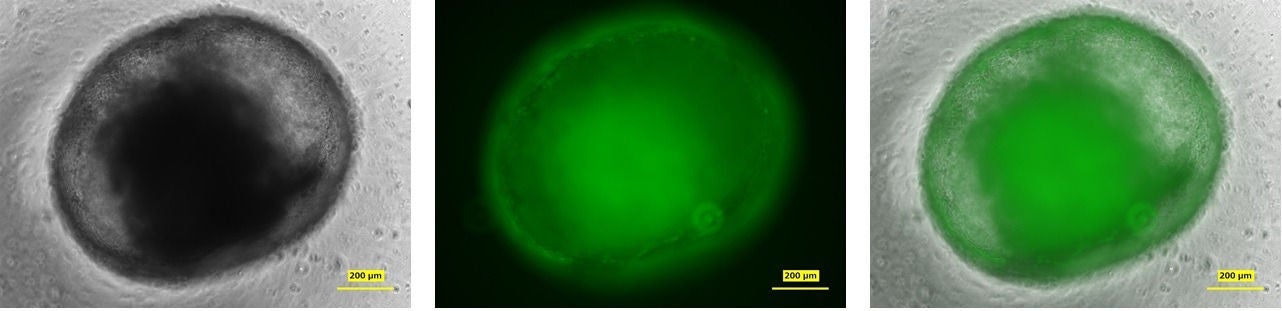 Left: Phase-contrast image of the mini-gut, Center: Fluorescence image of the same mini-gut (nutrients labeled with a fluorescent marker appear in green), Right: Overlay of the phase-contrast and fluorescence images
Polymer thin-film microfabrication at DNP: a key technology for mini-gut development
The mini-gut shown in the photo is approximately 1.5 mm in size, but it can be grown to about 1 cm. This is larger than conventional intestinal organoids developed to date, and unlike typical organoids, the mini-gut’s structure is inverted, exposing the nutrient-absorbing intestinal epithelial cells on the outside. This unique configuration makes it easier to measure absorption efficiency.
In addition to the intestinal epithelial layer responsible for absorption, the mini-gut also contains smooth muscle cells, enteric neurons, and other submucosal tissue components, enabling a three-dimensional reconstruction of tissue architecture that closely resembles the human intestine. These unique features allow the mini-gut to be applied to a wide range of research fields.
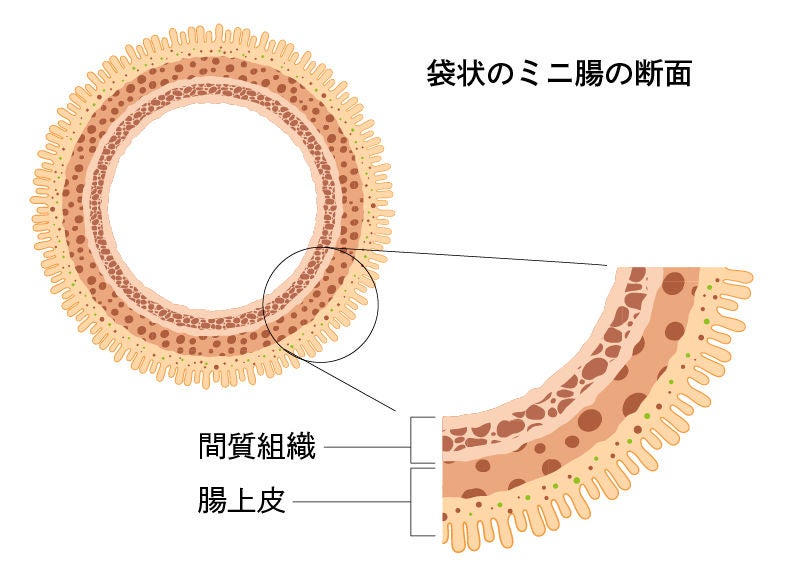 Cross-sectional illustration of the mini-gut
When human iPS cells *2 are seeded onto the patterned culture substrate and cultured for approximately 30 days, they naturally detach from the surface and can be collected as three-dimensional intestinal organoids. By continuing cultivation for an additional 30 days after collection, these organoids mature into fully formed mini-guts.
- 2. iPS cells: A type of pluripotent stem cell capable of differentiating into various types of tissue and organ cells. Unlike embryonic stem (ES) cells, which are derived from blastocysts, iPS cells can be generated from readily accessible somatic cells such as skin or blood.
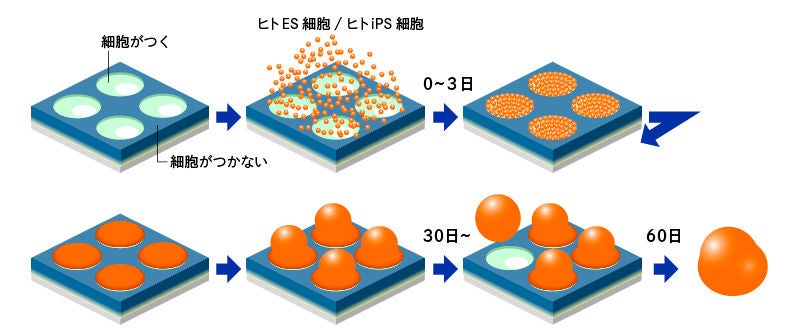 Schematic illustration of the mini-gut production steps
A key point here is that simply culturing iPS cells on a basic substrate does not result in mini-gut formation. To recreate the intestine’s complex structure and functions, a patterned substrate that enables cells to grow in an optimal configuration is essential. It is DNP’s microfabrication technology for polymer thin films *3— an advancement of the company’s sophisticated micro-patterning and precision coating techniques — that controls critical cellular behaviors such as adhesion and differentiation, making the creation of mini-guts possible.
This technology involves coating the substrate with a polymer that prevents cell adhesion, followed by the irradiation of vacuum ultraviolet (VUV) light *4 in a defined pattern to create regions where cells can attach and grow. DNP’s unique strength lies in combining proprietary expertise in designing optimal culture patterns with the microfabrication capabilities developed through photolithography technology.
- 3. Polymer Thin Film: A thin film of 1 micrometer (1/1,000 mm) or less made from polymeric materials such as plastics, resins, and rubbers, which lends itself readily to functionalization with specialized properties.
- 4. Vacuum ultraviolet (VUV) light: A form of electromagnetic radiation referring to the region of ultraviolet light with the shortest wavelengths, spanning approximately 10–200 nm.
DNP's commitment to quality and ease of use
Following the trial sale in December 2021, the miniature gut organoid*5 has garnered considerable attention from multiple sectors due to its promising applications. In April 2022, it was used in experiments to measure how COVID-19 variants, such as Omicron and Delta, replicate in the intestinal tract — an area where little prior knowledge existed.
DNP sees improving both the quality of its miniature organs and the user-friendliness of the product as key to delivering real social value and meeting rising expectations.
For example, organoids derived from biological tissue are often difficult to freeze, which presents challenges in maintaining quality during distribution. To supply them reliably to multiple research institutions, it is necessary to rethink everything from specialized containers and transport methods to transfer procedures. Additionally, to incorporate them into the development process of functional foods and pharmaceuticals, it is essential to establish correlations with conventional testing methods, such as animal experiments and experiments using isolated cells.
Improving the functionality and stabilizing the quality of the “miniature gut organoid” are important themes, but addressing challenges related to social implementation can be considered an even more difficult endeavor. At the same time, this is an area where DNP can truly demonstrate its value, having responded to the needs of many companies across diverse industries, including food and pharmaceuticals.
DNP is advancing its research with the aim of launching full-scale commercial sales of the mini-gut within the next five years.
- 5 国立成育医療研究センター プレスリリース
新型コロナウイルスの増殖性を立体臓器「ミニ腸」で検証 〜デルタ株とオミクロン株の全く異なる特性を発見〜
https://www.ncchd.go.jp/press/2022/0512.html
DNP’s commitment to advancing the entire medical and healthcare field
Rapid advances in technologies that use cells to create three-dimensional structures that replicate organs are accelerating the development of organoids like the mini-gut, and such models are expected to expand to other organs in the coming years. In the drug discovery field in particular, organoids of the brain, heart, and lungs are anticipated to be in high demand. Furthermore, methods that link multiple organoids to evaluate their interconnected effects on the human body are also expected to emerge.
Since its establishment in 2011, DNP has been engaged in business development in the medical and healthcare fields, including early participation in the Forum for Innovative Regenerative Medicine (FIRM). Building on the cell culture technologies cultivated through these efforts, DNP is also exploring the practical application of microphysiological systems (MPS) *6 — which aim to reproduce human physiological responses by combining various organ-specific cells with microfluidic channels *7 that connect them. With a long-term perspective, we will continue advancing our research in this area.
- 6. MPS (Microphysiological Systems): Engineered platforms that combine human organ-specific cells with microfluidic channels to replicate physiological functions and interactions observed in the human body.
- 7. Microfluidic channel: A microscale channel, typically a groove formed on a glass or polymer substrate, with widths and depths ranging from several to several hundred micrometers.
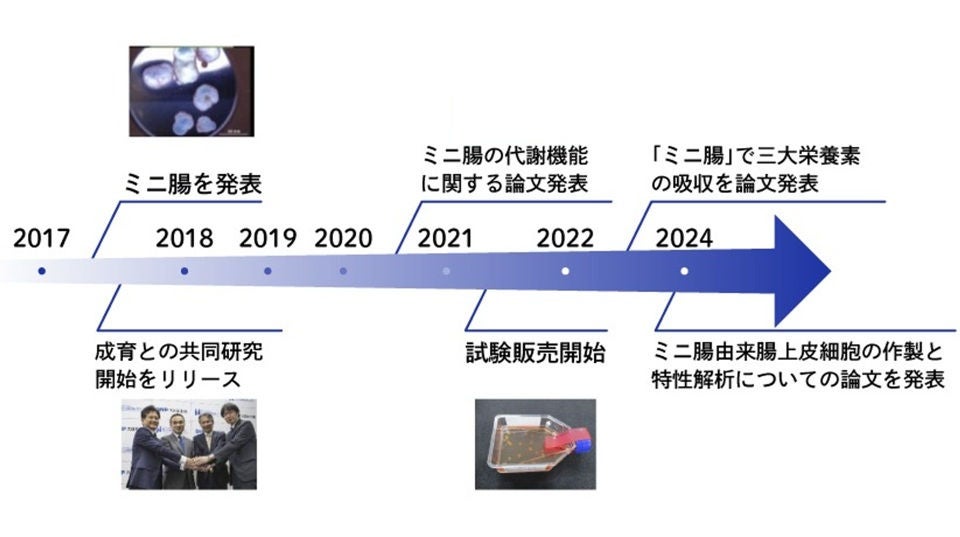 Development timeline since the 2017 announcement of the successful mini-gut creation
Nearly a decade has passed since DNP first achieved the successful creation of the mini-gut. Looking ahead to the next ten years, we will continue to advance new business initiatives across the medical and healthcare sectors by drawing on our expertise in human iPS cell–derived technologies, organoid research, and the knowledge acquired at the forefront of these fields. We remain committed to fostering innovations that will take shape in the years to come, and we appreciate your continued interest in DNP’s ongoing endeavors.
- Please note that the information provided is current as of the publication date.
Update date: December 18, 2025
First published: August 8, 2022 by DNP Features Editorial Department
Discover more

Related products and services
Articles
-
News: Absorption of the three major nutrients (carbohydrates, proteins, and lipids) confirmed in a "mini-intestine" created from human iPS cells.
-
News: National Center for Child Health and Development and Dai Nippon Printing begin joint research to support drug discovery using next-generation organ chip "Mini Intestine"