In locations where strict safety control is required—such as nighttime construction sites and warehouses with frequent forklift traffic—a key factor in preventing accidents is making warnings and guidance highly visible so that drivers and nearby workers can notice them quickly and respond appropriately. To address this challenge, DNP developed the DNP laser signal projector. Its key feature is the ability to project highly visible patterns that can be recognized from the intended distance and direction. This is achieved by combining micro-patterning technology and optical design with precisely controlled laser light. Use cases for the DNP laser signal projector are expanding not only at safety-critical sites such as roadworks and logistics facilities, but also into new areas, including directional guidance in public spaces.
Unseen and unnoticed hazards can lead to serious accidents
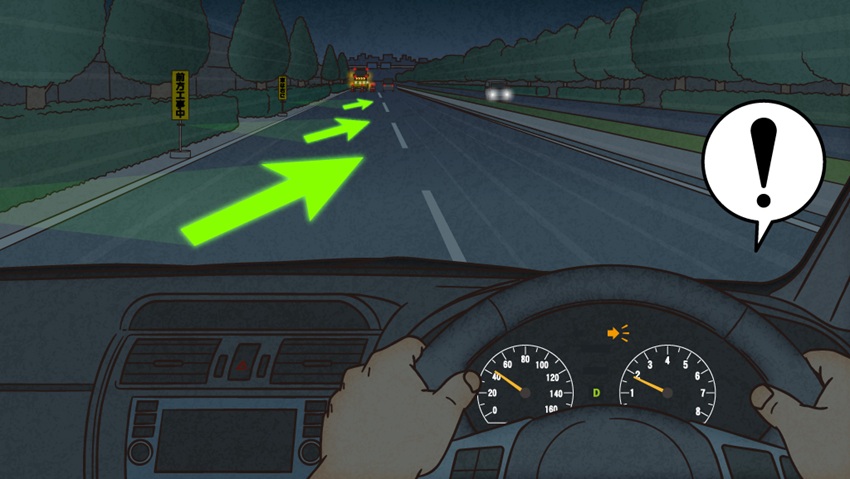
Late at night on a highway, beyond a curve where the streetlights don’t reach, a traffic controller raises a lighted baton. Heavy trucks pass by just meters away. In situations like this, both workers and drivers are forced to make split-second decisions. When warning lights, signs, and other safety markers go unseen—or unnoticed—the consequences can be serious, potentially leading to major accidents.
In recent years, accidents involving vehicles entering work zones on highways have been on the rise. According to data published by the three NEXCO companies (East Nippon Expressway Co., Ltd., Central Nippon Expressway Co., Ltd., and West Nippon Expressway Co., Ltd.), the number of such incidents doubled from 704 in 2020 to 1,457 in 2022. Nearly 90% of these cases were caused by drivers’ delayed awareness due to inattentive driving, such as careless driving and looking away from the road ahead.
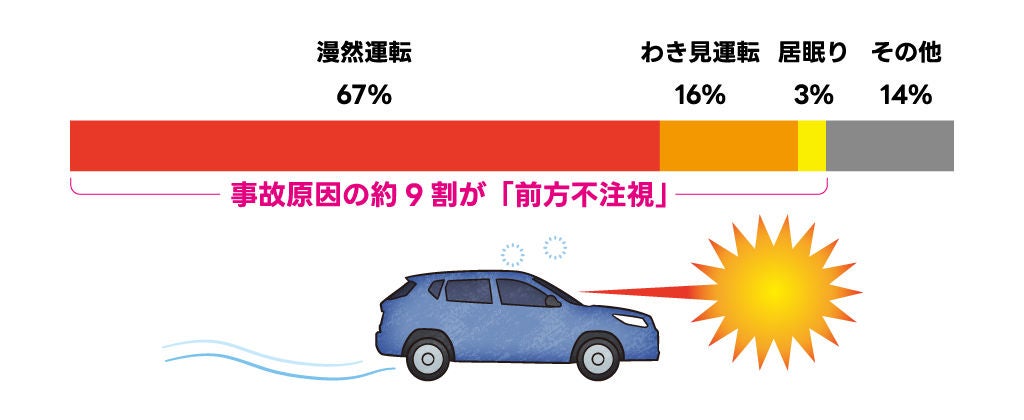 Causes of accidents involving vehicles entering work zones. Findings from a five‑year analysis by the three NEXCO companies (January 2018–December 2022). Inattentive driving—including careless driving, distracted driving, and drowsy driving—accounted for approximately 90% of the accidents. (The “Other” category includes accidents caused by improper steering or braking operations, speeding, skidding, and crosswinds.) Source: NEXCO West News Release, "Accidents Caused by Vehicles Entering Expressway Work Zones Are Occurring Frequently! — About 90% Are Caused by Not Looking Ahead! Look Ahead and Stay Focused!" (March 27, 2024)
On-site safety measures often rely on a wide range of visual warnings—such as warning boards, road signs, and traffic cones. However, if each setup requires extra time and cost, overall work efficiency can suffer. Moreover, an excessive number of visual warnings on the road can increase the time drivers spend shifting their gaze away from the road ahead toward the signage, potentially raising the risk of inattentive driving.
To resolve the trade-off between safety and operational efficiency, DNP’s development team turned to laser projection. Because laser beams can deliver visual information efficiently over long distances, they are well suited to indicating hazards from afar—more so than sound or vibration, which rely on hearing and touch. By projecting information where and when it is needed, laser projection can help avoid the trade-off and encourage safer actions. Based on this concept, DNP developed the DNP laser signal projector.
DNP’s HMX Technology: precision control of laser beams
DNP laser signal projector is compact and energy-efficient, yet capable of safely projecting bright, clear symbols over long distances. While specifications vary by symbols, it can project patterns from a few meters toward up to 100 meters away even from a height of 1 meter, giving it a high degree of flexibility in installation including projection distance and illumination angles.
At the heart of this product is DNP’s proprietary Holographic Matrix (HMX) Technology. Guided by its mission to communicate information accurately and clearly, DNP has expanded its business from printing on paper to packaging, interior finishing materials, and optical films for displays. HMX Technology was born from this background—and from a new idea: treating light itself as a visual warning medium.
Conventional holography records three-dimensional information as interference fringes illuminated from an object onto a recording medium, and later reconstructs that light as a three-dimensional image using laser illumination. While it makes it relatively easy to reproduce complex 3D shapes, it is technically difficult to precisely control light to produce a high-definition reconstructed image over long distance. As a result, for applications that require projecting patterns over long distances, it is difficult to achieve sufficient image quality.
With HMX Technology, controlled laser beams are directed into the HMX elements, enabling high-definition signal projection that remains sharply visible from near to far—something conventional holography cannot achieve.
In HMX Technology, HMX components are assemblies in which multiple HMX elements (special holographic optical elements essential for controlling light) are precisely arranged. This configuration enables fine control over the direction and intensity of the emitted laser light. As a result, the system can clearly project a wide range of visuals, including intended symbols, symbols with a sense of depth, and symbols that appear uniform over a broad area.
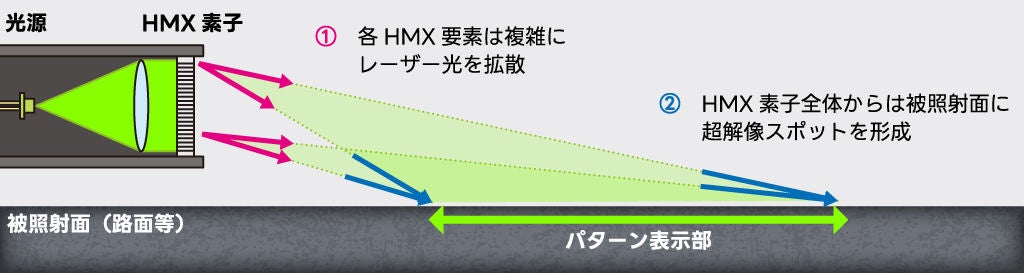 A simplified diagram of HMX Technology.
The introduction of controlled laser beam into the HMX component enables the formation of clear images across the projection surface, from the foreground to the background.
A simplified diagram of HMX Technology.
The introduction of controlled laser beam into the HMX component enables the formation of clear images across the projection surface, from the foreground to the background.
Another major feature of laser light generated by HMX Technology is that safety is a key consideration in its design.
Compared with area light sources such as LEDs, the light‑emitting point of a laser is extremely small. This means that, in principle, laser light can be projected over long distances even using a small lens. However, when this light is viewed directly by the human eye, the eye’s lens can refocus the laser onto the retina, creating a risk of retinal damage.
In contrast, the diffused light from the HMX components used in the DNP laser signal projector consists of complex diffused light with a cross‑sectional area sufficiently larger than that of the human pupil. As a result, even in the event of accidental viewing, the risk of retinal damage due to refocusing onto a single point is significantly reduced.
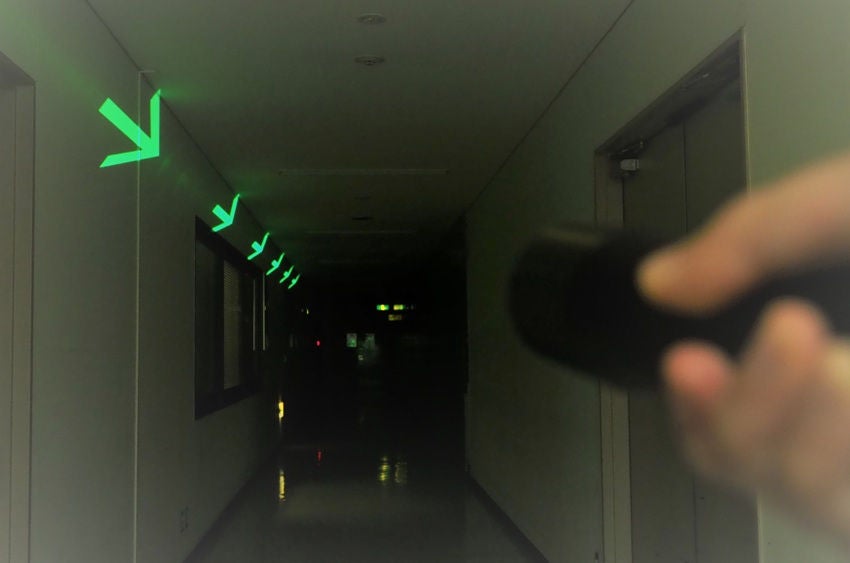 Projected image by the DNP laser signal projector
From validation to deployment: continuous improvement in the field
Development of HMX Technology, the core technology behind the DNP laser signal projector, started more than a decade prior to its trial commercialization in 2022. This effort was not undertaken as a commissioned project, but as an independent DNP initiative to challenge a new domain by treating light itself as a display medium.
Accurately handling large volumes of complex data and translating them into manufacturable processes required close collaboration between DNP’s optical design and manufacturing technology teams. Through repeated prototyping and refinement, challenges were addressed one by one as the teams worked toward an optimal design.
In parallel, we also conducted essential on-site verification, an indispensable step in the development process. Because the product is intended for use in a wide range of environments, our highest priorities were ease of use for the people working on site and their confidence in the effectiveness of the solution. With the cooperation of road operators and industrial stakeholders, performance was verified in diverse settings, including active road construction sites and factory areas. Resistance and tolerance to external factors such as illumination conditions, installation angles, vibration, impact, weather, and dust were evaluated. Through successive improvements based on these evaluations, stable and high performance was achieved even under harsh outdoor conditions, paving the way for practical application.
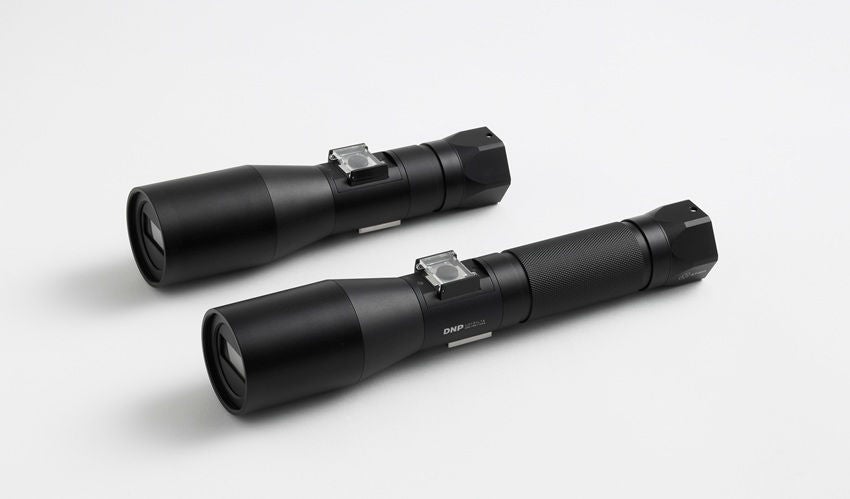 DNP laser signal projector.
A portable model commercialized in June 2025. The lineup includes a battery‑powered type (bottom; 256 mm in length, 600 g) and a non‑battery type that requires an external power connection (top; 193 mm in length, 450 g).
DNP laser signal projector.
A portable model commercialized in June 2025. The lineup includes a battery‑powered type (bottom; 256 mm in length, 600 g) and a non‑battery type that requires an external power connection (top; 193 mm in length, 450 g).
Through continuous refinement based on accumulated on-site verification, and by integrating the fine patterning technologies and large-scale data processing capabilities developed through printing, DNP have established a system that enables advanced control across all stages, from design and data processing to verification and mass production. The ability to drive this end-to-end process in an integrated manner, together with the ongoing dedication and expertise of the team, has transformed the DNP laser signal projector from an outcome of the R&D stage into a product ready for reliable use in real-world environments.
From field adoption to a “future standard”
DNP laser signal projector is currently being adopted primarily at infrastructure sites such as roads, as well as in factory environments.
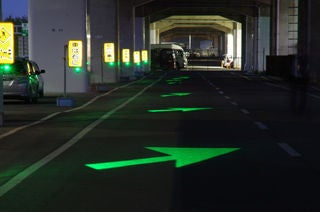
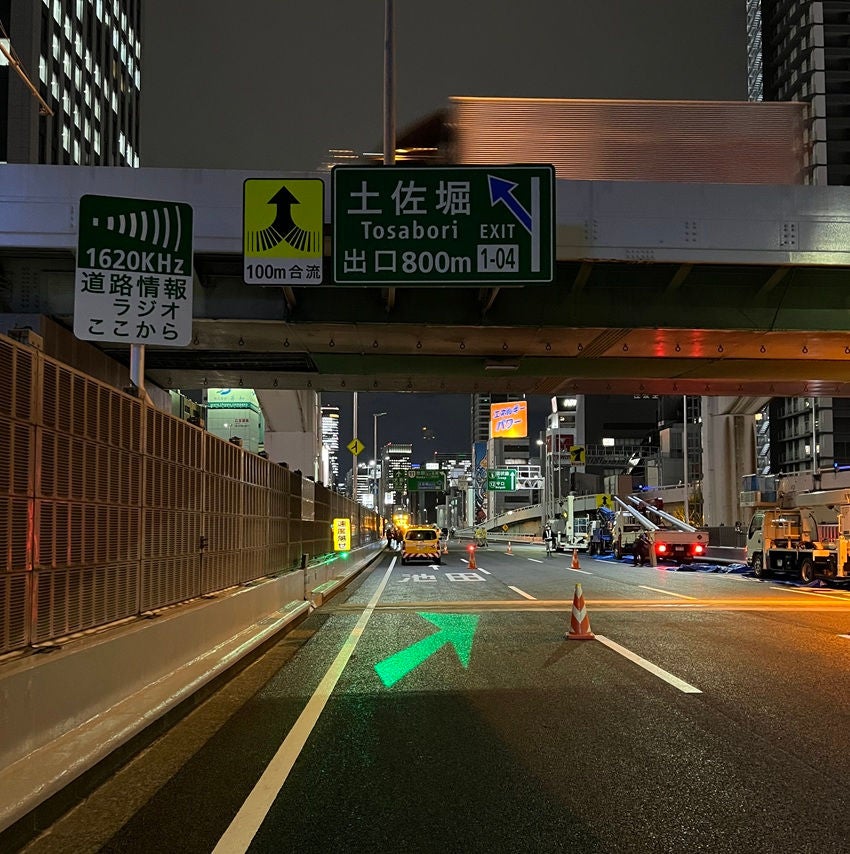 Road surface projection using the DNP laser signal projectors. A test installation conducted on a metropolitan loop route in November 2021 using the DNP laser signal projector. By projecting an arrow symbol onto the road surface, drivers can be encouraged to change lanes earlier in a more intuitive manner.
Hanshin Expressway Engineering Co., Ltd. implemented an initiative in which an arrow pattern onto the road surface ahead of nighttime construction zones to encourage drivers to change lanes earlier. Used in combination with internally illuminated advance warning signs, this approach improved visibility compared with conventional methods and helped reduce accidents involving vehicles entering work zones.
Additionally, Hokkaido Giken Co., Ltd. has developed the G-Scrite Construction Method, which uses this product to project reference lines with light for road lane marking. In addition to shortening work processes and reducing costs, the method also enhances safety by minimizing the time workers need to spend on the road. The G-Scrite Construction Method has been registered with the New Technology Information System (NETIS), operated by the Ministry of Land, Infrastructure, Transport and Tourism (MLIT) of Japan. Its effectiveness has been officially recognized.
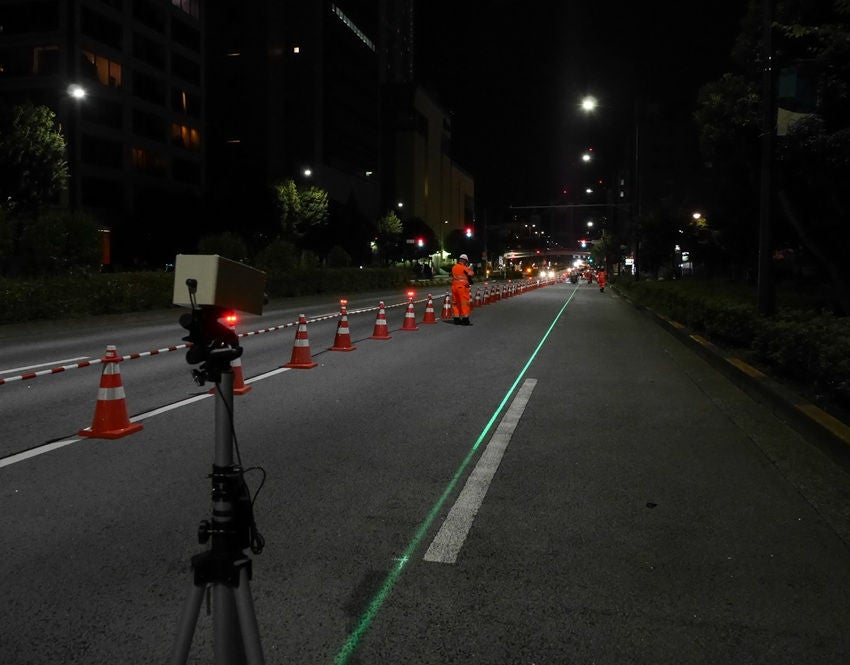 The G-Scrite construction method using the DNP laser signal projector. A method to mark reference lines for road lane marking. Compared with conventional lane marking methods, it has achieved cost reductions of approximately 21% and shortened work processes by approximately 35%.
In addition, the technology is expected to find applications in a wide range of other scenarios.
In indoor environments such as factories and warehouses, using light to indicate hazardous areas, including forklift routes helps ensure safety while improving operational efficiency. Even at sites where painted markings or signage have been difficult to implement, the use of light enables flexible and adaptable area management.
During disasters or power outages, the technology is expected to be used for emergency guidance by indicating evacuation routes with light. Because the information is conveyed intuitively without relying on language, it is effective for safely guiding people in locations where diverse groups gather, such as stations, transportation facilities, commercial complexes, and event venues.
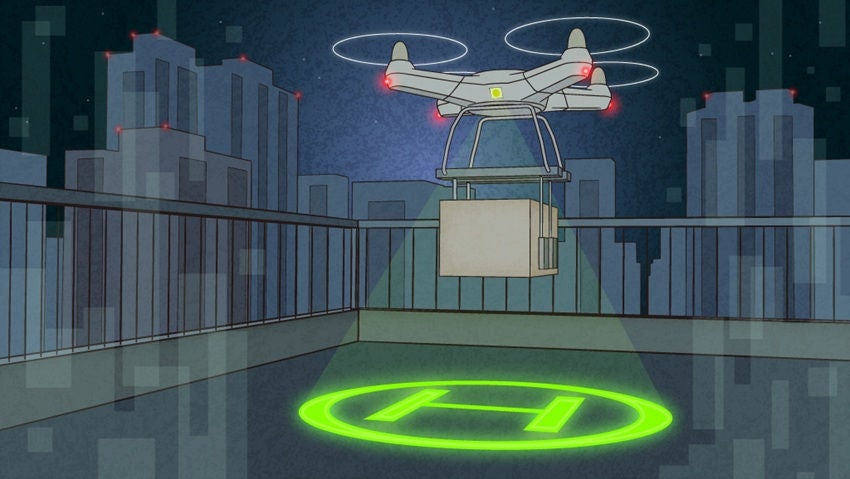
The technology is also being considered for use in next‑generation mobility applications, such as automobiles, robots, AGVs, and drones. By using light to indicate the direction of movement, it can help prevent contact with people and enhance both safety and efficiency.
Compact, easy to handle, and installable in a variety of locations, this technology delivers appropriate information when and where it is needed. Centered on the DNP laser signal projector, a flexible, light‑based system is steadily spreading across diverse work sites as a new form of infrastructure.
- Please note that the information provided is current as of the publication date.
First published: February 16, 2026 by DNP Features DNP's Editorial Team