
DNP Survey Reveals DNA of Corporate Longevity, Exploring the Strengths of Japan’s Enduring Companies
Secret lies in continuously adapting to changing times, not in just preserving the status quo
Jul 28, 2026
Tokyo, July 28, 2026, Dai Nippon Printing Co., Ltd. (DNP) is pleased to announce the results of a survey into the DNA of Corporate Longevity, Exploring the Strengths of Japan’s Enduring Companies. The survey targeted companies that have been in business for over a century and generate annual sales of at least 10 billion yen. Responses were received from 314 companies.
The year 2026 marks the 100th year since the beginning of Japan's Showa era (1926–1989). It is an opportunity to reflect on the endurance of Japan’s corporate sector, and the management strategies that have supported their development. Amid growing social and market uncertainty, companies are expected to continuously create value by adapting to change.
As DNP celebrates its 150th anniversary in October 2026, the Company conducted this survey to better understand the management practices and drivers of innovation behind companies that have sustained growth for more than a century.
Survey Summary
- Approximately 50% of enduring companies cite "Reviewing business operations in response to changing society and the times," as a key to longevity. The secret to sustainable management lies in business transformation.
- About 80% of enduring companies continue to build on their founding strengths. Additionally, around 70% have established a culture where management regularly communicates the company's vision to employees.
- Over 60% of long-standing companies identify their "Solid customer base and trust-based relationships," as a key strength.
- Companies also view customers not merely as buyers, but as one of the starting points for innovation. Enduring companies are categorized into six types. Companies experiencing business growth share a culture “Values taking on challenges."
Approximately 50% of enduring companies cite business transformation in response to societal change as a key driver of sustainable growth
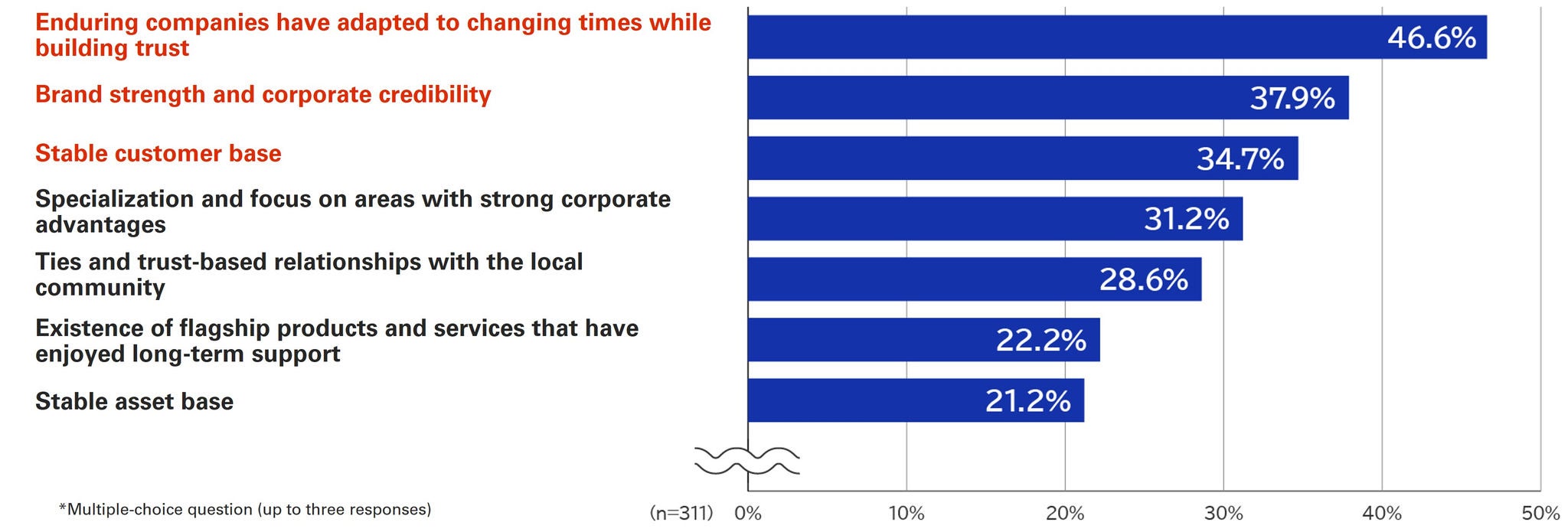
When asked what had enabled them to sustain their businesses for more than 100 years, the largest proportion of respondents cited " Reviewing business operations and structure to adapt to changing times and environments " (46.6%). This exceeded the proportion citing "Brand strength and corporate credibility" (37.9%) and “stable customer base" (34.7%)*1.
These findings suggest that the ability to adapt continuously to changes in society and the business environment is a key factor in supporting sustainable growth.
About 80% of enduring companies continue to base their management on their founding strengths
In response to questions regarding changes in corporate strengths, the most common answer was "We have built on our founding strengths while evolving their form and substance" (61.9%), followed by "Our strengths have remained largely unchanged since our founding" (17.9%)*2. These results indicate that approximately 80% of enduring companies continue to leverage their founding strengths as a foundation for their current business operations.
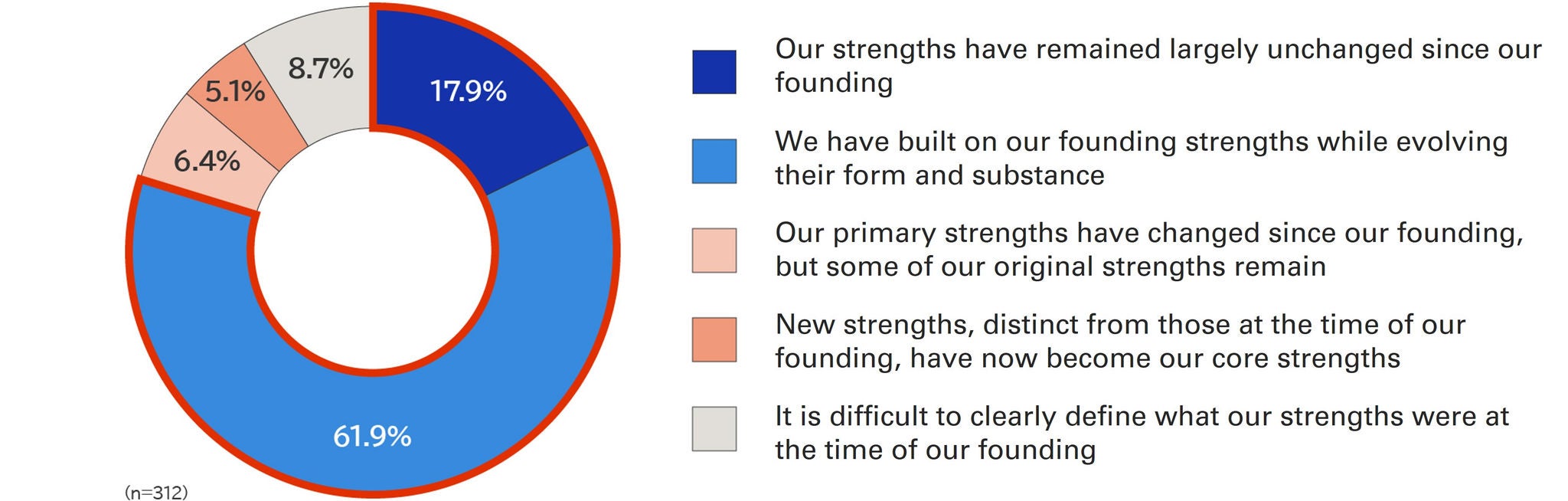
Taken together with the previous findings, the results suggest that enduring companies are not those that simply preserve their core strengths, but those that continuously evolve while building on their core strengths.
In approximately 70% of enduring companies have established a culture of regularly communicating the corporate vision
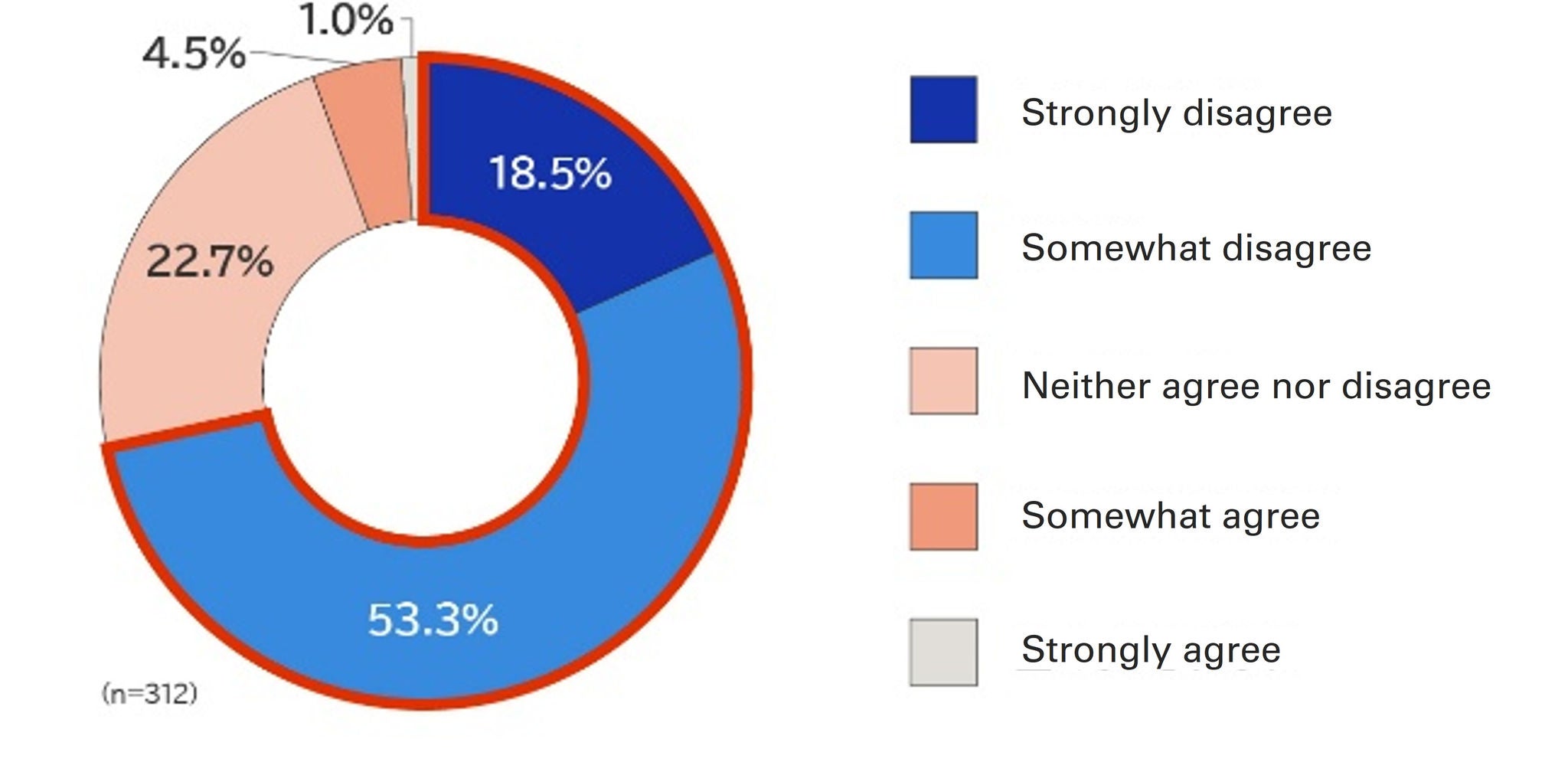
When asked whether their corporate philosophy and vision are reflected in daily operations and decision-making, over 70% of companies responded either "Somewhat agree" (53.3%) or "Strongly agree" (18.5%)*2.
These results reveal that many enduring companies do not merely establish corporate philosophies and visions but actively embed them throughout the organization via ongoing communication and the management activities of top leadership. Consistent communication of the vision by top management is considered a key factor in adapting to social and time-driven changes, and to supporting sustainable growth.
A strong customer base and relationships with customers are key strengths of long-established companies and a source of innovation
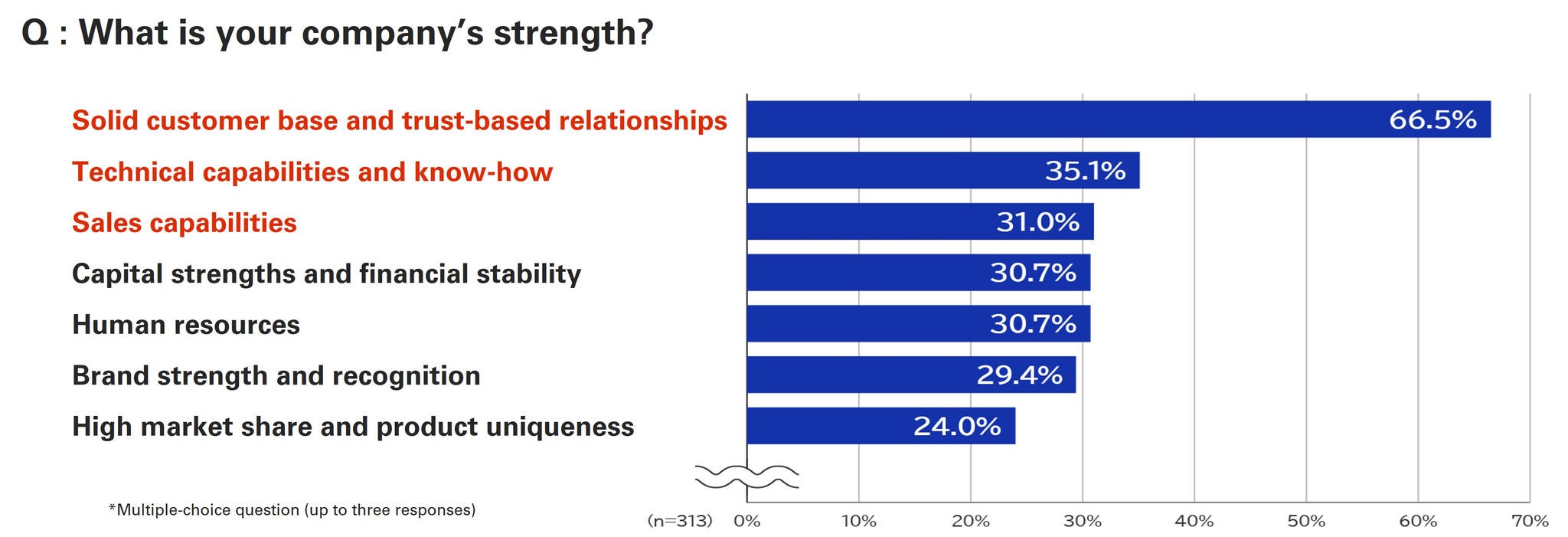
When asked about their company's strengths, the largest proportion of enduring companies cited "Solid customer base and trust-based relationships" (66.5%), followed by "Technical capabilities and know-how" (35.1%) and "Sales capabilities" (31.0%)*1.
Also, the most frequently cited "Driving force behind the continuous creation of innovation" was "Customer needs and challenges" (42.5%). This suggests that for many enduring companies, customers are not merely buyers but co-creation partners with whom they identify opportunities for future growth.
Following "Customer needs and challenges," other key factors mentioned included " Communication of top-management vision" and "Awareness of problems and sense of crisis." The findings suggest that innovation is driven by the ability to identify changes in society and the marketplace through close dialogue with customers, together with clear direction from senior management.
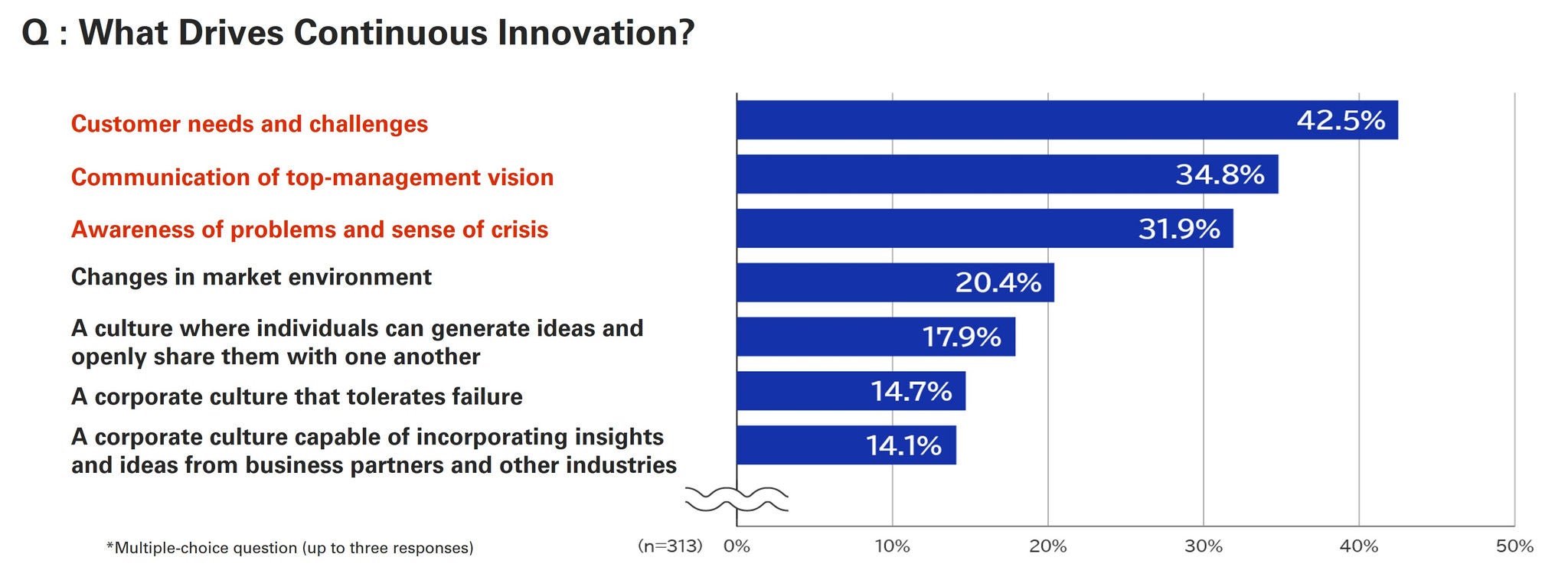
*1 Multiple-choice question (up to three responses)
*2 Single-choice question
Enduring companies are classified into six types; "Values taking on challenges" is key to performance growth.
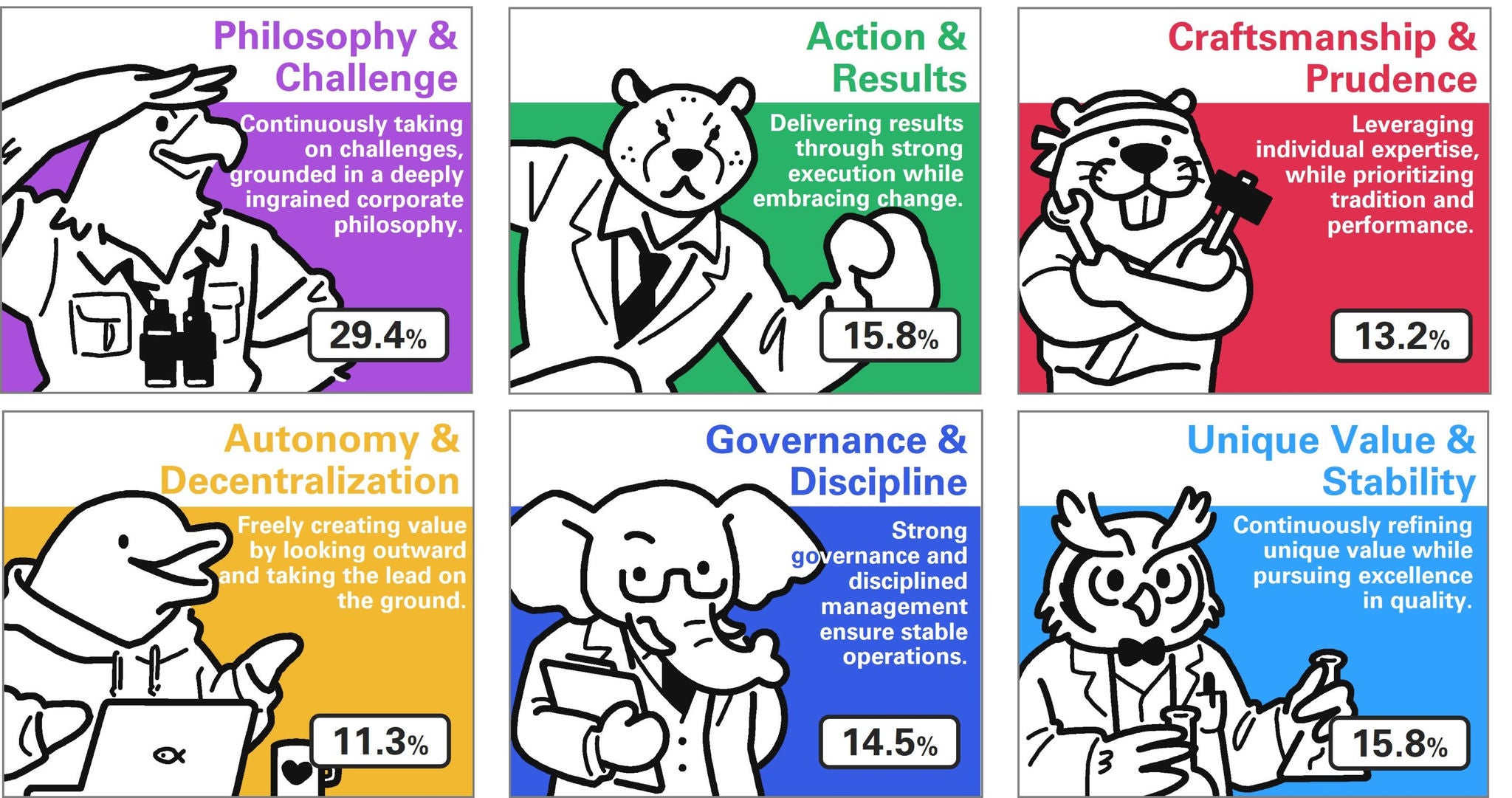
Based on survey results and subsequent factors and cluster analyses, enduring companies were categorized into the following six organizational types across five dimensions: "Corporate philosophy," “Governance," "Value creation," "Challenge & learning," and "Institutionalization."
Six organizational types and features
(1) Philosophy & Challenge
(2) Action & Results
(3) Craftsmanship & Prudence
(4) Autonomy & Decentralization
(5) Governance & Discipline
(6) Unique Value & Stability
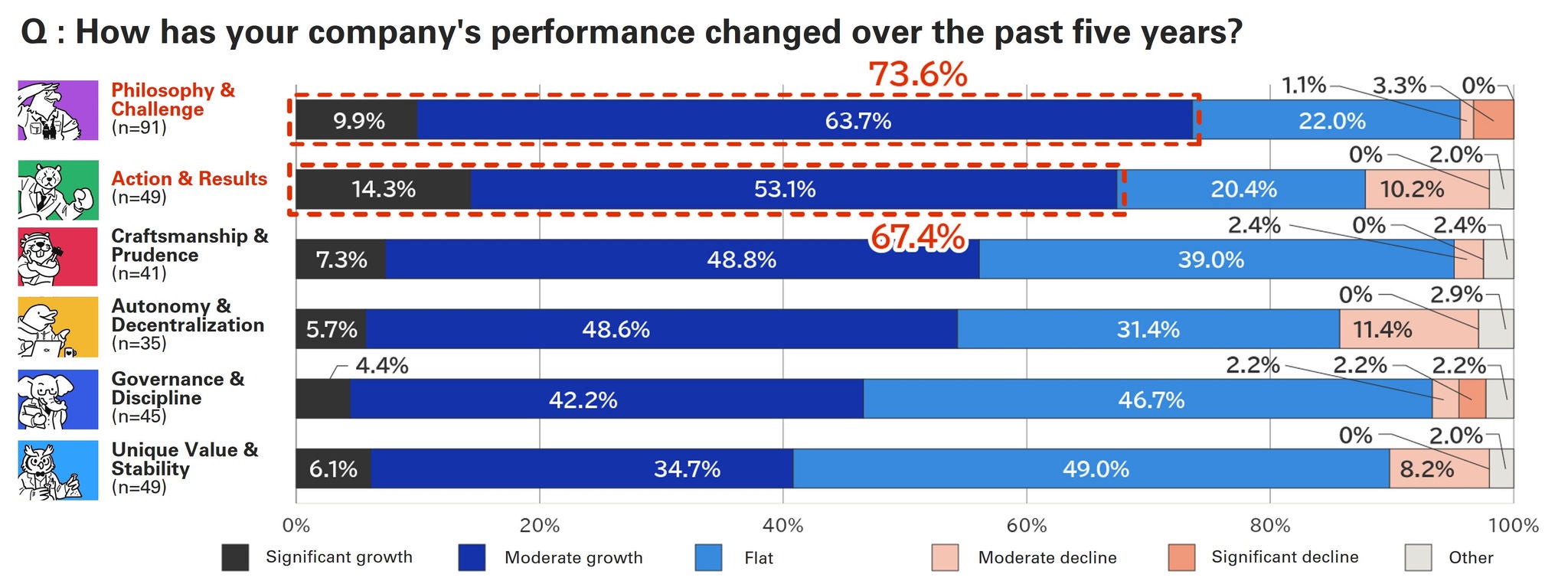
Among these, companies classified as (1) Philosophy & Challenge and (2) Action & Results were more likely to report business growth over the past five years.
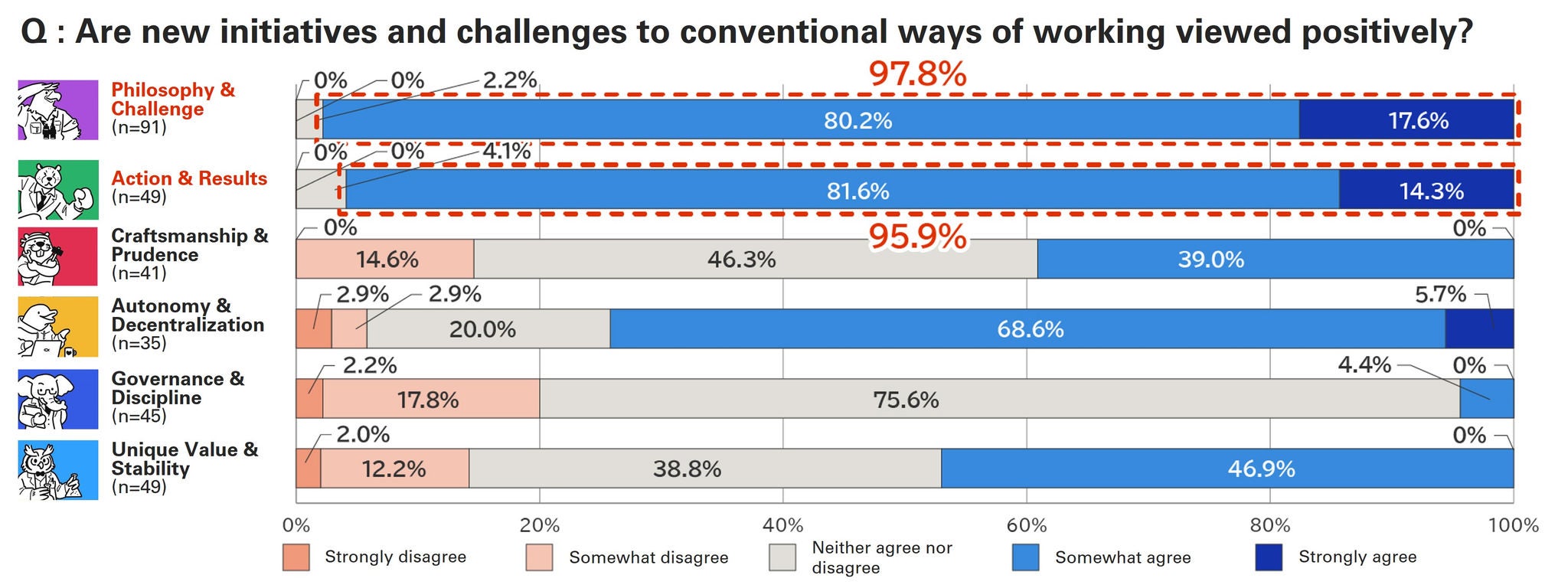
Companies with growing performance foster a culture that values taking on challenges
Regarding their performance over the past five years, approximately 70% of enduring companies classified as either (1) Philosophy & Challenge or (2) Action & Results reported business growth. These companies demonstrated a strong tendency to positively evaluate new initiatives and efforts to try approaches that differed from the status quo.
The findings suggest that organizations which encouraged employees to take on challenges, and turn those challenges into action are more likely to achieve sustained business growth.
Expert Commentary
Professor Geoffrey Jones, Harvard Business School
The report is especially valuable because it provides empirical evidence that "using the past" correlates with performance. Although large-scale surveys of long-lived firms exist, studies of this scale and diversity are rare. This project's quantitative firm-level dataset therefore makes a major contribution to business history research.
Moreover, the study is academically significant because it not only supports existing theories but also challenges widely held assumptions.
For example, the two growth-oriented types, "Vision and Challenge-Oriented" and "Action and Result-Oriented," score highly on continuously conducting small-scale experimentation (over 60%) and on treating failure as a source of learning (over 80%). This challenges the common assumption that experimentation is primarily a characteristic of young firms.
Another thought-provoking finding is that, when faced with market or competitive disruption, 42.9 to 66.7 percent of companies pursue expansion into new business areas or diversification, challenging conventional views of Japanese corporate conservatism.
I believe the report also offers a number of compelling insights for business leaders. First, the firms in the survey distinguished between "what they chose not to change as times and markets changed" and "what they chose to change." Second, growth in these firms stems from two complementary factors: fostering strong relationships through deep dialogue and co-creation with customers and embedding the company's philosophy and vision into daily operations and decision-making. Third, the survey suggests that what separated survivors from decliners during times of crisis was the direction of their response. Companies tended to overcome market disruption by taking an offensive approach rather than a defensive one. These findings are likely to provide business leaders with new insights.
Lastly, this report would make excellent classroom material for debates in my course at Harvard Business School about whether entrepreneurship is primarily a young-firm phenomenon or can be a recurring capability within long-established firms. I believe many students would be surprised by how innovative and entrepreneurial long-lasting firms are.
About Geoffrey G. Jones
Geoffrey Jones is a Professor of Business History at Harvard Business School, where he teaches the Entrepreneurship and Global Capitalism course in the second year of the MBA program. He is the Faculty Chair of the School’s Business History Initiative and a faculty affiliate of The Reischauer Institute of Japanese Studies at Harvard University. He has written numerous books and case studies on Japanese leaders and corporations from a business history perspective. His publications include "Gappon Capitalism: The Economic and Moral Ideology of Shibusawa Eiichi in Global Perspective" (co-authored). His latest book, "Underdog Capitalism," is scheduled for publication in 2027.

Chie Sato, Author, Consultant, and Media Personality
What enables companies to endure? What allows them to grow sustainably across generations?—As shareholder primacy and short-termism are being reconsidered, business leaders and investors around the world are searching for answers to these questions. In this context, Japan's long-lived companies have drawn renewed global attention.
Interest is growing even at Harvard Business School, where more faculty are studying long-lived companies as a source of insight into sustainable management. Recent years have also seen the publication of Harvard Business School cases on Toraya, founded in the early sixteenth century, and ITOCHU Corporation, founded in 1858. In 2024, 33 Harvard Business School professors visited many long-established Japanese companies as part of a faculty immersion to Japan.
This report offers timely and practical answers to the questions leaders around the world are asking.
Among its most interesting findings is that resilience is the foundation of both longevity and sustainable growth. That lesson is particularly relevant today. One of the most pressing challenges facing businesses is the paradigm shift driven by rapid advances in artificial intelligence. This report will provide valuable guidance for leaders seeking to navigate this transformation and turn it into an opportunity for sustainable growth.
The research also shows that one of the clearest distinctions between growing and stagnant companies is their approach to failure. Growing companies view failure more positively and treat it as a learning opportunity than stagnant companies do. This suggests that creating an environment where people can recover from setbacks, take on new challenges, and cultivate resilience is key to sustained growth. This report will offer practical guidance and fresh inspiration for business leaders concerned about their companies' future growth and striving to achieve the next breakthrough.
About Chie Sato
Chie Sato is an author, consultant, and media personality with several bestselling publications in Japan. She has written extensively for newspapers, magazines, and online media, and regularly lectures on leadership, management, and business education. Sato has authored or co-authored 18 books, several of which have been translated into Korean, Chinese, and Mongolian. Before becoming independent, she held positions at NHK, Boston Consulting Group, and The Walt Disney Company (Japan). She holds a Bachelor of Liberal Arts from the University of Tokyo and an MBA from Columbia Business School. Sato served as an outside director of Nihon Unisys (BIPROGY) from 2017 to 2024. Since 2024, she has served as an outside director of ITOCHU ENEX and Happinet Corporation.

Survey Overview
- Survey Title: The DNA of Corporate Longevity
- Survey period: January 28 – February 22, 2026
- Survey Methodology: Mail and web-based survey
- Valid Responses: 314 companies (founded more than 100 years ago with annual sales of at least ¥10 billion)
About Dai Nippon Printing Co., Ltd. (DNP)
Founded in 1876, DNP marks its 150th anniversary this year. DNP has grown to become one of the world’s largest comprehensive printing companies, offering a diverse portfolio of products and services across a broad range of industries.
By combining its proprietary Printing & Information (P&I) strengths and collaborating closely with a wide range of partners, we create new value that addresses social challenges and responds to the evolving needs of society and consumers.
Driven by a "DNA of challenge," cultivated over the past 150 years, we have continually developed new technologies and transformed them into value for society—creating future standards.
Moving forward, DNP will continue to leverage its P&I strengths to create new value as an innovation-driven company.
- Company and product names mentioned in this release are the trademarks or registered trademarks of their respective owners.
- Information contained in this release is current as of the date of announcement. It may be changed without notice.