
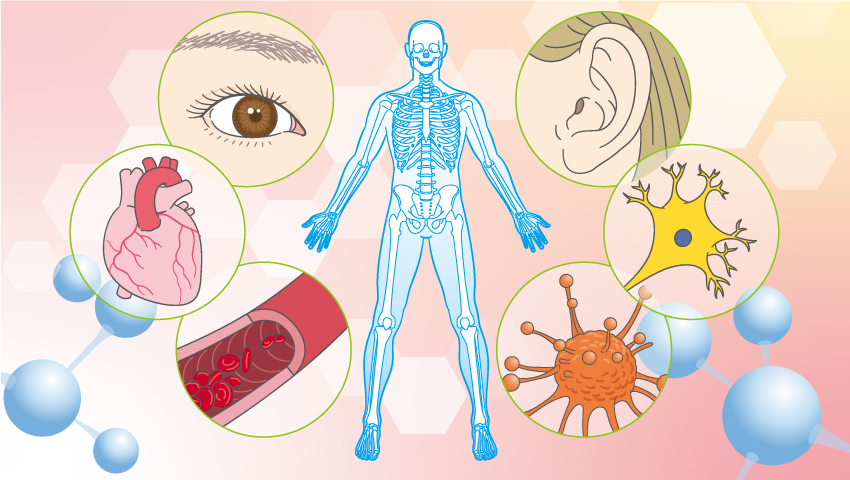
Regenerative medicine attracts attention as a technology with the promise to expand the possibilities of medicine. One of the barriers to its widespread adoption is high manufacturing costs compared to pharmaceuticals currently on the market. In response, Dai Nippon Printing Co., Ltd. (DNP) and Hyperion Drug Discovery Co., Ltd. (HDD) have jointly developed a soluble microcarrier. There are high hopes that the product will not only improve cell culture efficiency to reduce manufacturing costs and make therapies more affordable, but also contribute to post-administration safety through its high biocompatibility Here, we will introduce its features and prospects.
Increasing expectations and challenges regarding regenerative medicine
Regenerative medicine research has accelerated in recent years with the development of pluripotent stem cells, including embryonic stem (ES) cells and induced pluripotent stem (iPS) cells. These cells possess the ability to differentiate into various cell types with the same characteristics as those differentiated cells. This has the potential to lay the groundwork for innovative therapy that regenerates and repairs lost organs and bodily functions. For this reason, research is being conducted into the use of pluripotent stem cells to help treat various diseases related to the heart, nerves, cartilage, eyes, blood, and immune system.
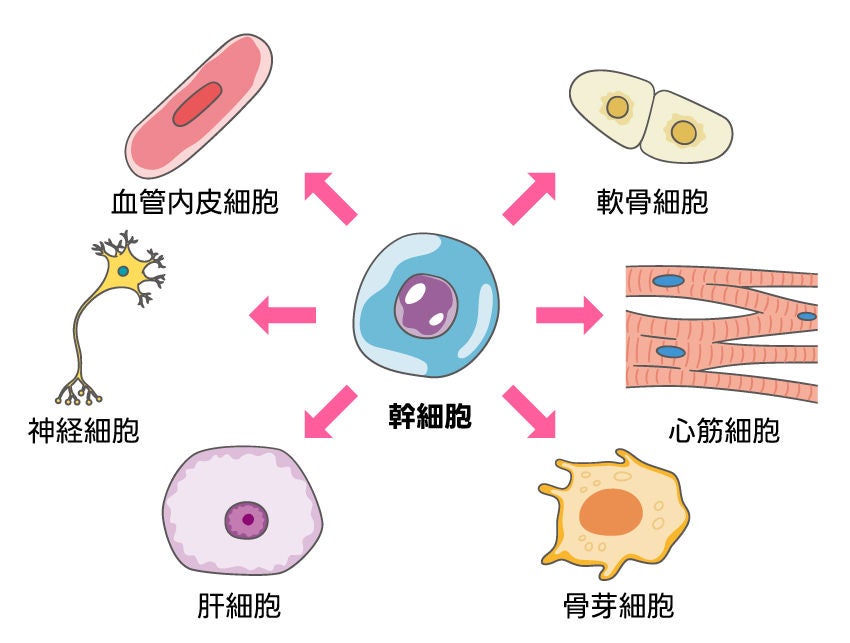 Differentiation of stem cells into various cell types, including endothelial cells, chondrocytes, cardiomyocytes, osteoblasts, hepatocytes, and neurons
Regenerative medicine began with cell sheets for the treatment of severe burns, which were approved in Japan in 2007. Currently, more than 10 items have been approved, but due to the time and effort required for cell culture, the treatment costs are significantly higher than those of conventional pharmaceuticals. Even under a high-cost medical care benefit system in Japan, it is not easily accessible in practice due to its high cost, and there is a need for more efficient methods of culturing cells in large quantities.
DNP and HDD have jointly developed a material to resolve this issue: Soluble microcarriers, which can improve operational efficiency and reduce costs through mass cultivation.
DNP has been focusing on developing new medical and healthcare-related businesses by utilizing its expertise in printing and information (P&I). It has developed a wide range of advanced solutions, such as a medication support service that enables remote monitoring of patients’ medication adherence, miniature three-dimensional (3D) intestinal models known as "intestinal organoids" for drug development applications, and an AI-assisted chest cancer screening reading system. In the field of regenerative medicine, DNP has participated in the Forum for Innovative Regenerative Medicine (FIRM) since its inception in 2011. It has also developed industry-academia partnerships, including running joint research courses at The University of Osaka for six years and Institute of Science Tokyo for over 10 years.
In 2020, DNP and HDD established a collaboration that combines DNP's expertise in microparticle surface processing technology and material selection with HDD's knowledge of cell culture technology for medical products and pharmaceutical regulatory compliance. The companies cooperated through each phase of development, including material selection, customer interviews, sample provision, and manufacturing process design, which led to the release of the soluble m in March 2023.
Greatly improving the efficiency and safety of cell cultures
Cell culture methods can broadly be divided into two categories: suspension culture and adherent culture. Suspension culture refers to cells that proliferate while in a suspended state, like blood cells. Adherent culture refers to cells that adhere to a surface to proliferate, such as cells from muscle, skin, or cartilage. Attaching cells to microscopic particles called microcarriers can greatly improve the efficiency of adherent cell culture.
Comparison of adherent and suspension culture
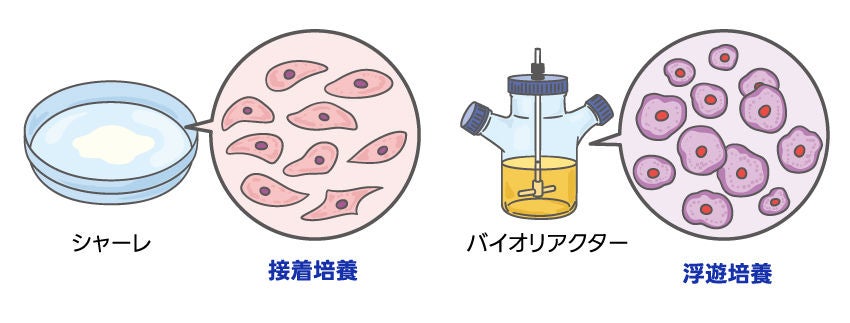 Adherent culture: A method in which cells proliferate by adhering to a substrate. Cell growth is proportional to the surface area of the substrate. During harvesting, the cells must be detached from the substrate. Suspension culture: A method for non-adherent cells that do not require a substrate. Cells proliferate by clumping together.
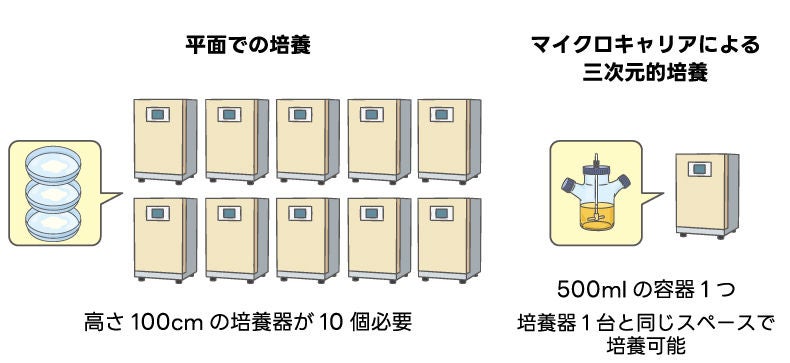
Adherent culture usually involves attaching to containers like Petri dishes (two-dimensional culture). For example, culturing 100 million cells would require several hundred to several thousand containers, each needing periodic culture medium replacement. In addition, 10 to 20 incubators the size of small refrigerators would be required to store them. By replacing these containers with microcarriers, cells can be cultured three-dimensionally within the medium. As a result, the same number of cells can be cultured in a container roughly the size of a 500 mL bottle. This dramatically reduces space requirements and also greatly improves the efficiency of operations such as culture medium replacement.
Space required for culturing 100 million cells
However, cultures grown with conventional plastic microcarriers generate microscopic fragments due to microcarrier collisions, which cannot be removed. For this reason, they have only been used to manufacture antibody drugs and vaccines, not for regenerative medicine, where cells are administered into the human body.
In contrast, the soluble microcarrier jointly developed by DNP and HDD uses cell dissociation reagents commonly employed in regenerative medicine. It dissolves only the microcarrier, allowing the cells to be easily collected without leaving behind any microscopic fragments. In addition, both the raw material and the cell dissociation reagentst have been shown to have low toxicity, making them highly biocompatible.
Cell culture workflow using soluble microcarriers
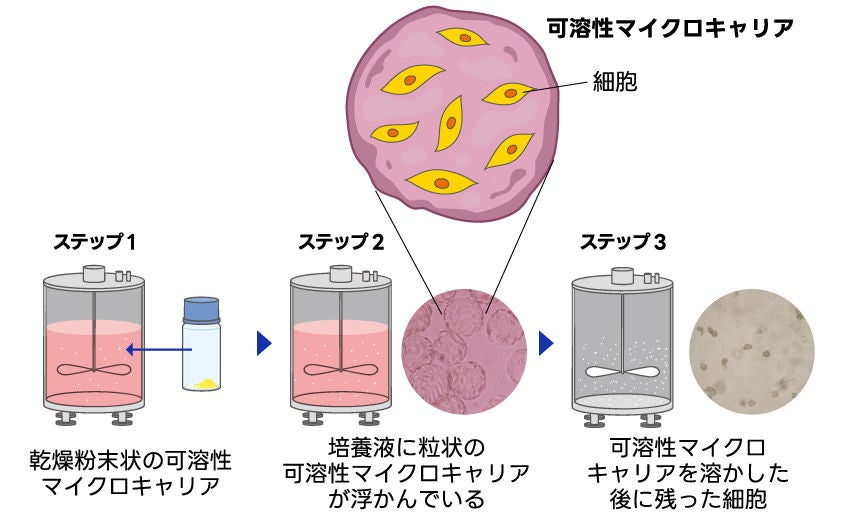 (Left) Step 1: Powdered microcarriers are swellen in a culture medium or a similar solution. (Center) Step 2: Cells are added to the culture medium containing the swollen microcarriers, allowing them to adhere to the microcarrier surfaces. Once the cells have proliferated to a certain volume, additional microcarriers are introduced. The cells then transfer to the new microcarriers and continue to proliferate. During this stage, the culture environment is maintained by occasionally stirring the container contents and replacing the culture medium. (Right) Step 3: Once cells reach the target culture volume, the culture medium is removed. A liquid that dissolves the microcarriers is then added and mixed, allowing the cell to be harvested without any microscopic fragments.
DNP's microcarriers have already been deemed suitable for use in the manufacture of regenerative medicine and other products by Japan’s Pharmaceuticals and Medical Devices Agency (PMDA), an independent administrative institution that reviews the quality, efficacy, and safety of pharmaceuticals. We are now making efforts to commercialize the product.
Toward a future where regenerative medicine is readily available for everyone
As the safety of soluble microcarriers is further demonstrated and the cost of cell-based medicines is reduced, we can expect to see a society in which regenerative medicine is available at local medical institutions. This means that regenerative medicine, previously accessible only at certain advanced medical facilities, will become available at core regional hospitals, with lower costs and insurance coverage. This could lead to the treatment of diseases that could not be treated in the past.
To realize this vision, several challenges must be addressed: further improving the efficiency of cell culture to reduce costs, verifying safety to reduce the risk of cultured cell alteration, and establishing a storage and distribution system to deliver cell-based medicines to the right place at the right time.
Clearing each of these challenges will require industry-wide collaboration, extending beyond the boundaries of individual companies, organizations, and research institutions. Based on the strong partnerships it has built with companies like HDD and academic institutions, DNP will continue to engage in a wide range of activities that broaden the scope of regenerative medicine. This includes providing soluble microcarriers to pharmaceutical manufacturers and taking on development contracts.
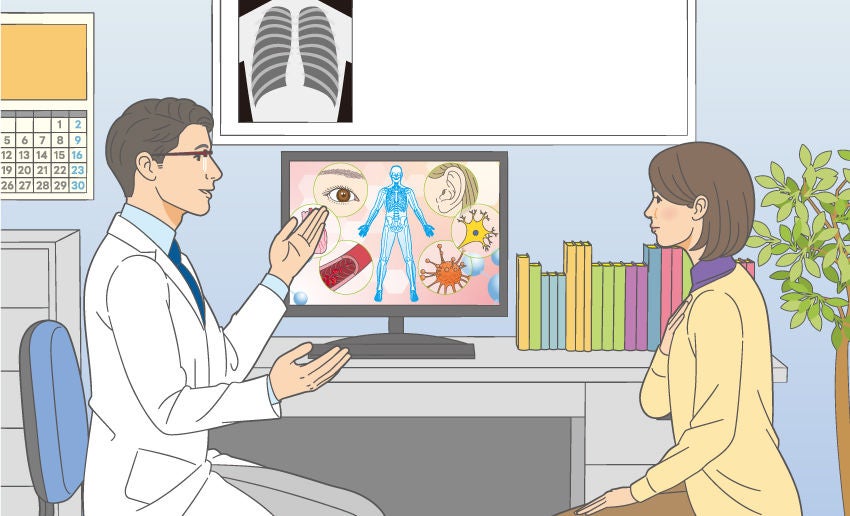
With a passion for creating new products and experiences, DNP is an irreplaceable partner working to commercialize core technologies with an eye on the global market.
Here, Kazuhiro Takekita of Hyperion Drug Discovery (HDD), a DNP partner that has made a significant contribution to the development of soluble microcarriers, evaluates DNP’s role in the industry:
"I was involved with DNP during my time at The University of Osaka Graduate School of Medicine, and at a previous position with the Pharmaceuticals and Medical Devices Agency (PMDA). Even back then, I had the impression that they had a passion for creating completely new products and experiences. They brought in AI image analysis, which was cutting-edge technology at the time, and built a program that saved labor and worked to standardize processes while meeting existing evaluation standards. They are a director company for the Forum for Innovative Regenerative Medicine (FIRM) and have consistently been a central participant in discussions, including the 2014 amendment of the Pharmaceutical Affairs Law. They have been a partner we can rely on regarding both technology and mindset.
Given their background, we were confident in reaching out to DNP to work together on the research and development of next-generation microcarriers. The company has been sincerely committed to the project and has been a great help in terms of development speed and ability to propose solutions.
Currently, the majority of the core technologies in our fields of regenerative medicine and biotechnology have been developed in other countries. There would be no greater joy than putting a new core technology developed here in Japan into practical use and helping patients around the world who still have limited treatment options. With that in mind, we have high hopes for our ongoing partnership with DNP."

Mr. Kazuhiro Takekita
President and CEO, Hyperion Drug Discovery Co., Ltd.
Kazuhiro has been responsible for reviewing regenerative medicine and biological medical devices for the Biological Products Review Division II at the Pharmaceuticals and Medical Devices Agency (PMDA). Subsequently, he has supervised the review of regenerative medicine as the chief of the Review Division of Regenerative Medical Products of the PMDA, was responsible for revising the Pharmaceutical Affairs Law in 2014, and for setting regulations for regenerative medical products. Since 2017, he has been a specially-appointed lecturer in the Department of Cardiovascular Surgery at the University of Osaka Graduate School of Medicine. In 2019, he became a specially-appointed associate professor at the Joint Research Course for the Treatment of Critical Limb Ischemia, where he continues to work on the development of various medical products, including human pluripotent stem cell-derived products. He is currently a specially-appointed associate professor in the Endowed Course of Future Medical Science. He also founded and serves as the President and CEO for Hyperion Drug Discovery Co., Ltd., which focuses on research and development in regenerative medicine and gene therapy; Peach Consulting, Co., Ltd., which offers consultation services; and also serves as Representative Director and President for Hyperion FoodTech, Co., Ltd., which is dedicated to researching and developing innovative food ingredients.
- Please note that the information provided is current as of the publication date.
Update date: May 29, 2026
First published: November 27, 2023 by Discover DNP Editorial Department
Discover more

Related products and services
Articles
-
News: Test sales of "mini-intestines," which are expected to have applications in regenerative medicine and drug discovery, are being conducted (in Japanese)
-
News: Operation of "AI-assisted chest cancer screening image interpretation system" utilizing artificial intelligence begins (in Japanese)
-
News: A pilot program for a "medication support service" that allows online monitoring of patients' medication adherence is being conducted in "Bison," a wide-area collaborative model in Mie Prefecture (in Japanese)