
Devices of all kinds connect wirelessly, devices purchased in one country can be used in another, display performance can be compared across manufacturers—these everyday conveniences that we often take for granted are supported by international standards. DNP’s Makio Kurashige has long been involved in international standardization activities to develop these standards. He has led the development of several international standards related to electronic displays and laser safety. In recognition of these contributions, he received the IEC-APC Chair’s Award*1 in May 2026. What does the work of developing international standards actually involve? How are DNP’s technologies and expertise applied to shaping global rules? We spoke with Kurashige about the background to the award and significance of his work.
- 1. IEC: The International Electrotechnical Commission, an international standardization organization in the electrical and electronic fields IEC-APC Chair’s Award: An award presented by the IEC Activities Promotion Committee of Japan (APC) to individuals who have made outstanding achievements and contributions to the standardization activities of the IEC
Profile
Makio Kurashige
General Manager and Senior Researcher, Business Development Division, Research and Business Development Center, Dai Nippon Printing Co., Ltd.
Kurashige Joined DNP in 2005. After working on the development of security holograms, he engaged in research and development of optical devices for augmented reality (AR) glasses and head-up displays, screens for laser projectors and laser lighting devices. In the IEC, he has been involved since 2012 in the international standardization activities of IEC/TC 110, which covers electronic displays, and has served as Assistant Secretary of IEC/TC 110 since 2024. He also participates as an expert on IEC/TC 76, which addresses the safety of laser products.
International standards: common benchmarks for technology
Q. What are standards and standardization activities?
Kurashige:International standards are documents that set out common rules applicable across countries, regions, and manufacturers. They cover a broad range of areas and can be categorized as follows:
- Basic standards, which cover terminology, symbols, units and other fundamentals;
- Method standards, which cover procedures for testing and measurement;
- Product and compatibility standards, which cover requirements related to product shape, dimensions, materials, safety, interoperability and other aspects;
- Management system standards, such as ISO 9001, which cover how organizations should be managed.
Even familiar technologies such as Wi-Fi are supported by the concept of standardization. Devices from different countries, regions, and manufacturers can connect with one another and be used in the same way around the world because technical specifications and evaluation criteria are shared and implemented. In this sense, international standards serve as a universal benchmark that enables products and technologies to be used with confidence, compared appropriately, and widely adopted.
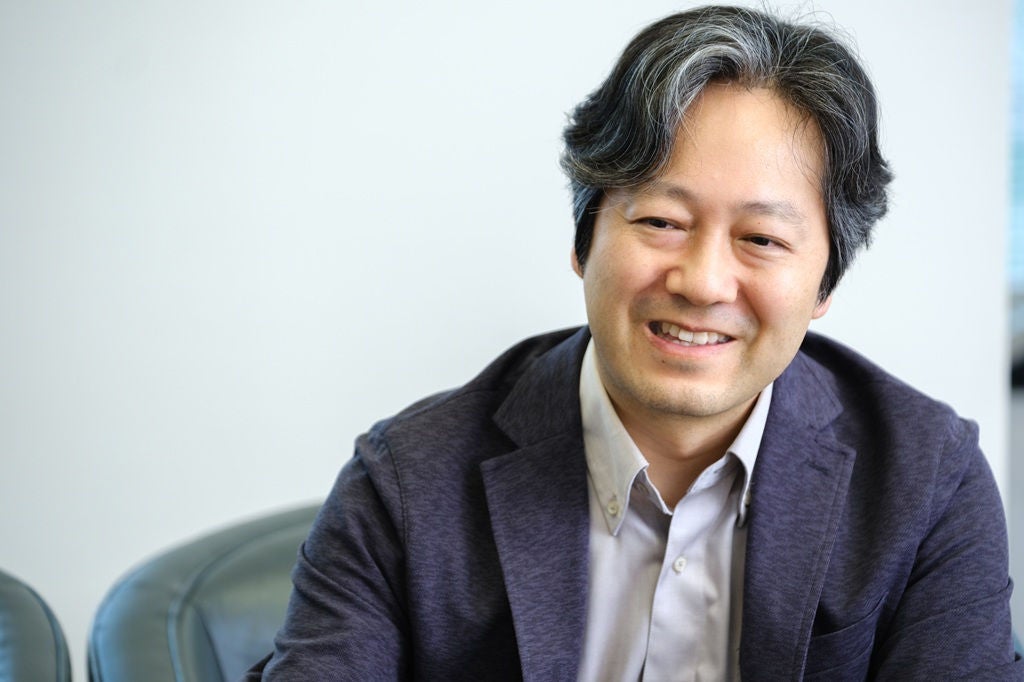
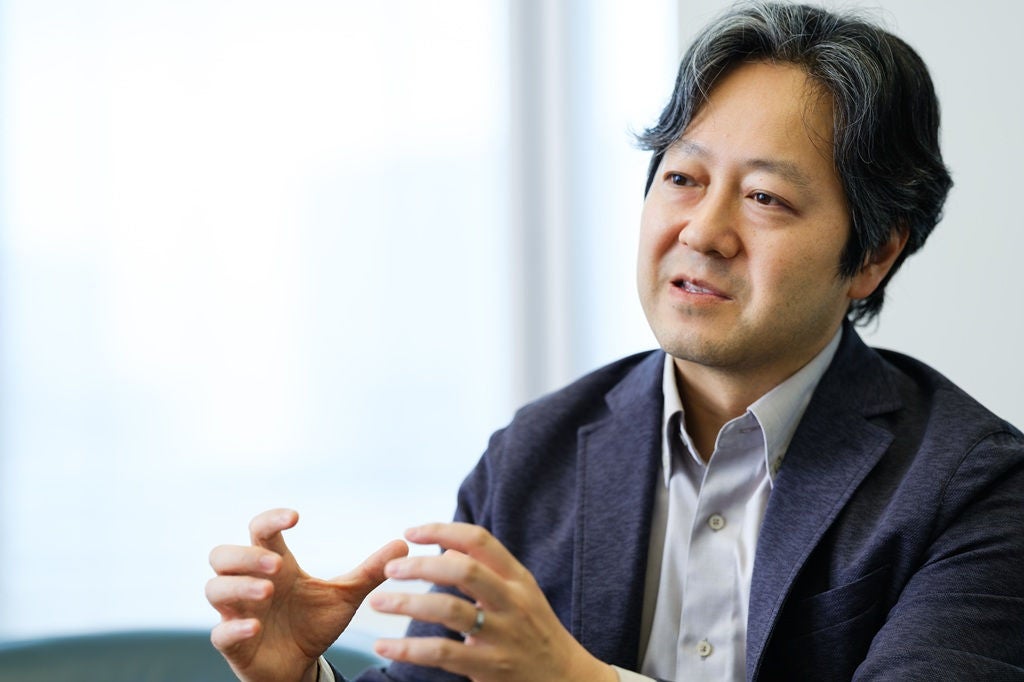 Makio Kurashige
Q. What kind of organization is the IEC, and what did this award recognize you for?
Kurashige:The IEC is an international standardization organization that develops international standards for the electrical and electronic fields. Other such organizations include ISO, which covers a broad range of fields other than the electrical and electronic fields, and the ITU, which covers telecommunications. What distinguishes the IEC is its focus on electrical and electronic technologies.
I have participated in IEC standardization activities since 2012 and have been involved in developing several international standards, mainly in the field of electronic displays. I have served as project leader for four standards to date, including terminology standard for laser displays*2and a standard for measuring display sparkle*3, leading their development through to publication. Since then, I have continued to work on activities related to technical evaluation and safety, including standards for the safety of moving platform laser products*4.
I understand that this IEC-APC Chair's Award recognizes not only my work on these specific standards, but also my overall contributions to standardization activities over many years. Developing international standards is different from developing technologies themselves, but I believe it plays an important role in laying the foundation for technologies to be properly evaluated by society and used with confidence.
- 2. Laser display: A general term for display products that use visible lasers as a light source.
- 3. Sparkle: Irregular granular noise caused by the overlap of the microscopic surface irregularities of an anti-glare film and the light-emitting sub-pixels of a display.
- 4. Moving platform: A general term for equipment and systems that transport people or goods, such as automobiles, aircraft, ships, and drones.
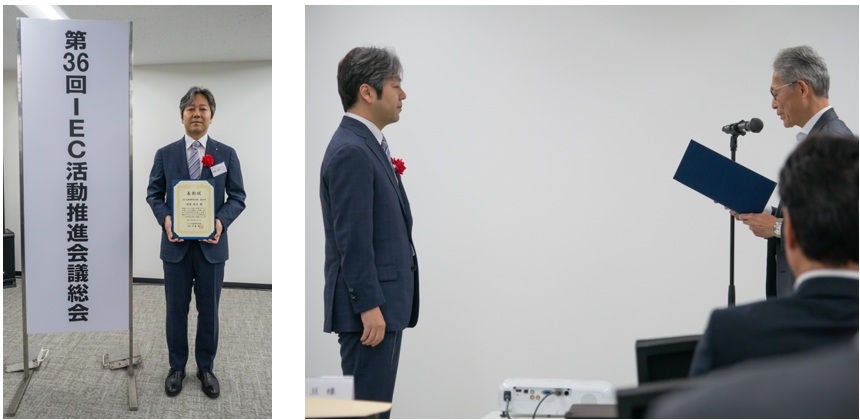 Photos from the IEC-APC Chair's Award ceremony at the IEC Activities Promotion Committee of Japan General Assembly
Titles don’t matter: engaging with global experts through DNP's technology and expertise
Q. Many of the international standards you led are related to your expertise in optics, correct?
Kurashige:The first project I led was the development of a terminology standard for laser displays. Around 2013, when the project began, the use of visible lasers as light sources for projectors was just starting to gain wider adoption. As a result, many technical experts in the display industry were unfamiliar with terminology and phenomena specific to laser technology. For example, there is a phenomenon called “speckle” in which the image is irregularly modulated due to the coherence of laser light*5. However, even when one researcher uses the term “speckle”, another researcher may not necessarily associate it with the same definition. Without a common understanding of terminology, it is difficult to discuss optical performance and image quality accurately. That is why we first focused on developing a standard that clearly defines the relevant terminology.
Since then, I have led the development of international standards covering optical measurement methods for laser projection screens, eyewear displays, or so-called AR glasses, and measurement of sparkle in displays with anti-glare film. All of these standards provide a basis for evaluating products and technologies in a consistent and appropriate manner.
- 5. Coherence of laser light: The property of light waves that caused them to reinforce or cancel each other when they overlap.
What are the challenges of establishing international standards?
Kurashige:In the IEC, participants in technical committees discuss the draft of standards in their capacity as individual experts registered by their respective countries. In these meetings, it does not matter which country or region you come from, which company you work for, or what position you hold. What matters is what you understand as a technical expert and the technical rationale behind your views.
When you participate for the first time, you first need to earn the trust of others and demonstrate that your views are worth listening to. To do that, you must be able to explain what is technically sound in a logical and convincing manner, often on the spot. Of course, the ability to discuss technical issues in English is essential, but you are also expected to explain and justify your views based on data and theory.
In standardization discussions, we focus on the proposal itself rather than on the person making it, and discuss whether the proposed content is technically valid . If there are issues with a proposal, we need to explain why the proposed approach does not allow for an appropriate evaluation, and in many cases, we are expected to present an alternative or revised proposal. Discussions can sometimes be challenging, but trust is gradually built through these exchanges. It is important to establish your standing as an expert not through your title, but through the substance of your contributions and continued engagement.
Q. Are there times when you feel like DNP's strengths really come into play?
Kurashige:Because DNP serves customers across a wide range of industries, we are exposed to an exceptionally broad variety of performance requirements and use cases. Keeping these diverse needs in mind, we have developed a wide range of products, services, and technologies. The insights we have gained through dialogue with our customers provide valuable support in standardization discussions. Because this accumulated knowledge is shared throughout the company, we are able to contribute perspectives on measurement methods and evaluation criteria that reflect real-world applications and usage scenarios.
Another strength of DNP, in my view, is its ability to take a medium- to long-term perspective on what the industry and the market need, even in areas such as standardization where the results are not always immediately visible. DNP has a customer-oriented culture, and whenever we encounter people facing challenges or unmet needs, we continually ask ourselves how we can help. I believe that this culture is what supports the work we do today.
Transforming “good technology” into “trustworthy technology”
Q. You also received an award at a technical conference outside the IEC, right?
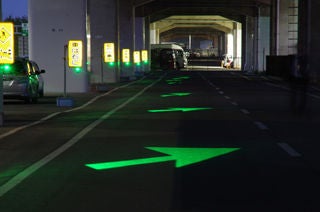
Kurashige:At the Laser Display, Imaging and Lighting Conference 2026 (LDC2026) held in April 2026, I received the LDC Regular Award, which is presented to outstanding papers published at the conference. The paper focused on the Holographic Matrix (HMX) technology*6 used in DNP’s laser products and optical safety*7 considerations associated with those products, and I believe it recognized my contributions as an engineer.
While laser-based display technologies can provide high visibility and rich visual expression, careful attention to safety is essential. Especially for applications used in public spaces or for emergency guidance, where the projected information is viewed by many people, it is important that the technology be both highly visible safe to use.
In this presentation, it was important to demonstrate how the potential of new laser-based display technology can be realized while ensuring optical safety. We were able to show not only the introduction of a new technology through research and development, but also how it has been translated into practical products with real-world applications in mind, as well as our efforts to achieve both high performance and safety.
- 6. HMX Technology: DNP's proprietary laser control technology incorporated into the DNP Laser Signal Projector. By controlling the direction and intensity of laser light with multiple HMX elements, it can project clear light patterns over long distances.
- 7. Optical safety: The concept of assessing potential hazards posed by light sources such as lasers and ensuring that products can be used safely through appropriate precautions and protective measures.
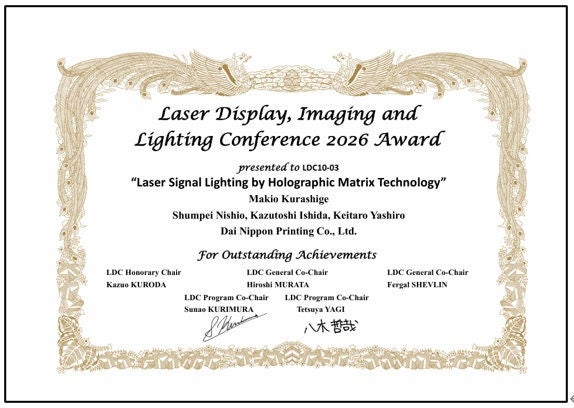 LDC Regular Award certificate presented at LDC2026
Q. Do the results of your research and development, as well as your presentations, also contribute to standardization activities?
Kurashige:I believe they are closely linked. In standardization activities, we discuss how technologies should be evaluated and under what conditions they can be considered safe, based on theory and data. The knowledge gained through research and development, together with findings presented at academic conferences, provides important evidence to support these discussions.
On the other hand, for a new technology to be adopted by society, it is important to demonstrate the novelty of the technology itself, while also to establish how it should be evaluated and how its safety can be assessed. Because I am involved in standardization activities, I am able to consider performance together with measurement methods and safety aspects from the research and development stage.
The knowledge gained through research and development supports discussions on standardization, while the perspectives gained through standardization activities also contribute to research and development. For me, it is important not to focus on one or the other, but to move back and forth between the two in order to help shape technologies into forms that can be effectively used in society.
Q. What value do you see in continuing to be involved in standardization activities?
Kurashige:Standardization is not about creating rules that favor certain parties through unfair means. It is about ensuring that good technologies are fairly recognized for their value and creating environment in which people can use them with confidence.
Standards are not something that can simply be created and then left unchanged. As technologies and markets evolve, standards must also be reviewed and maintained as needed. In such situations, it is extremely important that people who understand the background of past discussions and the rationale behind the established requirements remain involved.
If evaluation methods and safety requirements no longer reflect real-world conditions, the value of the technology may not be properly recognized, and users may be adversely affected.
Looking at the global landscape, however, rulemaking, including standardization, is increasingly regarded as an important prerequisite for creating markets, and competition for leadership in this area has intensified. Its impact can extend from the component level to the business level, and in some cases even affect an entire company. As a result, many companies, countries, and regions view standardization activities as an integral part of their business strategy.
If, for the convenience of particular interests, standards that properly evaluate products with features valued by users were to disappear, or if such standards were changed in a way that categorizes those features as “over-engineering,” products that are genuinely needed by certain people or in certain situations might no longer reach them.
That's why it is important to continuously follow how standards are proposed, established, and subsequently updated.
DNP has accumulated a wealth of technical expertise through the development of products and services and through ongoing dialogue with customers. By contributing that knowledge where it is needed and continuing to engage in standardization so that it serves as a fair benchmark, we can help create an environment in which products that truly provide value to people are properly recognized and selected.
For both product users and Japanese companies that bring technologies to society, the goal is to create a future in which truly valuable technologies and products are recognized and evaluated fairly for what they are. I believe that establishing and continuously maintaining the standards that make this possible is the significance of remaining engaged in standardization activities.
- Please note that the information provided is current as of the publication date.
By the DNP Features Editorial Team on July 13, 2026