
Decarbonized Society
The effects of climate change are becoming more severe with each passing year, significantly impacting the environment, society, and economy. In response to this climate crisis, there is a need to accelerate efforts to achieve carbon neutrality by 2050, and the role that companies must play in this is becoming ever more important. By working to resolve various environmental issues, including climate change, DNP will not only solve social issues, but also provide new value that meets people's expectations.
Targets/Results
2050 Targets
Scope 1 and 2: We aim to achieve effective net-zero greenhouse gas emissions from business activities at our own sites.
Scope 3: We will contribute to create a decarbonized society through our products and services.
| Item | 2030 Targets | FY2024 Results |
|---|---|---|
| Scope 1・2 emission reduction (SBT) |
Scope 1 and 2 emissions: 46.2% reduction compared to FY2019 |
Compared to FY2019: 18.4% reduction FY2024 emissions: ★866,000 tons-CO2e (FY2019 emissions: 1,062,000 tons-CO2e) |
| Scope 3 emission reduction (Target: Categories 1, 3, 4, 5) (SBT) |
Scope 3 emissions: |
Compared to FY2019: 15.9% reduction FY2024 emissions: ★2,990,000 tons-CO2e (FY2019 emissions: 3,556,000 tons-CO2e) |
| Reducing transportation-related environmental impact | Transportation fuel consumption per unit of sales: 11% reduction compared to FY2019 |
Compared to FY2019: 20.3% reduction FY2024 basic unit: ★1.02 kℓ/100 million yen (FY2019 basic unit: 1.28 kℓ/100 million yen) |
Some of the data contained in this report has been assured by LRQA Limited to ensure its reliability.
A star mark ★ has been attached to each one of the indicators that have been assured by LRQA Limited.
In April 2024, DNP revised its Scope 1+2 emissions reduction targets upward to comply with the international standard of the 1.5°C target. In April 2025, DNP switched its Scope 3 emissions targets from supplier engagement targets to reduction targets, and obtained updated SBT certification for these targets.
Additionally, we have revised our targets upward for resource recycling rates and water-use reduction in April 2024 and are currently working towards these targets.
Reduction of GHG Emissions
Initiatives to Reduce GHG Emissions Throughout the Supply Chain
Toward the realization of a carbon-free society, DNP is working to reduce GHG emissions (Scope 1 and 2) by transforming its business portfolio, further promoting energy conservation, and introducing renewable energy.
Furthermore, DNP believes it is important to reduce GHG emissions throughout the entire life cycle of its products and is working to calculate and reduce GHG emissions (Scope 1, 2, and 3) not only from its own manufacturing stage but also from the entire supply chain, including major overseas sites.
As DNP's emissions are highest at the raw materials procurement stage, we will promote reductions by encouraging our major suppliers to obtain SBTs by 2025.
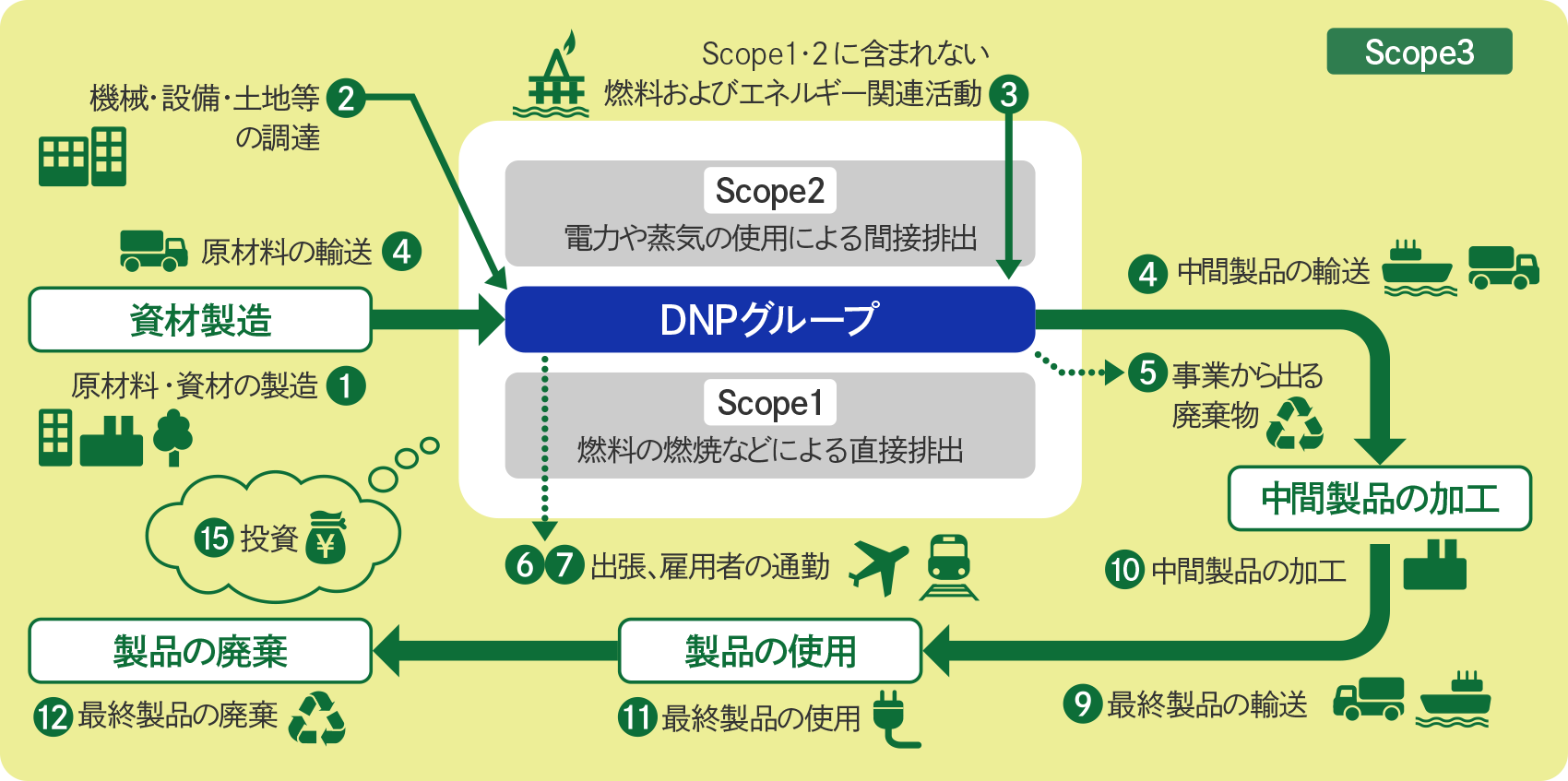
Emissions from the supply chain
Unit: 1,000 tons-CO2e
| FY2019 | FY2024 | |
|---|---|---|
| Scope1 GHG emissions | 367 | ★323 |
| Scope 2 GHG emissions | 695 | ★543 |
| Scope 3 GHG emissions | 5,111 | 4,331 |
| Scope 3 GHG emissions (Reduction categories: 1, 3, 4 and 5) | 3,556 | ★2,990 |
| Emissions from the supply chain | 6,173 | 5,197 |
Breakdown of Scope 3 GHG emissions
Unit: 1,000 tons-CO2e
| FY2019 | FY2024 | ||
|---|---|---|---|
| Category 1 | Purchased products and services | 3,167 | ★2,645 |
| Category 2 | Capital goods | 111 | ★134 |
| Category 3 | Fuel and energy-related activities that do not fall under Scopes 1 and 2 | 158 | ★144 |
| Category 4 | Transportation and distribution (upstream) | 199 | ★174 |
| Category 5 | Waste generated by operations | 32 | ★27 |
| Category 6 | Business travel | 13 | ★13 |
| Category 7 | Employee commute | 18 | ★28 |
| Category 8 | Leased assets (upstream) | - | - |
| Category 9 | Transportation and distribution (downstream) | 670 | ★555 |
| Category 10 | Fabrication of sold products | - | - |
| Category 11 | Use of sold products | 197 | ★162 |
| Category 12 | End-of-life treatment of sold products | 522 | ★432 |
| Category 13 | Leased assets (downstream) | - | - |
| Category 14 | Franchises | - | - |
| Category 15 | Investment | 24 | 18 |
Some of the data contained in this report has been assured by LRQA Limited to ensure its reliability.
A star mark ★ has been attached to each one of the indicators that have been assured by LRQA Limited.
Calculation method
The Ministry of Economy, Trade and Industry (METI) and the Ministry of the Environment (MOE) formulated and released the “General Guidelines on Supply Chain GHG Emission Accounting, Ver 2.7” the standards of which our calculations are based upon.
- Scope 1 emissions attributable to transportation and distribution carried out by group companies were included under Category 4.
- Category 8 is included in Scope 1 and 2.
- Category 10 was excluded from the calculation because the component ratio of end products is extremely small
- Category 13 and Category 14 are not applicable.
Scope of calculations
DNP and its consolidated group companies (excluding the Hokkaido Coca-Cola Group and the Bookstore Group)
As the scope of calculation was expanded, the data was recalculated for FY2019 and FY2022 to 2023.