
Biodiversity (Nature-Positive Society)
Basic Approach
Aiming to realize a nature-positive society, DNP minimizes its impact on biodiversity throughout the value chain and works to implement initiatives to ensure harmony with regional ecosystems. In accordance with the DNP Group Biodiversity Declaration formulated in March 2010, we examined our relationship with biodiversity in our business activities and selected the following key themes: the sustainable procurement of raw materials and the development of green spaces on business sites. We aim to build a nature-positive value chain by collaborating with government agencies, local authorities, and environmental organizations, and by promoting communication with various stakeholders, including local communities.
Policy
Indicators/Goals
| 2050 Environmental Vision | |||
|---|---|---|---|
| We aim to minimize the impact on biodiversity throughout the entire value chain and achieve harmony with regional ecosystems. | |||
| FY2030 Targets | FY2025 Results | ||
| Procurement ratio of products that comply with the DNP Group Guidelines for Procurement of Paper for Printing and Converting | 100% | 99.9% | |
Endorsement of the TNFD Recommendations
In addition to disclosing information using the framework recommended by the Task Force on Climate-related Financial Disclosures (TCFD), we will strive to improve the quality and quantity of information disclosure based on the Taskforce on Nature-related Financial Disclosures (TNFD) recommendations, thereby deepening dialogue with stakeholders.
Initiatives
Raw Material Procurement
In August 2012, DNP developed the DNP Group Guidelines for Procurement of Paper for Printing and Converting to achieve zero deforestation and maintain sustainable forest resources because in DNP’s business activi-ties, the procurement of paper relies heavily on and greatly affects the ecosystem. The guidelines stipulate selection criteria for sup-pliers and paper. Our goal is that 100% of the paper we procure is guideline compliant. We promote the use of wood from tree thinning, proactively use FSC®-certified paper, and ensure traceability to advance responsible raw material procurement.
Furthermore, in 2023, the Kyotanabe Plant of DNP Technopack Co., Ltd., a Group company that manufactures packaging materials, obtained ISCC PLUS certification, one of the international certification systems. Through this certification system, we will promote the expanded use of biomass and recycled materials throughout the supply chain using the mass balance method.
Creation of Greenery Areas at Business Sites
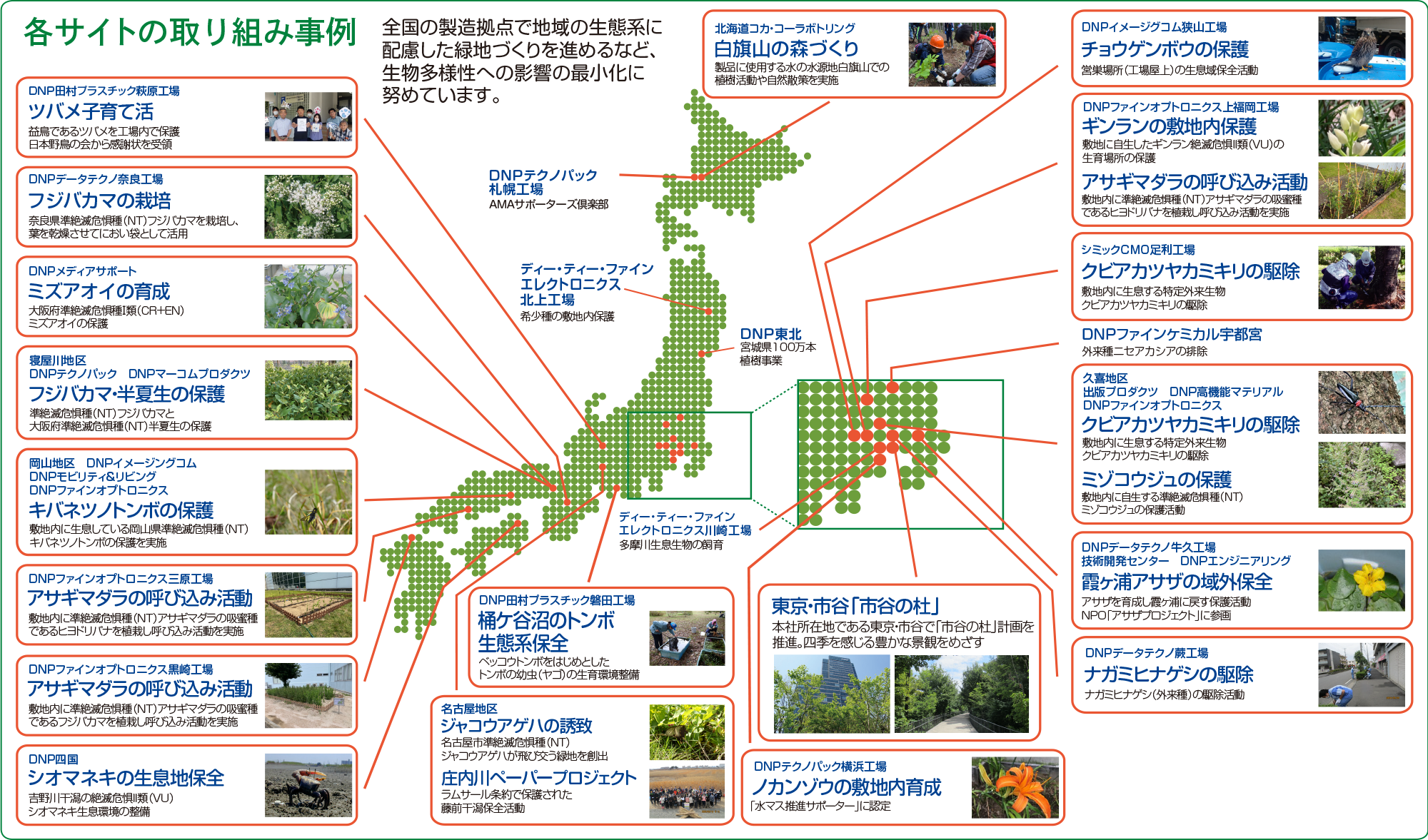
DNP is promoting creation of greenery areas at business sites to establish a connection with the surrounding environment and its creatures. We can prevent the theft of animals and plants, overhunting, and overharvesting in the greenery areas of business sites because entry into them is managed. The greenery areas can contribute significantly to the preservation of biodiversity with a low risk of supporting the damage caused by invasive species and natural predators. DNP is carrying out community-based biodiversity conservation activities on the premises of our sites, including the preservation of endangered species and the creation of greenery areas in light of regional ecosystems.
Dai Nippon Printing Co., Ltd. has obtained certification for "Ichigaya no Mori (Ichigaya Forest)" and "Moriyama no Mori" as “Nationally Certified Sustainably Managed Natural Sites*1*1” under a program promoted by the Ministry of the Environment to achieve the 30by30 target.
Moving forward, we will continue to deepen communication with local people and work towards obtaining certification for additional sites as Nationally Certified Sustainably Managed Natural Sites, with the aim of realizing Nature-Positive Society and achieving nature positivity (halting the loss of natural ecosystems and restoring them).

- Nationally Certified Sustainably Managed Natural Sites: sites that are certified by the national government under a program established by the Ministry of the Environment as sites that contribute to biodiversity conservation through private entities’ initiatives.
The program was launched in FY2023. In FY2025, it was given a legal basis through the enforcement of the Act on Promoting Activities to Enhance Regional Biodiversity and became a joint certification program administered by the three ministries: the Ministry of the Environment, the Ministry of Agriculture, Forestry and Fisheries, and the Ministry of Land, Infrastructure, Transport and Tourism.
This system was launched in fiscal year 2023 and was legally established in fiscal year 2025 with the enforcement of the "Regional Biodiversity Promotion Act." It is now operated as a joint certification system by three ministries, including the Ministry of Agriculture, Forestry and Fisheries and the Ministry of Land, Infrastructure, Transport and Tourism.