
Environmental Management
Basic Approach
DNP is constantly considering how its business activities can coexist with the global environment in order to realize a sustainable society and has set "environmental conservation and the realization of a sustainable society" as one of its Codes of Conduct.
In addition to complying with environmental laws and regulations, we are aware of the relationship between the environment and all our business activities and are working to achieve goals on themes such as "mitigating and adapting to climate change," "efficient use of resources," and "preserving biodiversity." Furthermore, with the aim of achieving the internationally shared goals of carbon neutrality and nature positivity, we are promoting activities throughout the supply chain and actively collaborating with external organizations such as industry groups to resolve environmental issues.
Policy
The DNP Group’s Corporate Philosophy states that it will connect individuals and society and provide new value. All activities to this end must comply with the DNP Group Code of Conduct whose tenets include “environmental conservation and the realization of a sustainable society.” In March 2000, we established the DNP Group Environmental Policy, aiming to help realize a sustainable society by reducing the environmental impact based on an understanding of the relationship between our business activities and the environment. We revised this policy in March 2022 because, in recent years in particular, society’s concerns about environmental problems have been growing, and we must carry out activities in view of the environmental impact of the supply chain as a whole. The activities will be accelerated.
Vision
In March 2020, we formulated the "DNP Group Environmental Vision 2050," setting medium-term targets and accelerating specific initiatives aimed at realizing a "decarbonized society," a "circular society," and a "nature-positive society."
DNP Group Environmental Vision 2050
DNP targets the realization of a decarbonized society, a circular society, and a nature-positive society by creating new value through Printing and Information (P & I) innovation designed to achieve the emergence of a sustainable society.
A Decarbonized Society through Climate Change Mitigation and Adaptation
・We aim to achieve effective net-zero greenhouse gas emissions from business activities at our own sites (Scope1+Scope2).
・We will contribute to create a decarbonized society through our products and services.
A Circular Society through the Efficient use of Resources
・We will provide maximum value through the efficient use and recycling of resources throughout the value chain.
A Nature-Positive Society via the Conservation of Biodiversity
・We aim to minimize the impact on biodiversity throughout the entire value chain and achieve harmony with regional ecosystems.
Promotion Structure
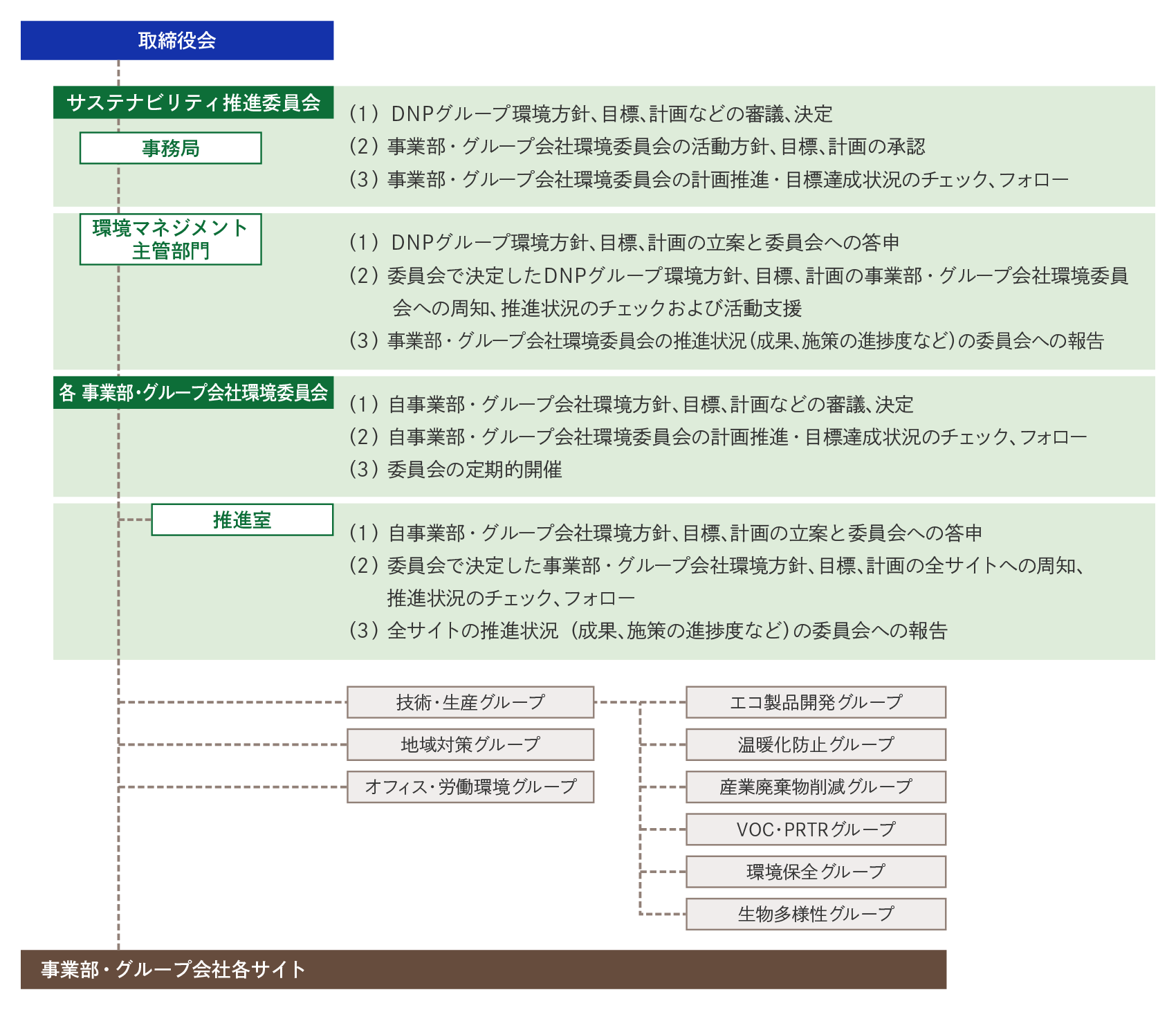
The DNP Group has established a division in charge of environmental management subordinate to the Sustainability Committee to coordinate Group-wide environmental activities. Operations & Group Company Environmental Committees have also been set up to promote activities within each business segment. Each committee has its own office or promotion office.
● Sustainability Committee
Chaired by the president and consisting of the directors and corporate officers in charge of divisions at the company’s headquarters, this committee manages medium- and long-term risks related to sustainability, identifies business opportunities and ensures they are reflected in its management strategies. In this process, the committee deliberates and makes decisions regarding the environmental policies, targets, and plans of the entire Group, and it monitors the progress of the plans and the status of the achievement of targets.
● Operations & Group Company Environmental Committees
We carry out such activities based on decisions made by the Sustainability Committee and the characteristics of different business areas, including activities at our locations outside of Japan.
Environmental Management System
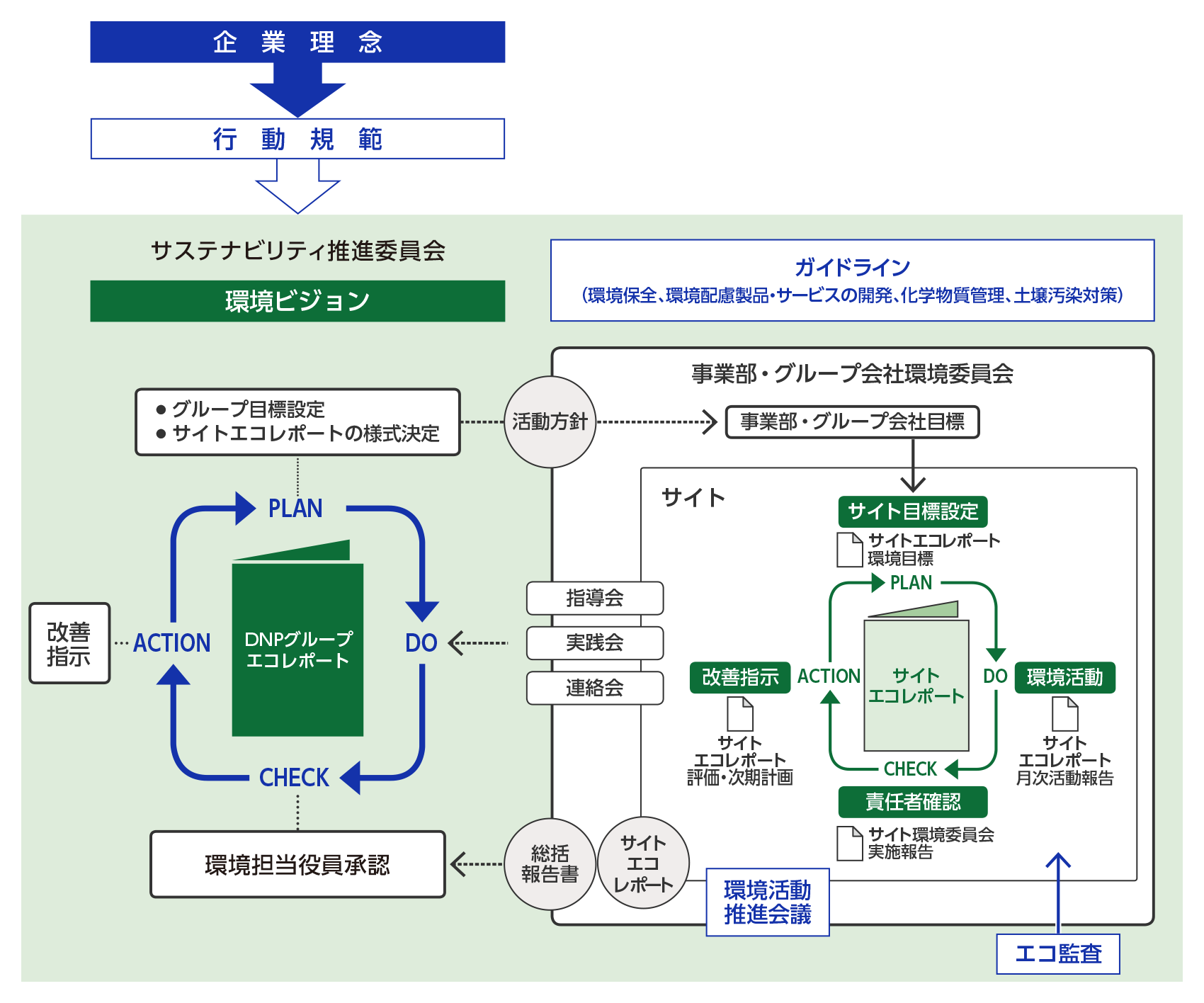
At DNP, we created our own environmental management system (EMS) in 1993, prior to the publication of the ISO 14001 standard. This system is built around two core tools: the DNP Group Eco-Reports and Site Eco-Reports set up by the Sustainability Committee Office as a framework. We also execute the Plan-Do- Check-Act cycle every six months.
The DNP Group Eco-Reports cover changes in applicable laws, our courses of action and how well the DNP Group overall has achieved its targets. The Eco-Reports are shared between the Operations & Group Company Environmental Committees and with every business site. The Site Eco-Reports document each site’s targets, plans, and status of activities. The Operations & Group Company Environmental Committees use the Site Eco-Reports to gain understanding of the situation at each site and submit a summary report to the officer in charge of the environment.
Subordinate to the Sustainability Committee, the division in charge of environmental management regularly holds meetings to promote environmental activities and receive reports from the Operations & Group Company Environmental Committees on progress and other issues.
The committees are also reinforcing management by instantly sharing important information via the company’s website.
Outline of the DNP Group Environmental Management System
ISO 14001 Certification
Acquisition rate: Global: 62% (acquired by 53 of 85 sites); Japan: 60% (acquired by 44 of 73 sites)
Eco-Audit (Internal Environmental Audit)
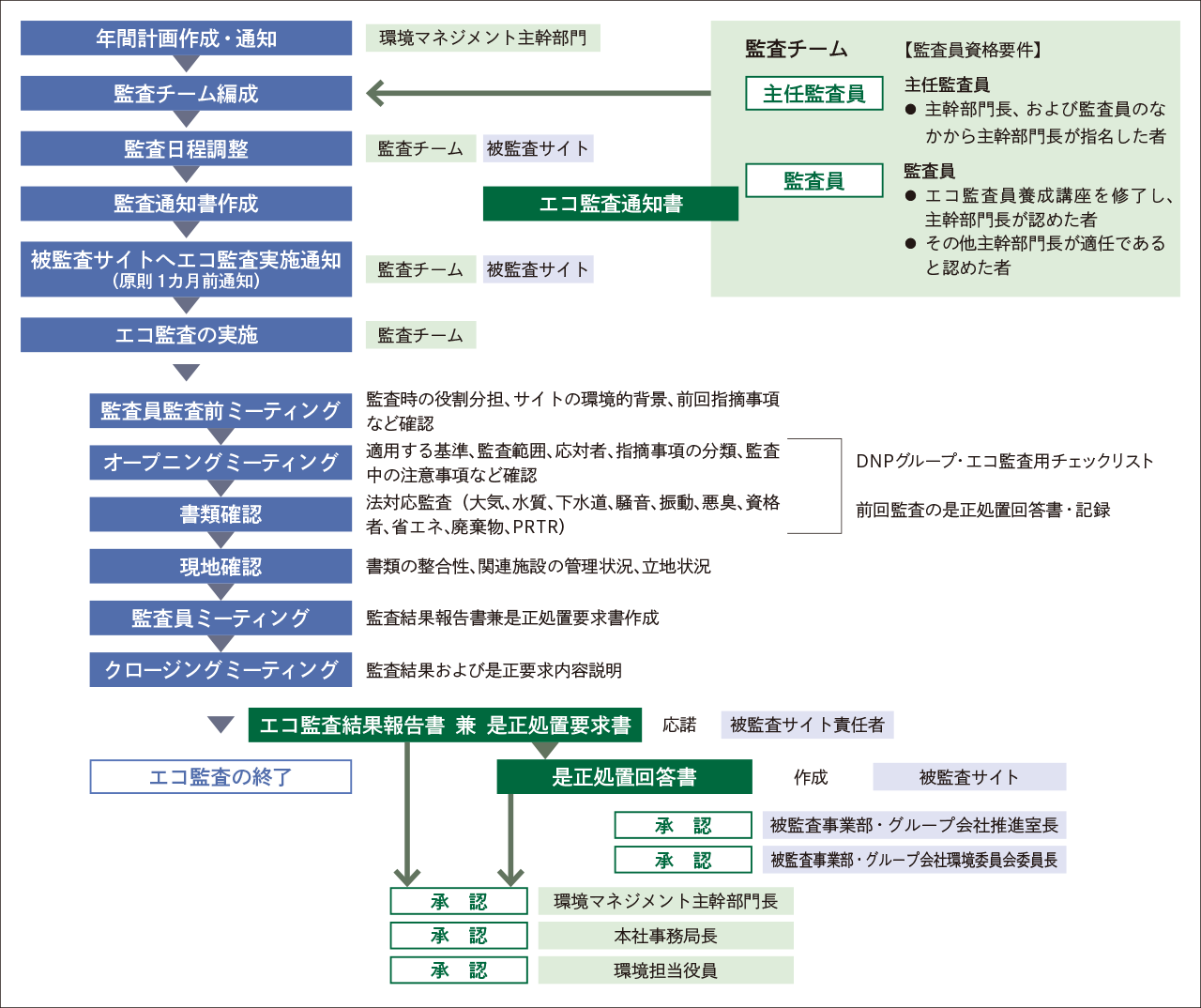
We began implementing “Eco-Audits” in 1996, so as to make our Environmental Management System (EMS) more effective. Eco-Audits are conducted by our internal auditor and cover our internal manufacturing sites. The audits have the following features.
(1) Auditors are DNP employees with no conflict of interest with the sites being audited and who possess specialized knowledge about products and processes, which produces meaningful and objective results maintaining an independent perspective.
(2) In the Eco-Audit we place importance on on-site confirmation of actual items. In addition, we point out factors for which danger is projected and request preventive action when needed.
(3) In addition to confirmation of compliance, we confirm the status of continuous improvements and corrections being made towards the achievement of the environmental targets. When necessary, we require audited sites to review plans.
Under this system, when an audit reveals that corrective measures are needed at a site, a “Corrective Action Request” is issued in writing and such actions as necessary are managed by the Sustainability Committee.
| Eco-Audit Contents Compliance Audit |
Reviewed in the site eco-reports and the Environmental Activities Promotion Meetings. Operations Audit |
|---|---|
(1) Document Audit
(2) On-Site Inspections
|
Plan
Do
Check
Action
|
FY2025 Results
| Number of sites audited | Number of attendees at sites | Cumulative auditor numbers | Cumulative auditing hours |
|---|---|---|---|
| 67 sites | 536 people | 128 people | 220 hours |
Findings determined to be “improvement required” in FY2024 included delayed notifications. We have confirmed that improvement measures have been taken in all of those cases.
We will analyze the content of the findings, determine the actions to take, and do a follow-up check in the Eco-Audits to be carried out in FY2025.*
- Notification Level and Improvements Required: “Improvement required”: Submission of a written description of correction measures performed or improvement plans, “Improvement consideration & examination”: Submission of a written description of results of consideration/ examination or improvement plans
Third-Party Assurance of Environmental Data
To ensure reliability, key environmental data is subject to third-party assurance by LRQA Limited.
Indicators/Goals (Metrics and Targets)
To achieve the DNP Group Environmental Vision 2050, we have established five metrics with medium-term targets: reduction of GHG emissions, increasing the resource recycling rate, reduction of water usage, the ratio of Super Eco-Products sales (eco-friendly products and services) to gross sales, and the procurement ratio of products that comply with the DNP Group Guidelines for Procurement of Paper for Printing and Converting. We are actively implementing initiatives to meet these targets. These initiatives are making steady and good progress, and we will continue to accelerate efforts to protect the environment and reduce our environmental impact.
| 2050 Vision | |||
|---|---|---|---|
| Realizing a “decarbonized society,” a “circular society,” and a “nature-positive society” | |||
| Topic | Metric | FY2030 Targets | FY2025 Results |
| Reduction of GHG emissions | Reduction of GHG emissions Scope 1 and 2 |
46.2% reduction from the FY2019 levels by the end of FY2030 |
32.3% reduction |
| Reduction of GHG emissions Scope 3 (Categories 1, 3, 4 and 5) |
27.5% reduction from the FY2019 levels by the end of FY2030 |
18.3% reduction | |
| Increasing the resource recycling rate | Increasing the resource recycling rate (the ratio of material and chemical recycling in relation to the amount of unnecessary objects) |
Achieve a 70% resource recycling rate for all unnecessary objects by the end of FY2030 |
65.9% |
| Reduction of water usage | Reduction of water usage (Per-unit water usage) |
30% reduction from the FY2019 levels by the end of FY2030 |
11.6% reduction |
| Increase of sales of eco-friendly products and services |
Ratio of Super Eco-Products sales (eco-friendly products and services) to gross sales |
Increase to 30% by the end of FY2030 |
18.3% |
| Procurement ratio of products that comply with the DNP Group Guidelines for Procurement of Paper for Printing and Converting | Procurement ratio of products that comply with the DNP Group Guidelines for Procurement ofPaper for Printing and Converting |
100% by the end of FY2030 | 99.9% |
DNP is also setting indicators and goals for each theme and moving forward with its initiatives.
Strategy and Risk Management
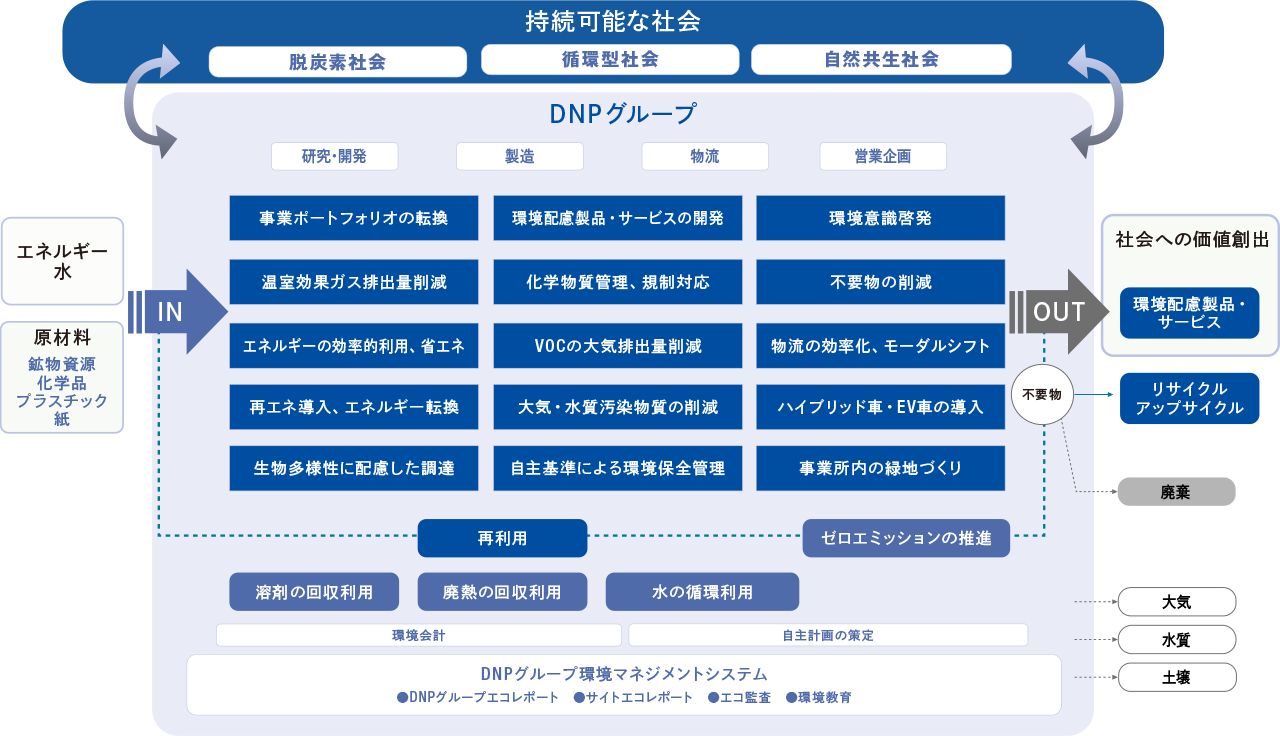
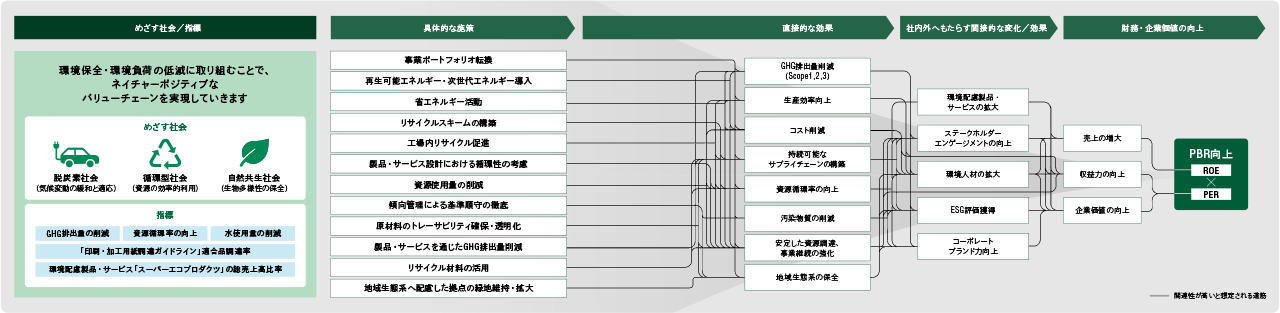
The DNP Group recognizes the environmental impacts of all its business processes—from research and development, manufacturing, and logistics to sales and planning, and disposal—and is promoting initiatives that balance the reduction of environmental impact with the creation of social value.
Aiming to realize a decarbonized society, a circular society, and a nature-positive society, we systematically implement initiatives under our environmental management system, including the efficient use of energy and resources, the reduction and recycling of waste, chemical substance management, and consideration for biodiversity.
The link between environmental initiatives and enhanced corporate value
Status of Legal Compliance
During the most recent three-year period, we had one incident with a value exceeding the standard. Regarding the incident, we were told by the government to submit an improvement report. This has already been completed. There are no ongoing legal disputes involving environmental issues. We have unfortunately had some complaints from areas neighboring our plants concerning noise and odors. Whenever we receive such complaints, we respond promptly by launching a thorough investigation into the cause of the problem and by working to make improvements and prevent recurrence.
Number of violations of laws and regulations in the past 3 years
| year | Exceeding regulatory limits | Violation of laws and regulations |
|---|---|---|
| FY2023 | 1 | 0 |
| FY2024 | 0 | 0 |
| FY2025 | 0 | 0 |
- Includes only cases for which the relevant authorities required a corrective action report.
Details of Incident (Cause, Improvement Measures, and Measures to Prevent Recurrence)
January 31, 2024 at Research and Business Development Center in Kashiwa
A water quality inspection by the authorities revealed that the biochemical oxygen demand (BOD) levels exceeded the discharge standards specified in the Water Pollution Control Act. As a result, we received a recommendation that we improve the quality of our discharged water.
Fallen leaves and sediment from a neighboring development project flowed into our premises during a rainstorm. Because we did not promptly remove these materials, the water eutrophied, causing BOD levels to exceed regulatory limits. We have since cleaned the stormwater drainage system, and subsequent water quality inspections have confirmed that the discharge is now within the regulatory standards.
Related Measures
Environmental Education
The DNP Group conducts environmental education programs according to level, working group and function concerning the DNP Group’s environmental conservation efforts, environmental knowledge, environmental laws and domestic and overseas trends concerning environmental issues. Our goal is for employees to gain the knowledge and management know-how necessary to improving employee environmental conservation consciousness and achieving our environmental goals.
Education for New Recruits
Course name: Environmental Activity Overall (required)
Basic environmental knowledge and conservation efforts of the DNP Group
| First Held | 1994 | |
|---|---|---|
| Eligibility | All new recruits | |
| Number of participants (persons) | FY2023 | 273 |
| FY2024 | 281 | |
| FY2025 | 287 | |
| Time of Year | When joining the company | |
Business Skills Seminar
Course name: Environment/Chemicals (optional)
Environmental Laws and Regulations Waste Treatment
| First Held | 1999 | |
|---|---|---|
| Eligibility | Employees related to operation | |
| Number of participants (persons) | FY2023 | 112 |
| FY2024 | 89 | |
| FY2025 | 115 | |
| Time of Year | Once yearly | |
DNP Learning Portal
Course Name: DNP Environmental Education
DNP’s environmental initiatives
| First Held | 2024 | |
|---|---|---|
| Eligibility | All employees (employees with a network ID) |
|
| Number of participants (persons) | FY2023 | — |
| FY2024 | 23,380 | |
| FY2025 | 22,829 | |
| Time of Year | Once yearly | |