Resource Recycling (Circular Society)
Basic Approach
The importance of further promoting plastic resource recycling in Japan is increasing in response to the marine plastic waste issue, climate change, and the tightening of waste-import regulations in various countries. DNP is promoting the efficient use of resources throughout the entire supply chain in order to realize a circular society outlined in the "DNP Group Environmental Vision 2050"
Indicators/Goals
Aiming to transition from economic activities based on mass production, mass consumption, and mass waste to a "circular economy" that uses resources sustainably, DNP has set the goal of realizing a circular society (efficient use of resources) in its "DNP Group Environmental Vision 2050". To achieve this, we are working to "minimize the total amount of unnecessary objects generated and the rate of final disposal site utilization." From FY2021, we are advancing efforts for recycling without thermal recovery, using the "resource recycling rate" as an indicator, thereby promoting the efficient use of resources.
| 2050 Environmental Vision | |||
|---|---|---|---|
| We will provide maximum value through the efficient use and recycling of resources throughout the value chain. |
|||
| 2030 Targets | FY2025 Results | ||
| Increasing the resource recycling rate *1 | Achieve a resource recycling rate of 70% | Resource recycling rate in 2025: ★65.9% | |
| Reducing volume of water used | Water usage per unit of sales revenue 30% reduction compared to FY2019 *2 |
Compared to FY2019: 7.7% decrease Unit cost for FY2025: ★5.95 m³/million yen (FY2019 Unit Cost: 6.73 m³/million yen) |
|
Resource Recycling Rate
| FY2023 Results | FY2024 Results | FY2025 Results |
|---|---|---|
| 62.4% | 63.5% | 65.9% |
Water usage per unit of sales
| FY2019 (Base year) | FY2023 Results | FY2024 Results | FY2025 Results |
|---|---|---|---|
| 6.73m3 / million yen | 5.12m3/百万円 | 6.21m3 / million yen | 5.95m3 / million yen 7.7% reduction |
Some of the data contained in this report has been assured by LRQA Limited to ensure its reliability.
A star mark ★ has been attached to each one of the indicators that have been assured by LRQA Limited.
*1 Resource recycling rate: The percentage of unnecessary objects (waste and valuable waste), excluding recyclable paper and other valuable recyclable materials, that are subject to material recycling or chemical recycling. Heat recovery from incineration, the conversion of waste plastics into solid fuel, and the conversion of waste oil into fuel are classified as thermal recovery and excluded from the recycling rate.
*2 From fiscal year 2026, the water usage reduction target will be updated to "Reduce water usage per unit of consumption by 30% compared to fiscal year 2019 at 10 locations with high water usage." The 10 locations are: DNP Fine Optronics Kamifukuoka Plant, DNP Fine Optronics Mihara East Plant, DNP High-Performance Materials Tobata Plant, CMIC CMO Shizuoka Plant, CMIC CMO Nishine Plant, CMIC CMO Toyama Plant, CMIC CMO Ashikaga Plant, DNP Technopack Kyotanabe Plant, DNP Technopack Izumizaki Plant, and PT DNP Indonesia.
Initiatives
Resource Recycling
Minimizing total unnecessary objects emissions
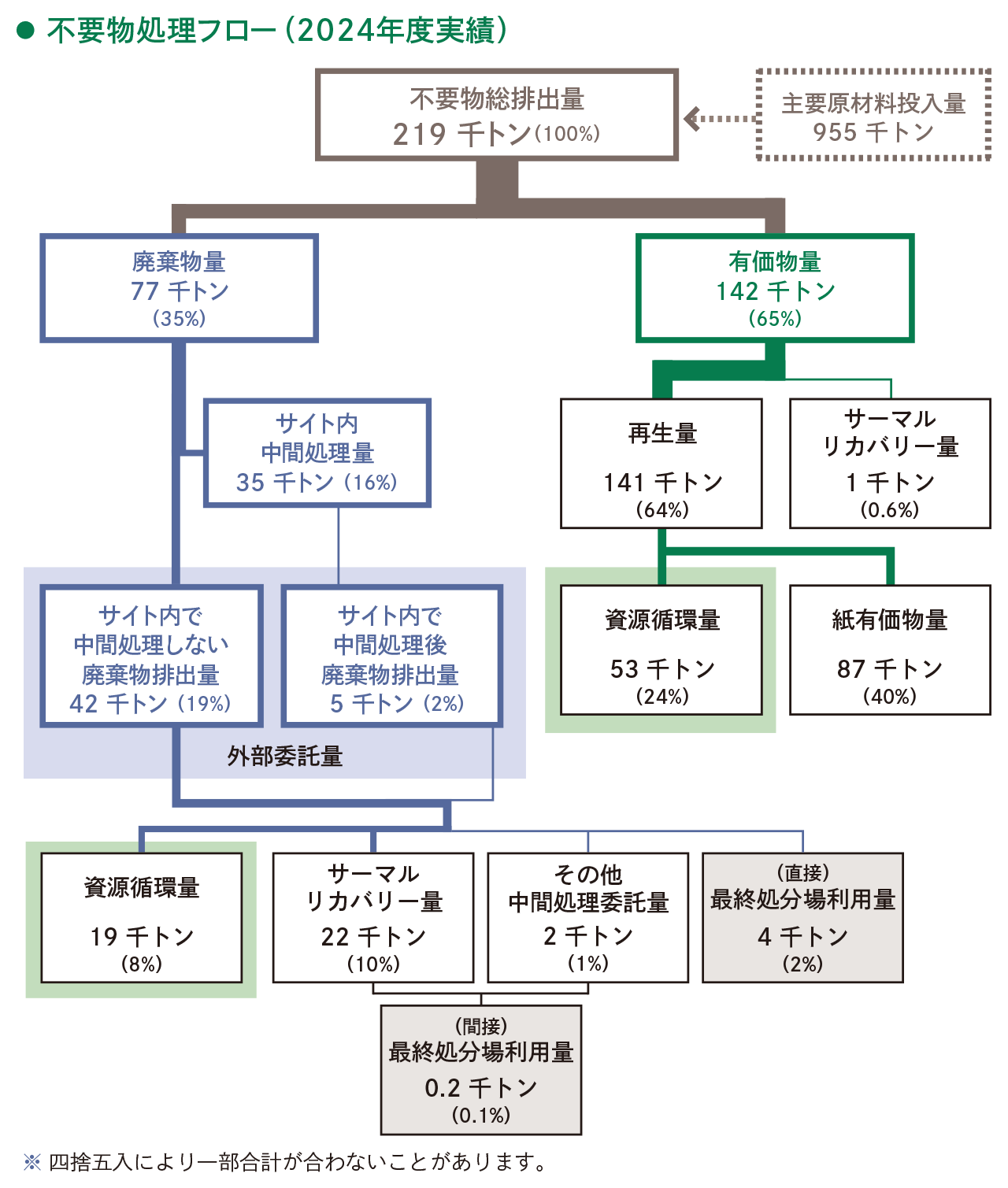
We engage in yield improvement activities in production processes to control unnecessary objects (waste and Recyclable materials) emissions from our Sites. We try to limit our use of materials in production activities to the smallest amount necessary.
Promoting the Recycling of Unnecessary objects (Waste and Recyclable materials)
Many different initiatives are under way to increase the resource recycling rate of unnecessary objects (waste and Recyclable materials) emissions from our sites. In particular, we are focusing on plastics which are a large proportion of waste and accelerating efforts to achieve a 60% resource recycling rate by FY2030. Specifically, we are strengthening (1) change of product specifications to facilitate resource recycling, such as using a single material (shift to mono-material products); (2) promotion of material recycling by separating waste into more detailed segments, and; (3) collaboration with partner companies to shift to chemical recycling.
- Combustion, conversion into solid fuels, and other processes involving heat recovery are treated as thermal recovery and are therefore not included in recycling (resource recycling).
Minimizing the landfill waste rate (Japan)
In Japan, we are working to minimize the landfill waste rate with zero emissions as a goal. The Zero Emissions initiative aims to reduce the ratio of landfill waste to the total volume of unnecessary objects to 0.5% or less, and we are working toward achieving this goal.
Effective Use of Water Resources
As the degree of risk to water resources varies by country and region, DNP conducts water risk surveys at its manufacturing sites, including overseas bases. In areas with a high risk of flooding, we also implement flood prevention measures.
Reducing volume of water used
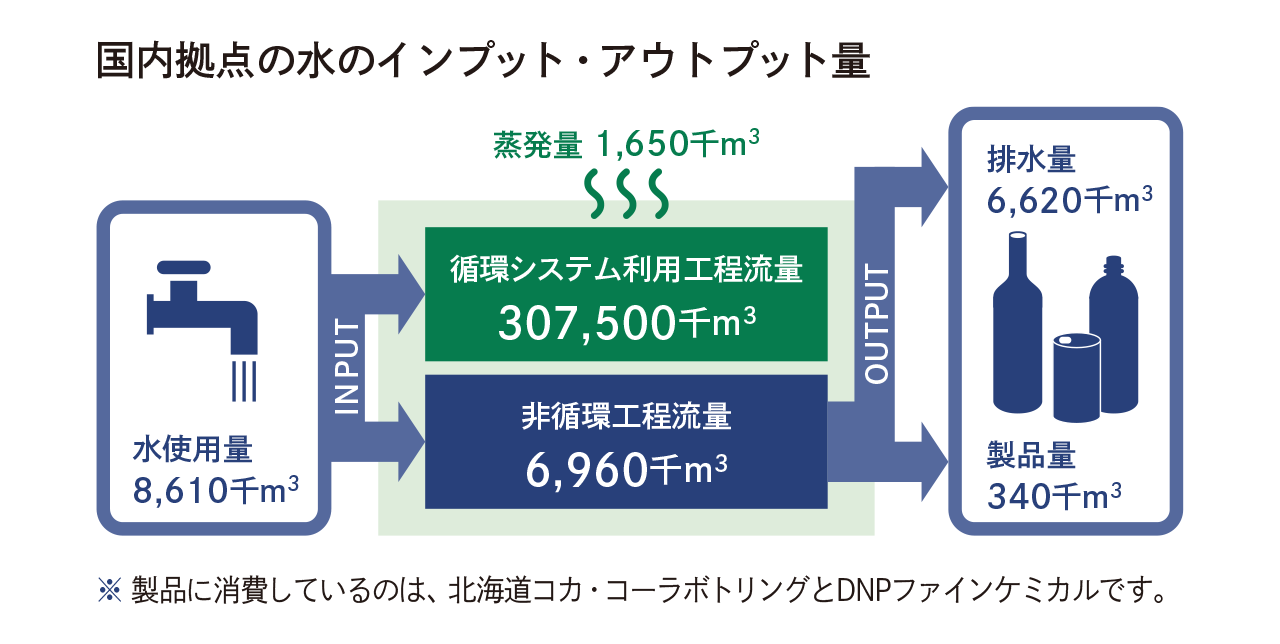
The DNP Group strives to reduce its water con-sumption by conserving water, reducing the amount of water supplied to utility systems and increasing the use of recycled water. In the Electronics and Other segments that require a large amount of water, we are making particular efforts to reduce consumption, such as opti-mizing the amount of water used in manufactur-ing processes, refining each process, installing water meters to eliminate loss as well as expanding cascade use of washing water. We are also making effective use of rainwater in our office buildings and other sites.
FY2025 Results
Water usage: 9,003 [thousand m³] Water usage per unit of sales: 5.95 [m³ /million yen]
Use of recycled water
We are working hard to conserve water resources by promoting a closed-loop system in which water is recycled and reused instead of released. In this way we have been able to cut down on the high volume of water required for cleaning our products, air conditioning, and heating and cooling production machinery.