
Risk Management
Basic Approach
The DNP Group strives to create new value that enhances the sustainability of the global environment and realizes a healthy society and economy, and comfortable and fulfilling lives for people, thereby achieving sustainable growth for DNP itself. As the factors that affect management, such as sudden changes in the social environment, become increasingly diverse and widespread, we believe that appropriately assessing and analyzing risks across the company, reflecting them in our medium- to long-term management strategies, and strengthening the process of converting them into business opportunities will help build a more sustainable society and lead to the future standards that we advocate.
Promotion Structure
Based on our fundamental approach, the Sustainability Committee—chaired by the Representative Director and President—oversees the management of medium‑ to long‑term risks, the identification of business opportunities, and the incorporation of these insights into management strategies. In addition, the BCM Promotion Committee ensures employee safety and maintains production activities in the event of emergencies, including business disruptions caused by natural disasters or cyberattacks, thereby supporting business continuity. The Corporate Ethics Committee works to enhance employee compliance awareness, which is essential to corporate continuity, and to reduce risks. Working in close collaboration, these three committees have established a system that comprehensively addresses company‑wide risks and promotes integrated risk management.
The Board of Directors receives reports and recommendations on matters deliberated and resolved by each committee, and deliberates on and supervises the DNP Group’s risk management policies and action plans.
Sustainability Committee
The Sustainability Committee convenes in principle four times per year, and additionally as necessary, to appropriately reflect the DNP Group’s approach to sustainability in its management strategies. The Committee deliberates on the following matters and submits reports and recommendations to the Board of Directors.
- Managing medium‑ to long‑term sustainability‑related risks, identifying business opportunities, and reflecting these in management strategies
- Formulating sustainability‑related policies and overseeing the execution of initiatives by each division
- Identifying sustainability issues, setting goals and plans, evaluating progress and implementation status, and carrying out corrective and improvement measures
Corporate Ethics Committee
The Corporate Ethics Committee oversees internal controls as an organization responsible for enhancing employee compliance awareness—an essential foundation of business continuity—and for reducing risks. The Committee meets at least once a month to deliberate on the following matters and submits reports and recommendations to the Board of Directors.
- Formulating and approving policies related to the Group-wide compliance framework, as well as implementation plans for related activities
- Conducting comprehensive inspections, guidance, and reviews of the development and operation of compliance systems in accordance with implementation plans
BCM Promotion Committee
The BCM Promotion Committee addresses business continuity risks as an organization responsible for ensuring corporate continuity by securing employee safety and maintaining production activities even in the event emergencies, including business disruptions caused by natural disasters or cyberattacks. The Committee convenes in principle four times per year, and additionally as necessary, to deliberate on the following matters and to submit reports and recommendations to the Board of Directors.
- Establishing and enhancing the business continuity management (BCM) framework
- Promoting disaster prevention and preparedness activities
Risk identification and importance assessment process
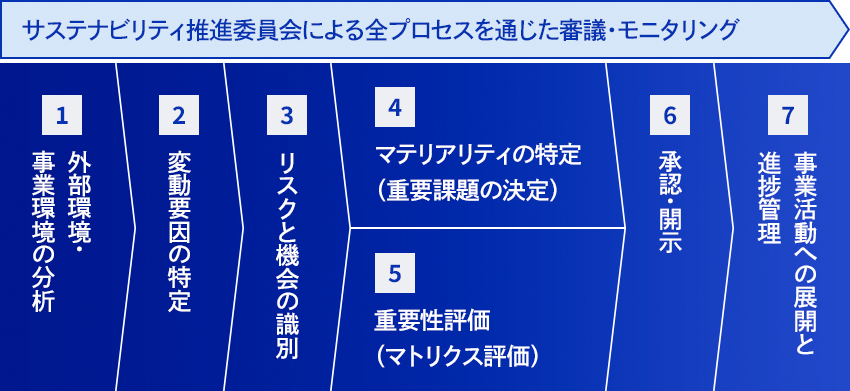
DNP continuously identifies, evaluates, and reviews risks and opportunities in response to changes in the business environment, assesses their importance from the perspective of their financial impact on the business and prioritization, and reflects them in its medium- to long-term management strategy.
These processes are conducted at least annually, and the results are reflected in management in response to changes in the external environment and progress in business strategies.
Risks and Opportunities of the DNP Group
Under a flexible and resilient governance framework, DNP identifies risks and opportunities that could affect its business, taking as a starting point changes in the external environment and megatrends, or variables, relating to the environment, society, and economy. Through its responses to these risks and opportunities, DNP promotes integrated risk management to minimize the negative impacts of these variables while expanding business opportunities.
The principal risks and opportunities identified by DNP are outlined below.
Identified risks and opportunities
| External environmental changes (factors causing fluctuations) | Risks | opportunity | |
|---|---|---|---|
| DX, AI, Security [Technology Trends Related] |
|
|
|
| Globalization, geopolitics, legal regulations [Related to economic activity] |
|
|
|
| Demographic trends, talent acquisition, and human rights awareness. [Human Capital Related] |
|
|
|
| culture, institutions, ethics [Value chain related] |
|
|
|
| Degradation and transition of natural and biodiversity [Environment-related] |
|
|
|
* indicates emerging risk
Key risks and opportunities
DNP assesses the significance of the identified risks and opportunities based on criteria including the magnitude of financial impact (¥10 billion or more, ¥1 billion to less than ¥10 billion, or less than ¥1 billion per year), timing of occurrence (within five to ten years, within five years, or already materialized), likelihood of occurrence (high, medium, or low), and the degree of impact on society and the environment (high, medium, or low). Based on the assessment results, the Sustainability Promotion Committee identifies risks and opportunities that could have a particularly significant impact on management as “significant risks and opportunities.”
The identified significant risks and opportunities are incorporated into the business, financial, and non-financial strategies set out in the Medium-term Management Plan. They are also translated into specific measures for managing individual risks and creating business opportunities. In addition, DNP has identified priority response measures to reduce significant risks.
Important risks
For significant risks, we have established priority measures to mitigate their impact on our business, and we are strengthening management, focusing on "supply chain management," "information security," and "commitment to respecting human rights."
| Key risk items | Specific details | Main countermeasures |
|---|---|---|
| Disruptions to supply chains due to geopolitical risks |
|
Supply Chain Management |
| Business disruption due to cyberattack |
|
Strengthening information security |
| AI-powered dissemination of misinformation and human rights violations |
|
Respect for human rights |
| Strengthening human rights due diligence and legal regulations |
|
Important opportunity
Regarding key opportunities, we are actively linking them to the focus business area in the medium-term management plan and seizing them as growth opportunities.
| Items of important opportunities | Specific details | Related Focus business area |
|---|---|---|
| Large-capacity data distribution in a highly secure environment |
|
Information security |
| Expansion of the digital services market |
|
Photo imaging |
| Increased demand for environmentally friendly products, services, and technologies; market acquisition through early development. |
|
Mobility & Living related |
| Strengthening supply chain competitiveness and business resilience. |
|
Industrial high-performance materials |
| Production innovation through the use of AI and robots |
|
Digital interfaces |
| The promotion of DX and the social implementation of AI are driving increased demand in related business field |
|
Semiconductors |
In addition to implementing specific measures for the identified risks and opportunities, DNP positions its non-financial strategy as a means of strengthening its management foundation and undertakes comprehensive initiatives accordingly. DNP considers the measures associated with the core themes of its Medium-term Management Plan, namely “strengthening human capital,” “strengthening intellectual capital,” and “environmental initiatives,” to contribute to enhancing corporate value over the medium- to long-term, not only by reducing risks but also by creating new business opportunities and establishing a competitive advantage. DNP is therefore further strengthening its efforts in these areas.
Related Measures
Employee Training
DNP has established the "DNP Group Code of Conduct," outlining the behaviors that all employees should adopt in their business activities. This code is disseminated through "hierarchical training" and "Autonomous Corporate Ethics Training" conducted annually for all group employees both domestically and internationally. Furthermore, recognizing the importance of risk management across the entire supply chain, DNP encourages employees and business partners to understand and endorse the DNP Group's human rights policy, environmental policy, and sustainable procurement guidelines, and to implement them.
- The term “all employees” refers to Directors, Audit & Supervisory Board Members, Corporate Officers, and Advisers of DNP Group companies, as well as individuals employed by each company and dispatched employees engaged under labor dispatch contracts.
Business Continuity Plan (BCP/BCM)
If an emergency occurs that threatens the continuation of a business and business activities are interrupted, it will have an impact not only on the company itself, but also on various stakeholders, including customers, business partners, and the people working there. In preparation for such situations, DNP has established the BCM Promotion Committee at its headquarters to promote countermeasures, and has also established the Business Unit and Group Company BCM Promotion Committee in each business unit. Utilizing this structure, we are constantly aware of disaster risks and are promoting appropriate preventive measures, based on the principles of "giving top priority to human safety measures in the event of a disaster" and "enhancing the company's disaster response and recovery capabilities."
Specifically, we are working to build a strong corporate structure that can quickly restore business activities even in emergencies by implementing fire, earthquake, and flood prevention measures for manufacturing equipment and other major facilities, diversifying manufacturing bases and raw material suppliers, formulating a business continuity plan (BCP) to minimize production stoppages and disruptions to product supply, and promoting appropriate management of that plan (BCM).
Disaster prevention system in preparation for unforeseen circumstances
DNP has established the Central Disaster Prevention Council to develop and promote basic disaster prevention measures for the entire group, the Business Unit and Group Company Disaster Prevention Council to promote specific disaster prevention measures suited to the characteristics of each business, and the Regional Disaster Prevention Council to promote disaster prevention measures by deepening cooperation between regions and areas, and is formulating disaster prevention plans and promoting preventive measures. For unforeseen circumstances such as disasters, we have established basic policies and promotion systems as the DNP Group Basic Disaster management Regulations, and are promoting a wide range of disaster prevention measures to ensure the safety of employees, their families, and related parties, and to reassure various stakeholders.
| Head Office | Each Business Unit / Group Company | |
|---|---|---|
Permanent Disaster Prevention Organization |
DNP Group Central Disaster Prevention Council ChairpersonDeputy chairperson Secretariat Subcommittee · Human resources subcommittee · Facilities subcommittee · Asset preservation subcommittee · Business activities subcommittee · Public relations subcommittee · Community subcommittee |
Business Unit and Group Company Disaster Prevention Council ChairpersonDeputy chairperson Secretariat Coordinator · Human resources coordinator · Facilities coordinator · Asset preservation coordinator · Business activities coordinator · Public relations coordinator · Community coordinator Fire protection and disaster prevention manager (DNP's own firefighting organization) *Individually established for each business unit / group company In areas composed of multiple organizations, regional disaster prevention councils are also set up to promote disaster prevention measures across the organization. |
Functions and roles |
Development and promotion of comprehensive and systematic disaster preparedness measures throughout the DNP Group |
Promotion of practical disaster preparedness measures considering business content and regional characteristics |
Maintenance of regulations, plans, etc. |
DNP Group basic disaster
management regulations |
· Disaster response work plan |
Countermeasures organization in times of disaster |
DNP Group Central Disaster Response Headquarters *The DNP Group’s Central Disaster Prevention Council will be transferred as is, to promote and otherwise take overall control of company-wide disaster emergency measures, disaster recovery / reconstruction and other necessary measures in the time of a disaster. |
Business Unit and Group Company Disaster Response Headquarters *The disaster council in each business unit / group company will be transferred as is, to promote and coordinate disaster emergency measures, disaster restoration / reconstruction and other necessary measures at a specific disaster site. |