
Eco-friendly Products and Services
Basic Approach
At DNP, we have created the Eco-friendly Products and Services Development Guidelines in order to provide eco-friendly products and services from the design stage, so as to reduce the environmental impact of our products and services throughout their lifecycle in accordance with the guidelines.
Guidelines for Developing Eco-friendly Products and Services
Reduction of Environmental Pollutants
Elimination of ozone layer-damaging substances, heavy metals and volatile organic compounds, and prevention of release into the environment of nitrous oxides and other substances.
Resource and energy conservation, reduction of GHG emissions
Reduce the use of metals and fossil fuels. Promote energy-conserving products and systems.
Sustainable use of resources
Utilize natural resources in a sustainable way.
Long-term usability
Consider the ease of repair and parts replacement, length of maintenance and repair service, and the expandability of functions.
Reusability
For product parts, considerations regarding disassembly, cleaning, and refilling; establishment of a collection and reuse system that is easy for the purchaser to use.
Recyclability
Consideration is given to recyclability through the use of easily recyclable materials, designs that facilitate separation, disassembly, and sorting of individual materials, and the creation of collection and recycling systems that are easy for purchasers to use.
Use of recycled materials, etc.
Use as many collected and recycled materials and parts as possible.
Ease of treatment and disposal
Attempt to place as little burden as possible on incinerator facilities and landfill sites.
Making environmental impact visible and taking into consideration biodiversity
Making visible any impact that should be reduced, and aiming to protect biodiversity.
Supporting and promoting environmental education and awareness
Helping to create a sustainable society.
Indicators/Goals
Based on its “Guidelines for the Development of Environmentally Friendly Products and Services,” DNP aims to create new value by promoting the development of environmentally beneficial products and products that are easy to recycle. By reducing environmental impact throughout the entire lifecycle of its products and services, the company strives to realize a “decarbonized society,” a “circular society,” and a “nature-positive society.”
| 2050 Environmental Vision | ||
|---|---|---|
| We will contribute to create a decarbonized society through our products and services. | ||
| 2030 Targets | FY2025 Results | |
| Increase in sales of Eco-friendly products and services |
Increase the ratio of Super Eco-Products sales to 30% |
Total sales ratio for fiscal year 2025: ★18.3% |
Total sales ratio of Super Eco-Products
| FY2023 Results | FY2024 Results | FY2025 Results |
|---|---|---|
| 12.0% | 15.0% | 18.3% |
Some of the data contained in this report has been assured by LRQA Limited to ensure its reliability.
A star mark ★ has been attached to each one of the indicators that have been assured by LRQA Limited.
Initiatives
Super Eco-Products
Among our environmentally friendly products and services, we identify those with superior environmental performance as Super Eco Products based on our own evaluation criteria, thereby driving sales growth.
Results for fiscal year 2025 (regarding Super Eco-Products)
| Revenue | Percentage of total sales | Number of new registrations | Total number of registered products or services |
|---|---|---|---|
| 276.1 billion yen | 18.3% | 32 Products and Services | 110 Products and Services |
● Example Super Eco-Products
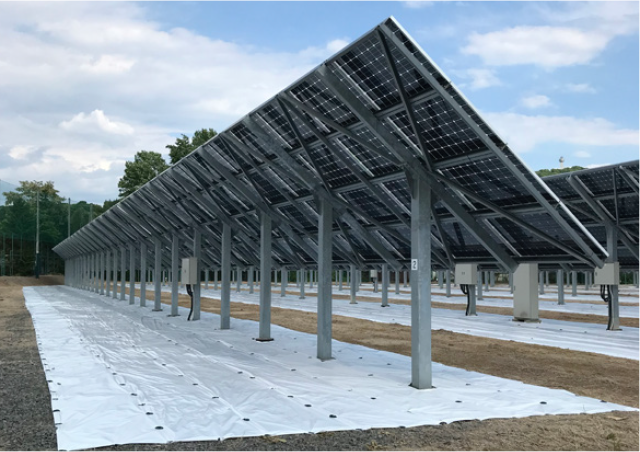
LDF solar power station reflection sheet
The product is laid on the ground at solar power stations equipped with solar cell modules that generate power by receiving light on both sides of the modules. It can increase the amount of electricity generated by increasing the incident light striking the back of the module. This con-tributes to the efficient generation of renewable electricity.
Environmental Label Certification
We have earned environmental labeling certifications such as CoC (Chain of Custody) certification and the Japan Environment Association’s Eco Mark. We are working to expand the sale of products and services with these certifications, so that their packaging and advertising can serve as a means to educate consumers properly about the environmental aspects of our goods and services.
● Main Certification Acquisition Results
| Eco Mark (Type 1 Environmental Label*) | |
|---|---|
| This environmental label is attached to products recognized as having low environmental impact throughout their lifecycle, from production through disposal, and as being useful to environmental conservation. | Acquired for DNP’s biomass plastic packaging material, Biomatech®, a blend with plant-based materials |
| CoC Certification | |
| CoC (Chain of Custody) This is a certificate of control throughout each stage of processing and distribution |
Acquired for FSCTM and PEFC |
* Environmental Label
Environmental Labeling: This is broadly divided into three types: Type 1, such as the Eco Mark (third party certification); Type 2, in which a company itself makes the declaration (self-declaration); and Type 3, in which environmental information is provided on the label, such as the EcoLeaf (environmental information labeling), with each having specifications under ISO or JIS.
Reference information: “Environmental Labeling Database” of the Central Environment Council of the Ministry of the Environment