
Process for Identifying Materiality
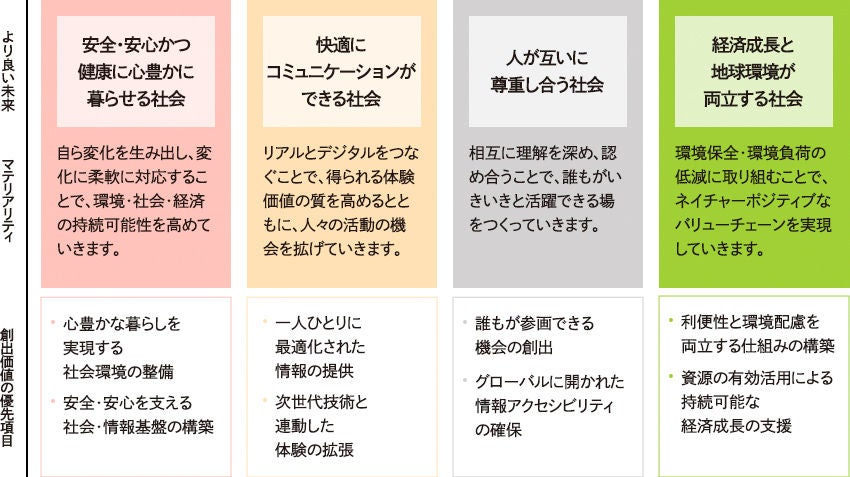
To realize the four societies that DNP aims for as a "better future," it identifies material issues from a double materiality perspective (both impact on society and the environment, and impact on corporate value), taking into account changes in the economy, society, and environment, as well as the expectations of stakeholders.
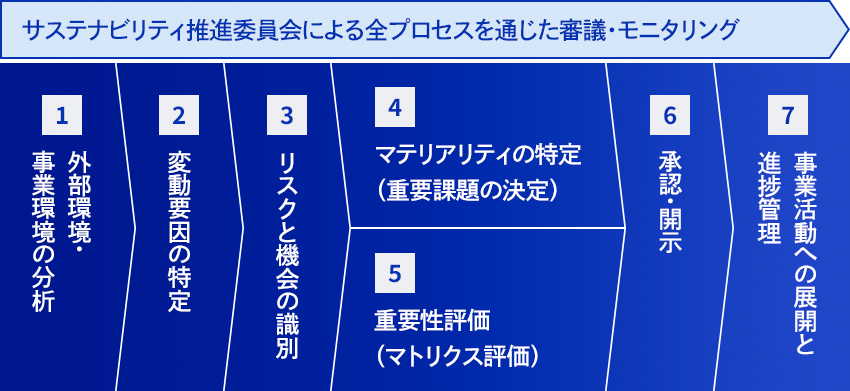
Analysis of the external environment and business environment
- Understanding international frameworks and trends
- Analysis of social issues and megatrends
- Understanding stakeholders' expectations and concerns
- Analysis of DNP's business environment
Related stakeholders
Employees, local communities, business partners,
shareholders/institutional investors,
education/research institutions, NPOs/NGOs, various organizations, etc.
International frameworks considered
SDGs, GRI Standards, SASB Standards,
United Nations Global Compact, TCFD, TNFD,
UN Guiding Principles on Business and Human Rights, etc.
Identifying the factors causing fluctuations
DNP identifies variables in the external environment that could affect the DNP Group’s business environment over the medium to long term.
Identifying risks and opportunities
DNP identifies risks and opportunities that could affect its business, taking as a starting point changes in the external environment and megatrends, or variables, relating to the environment, society, and economy.
Identifying material issues (determining key issues)
Based on the impact on society and the environment, as well as the expectations of stakeholders, we identify material issues based on a double materiality framework.
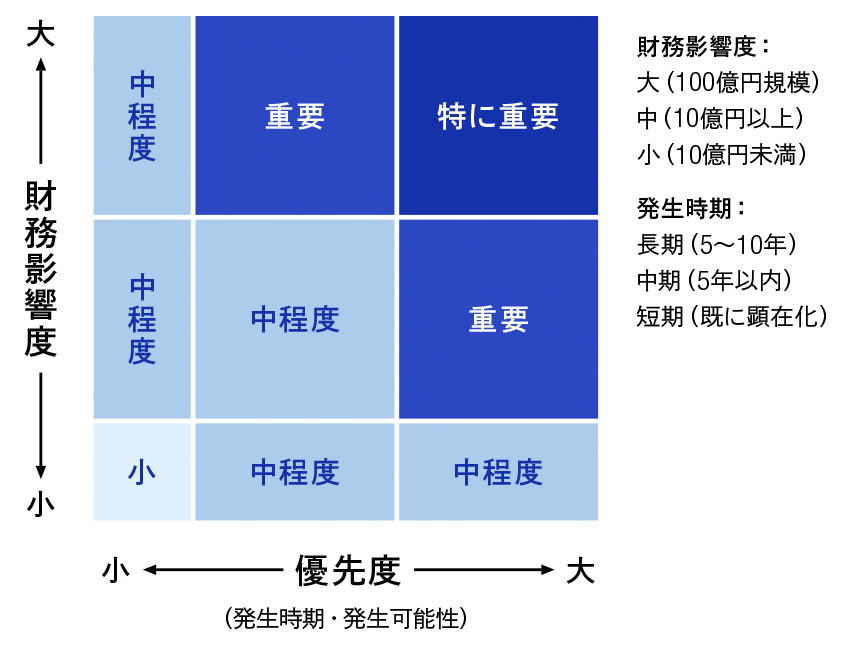
Importance assessment (matrix assessment)
DNP conducts materiality assessments of risks and opportunities that may affect its business from perspectives such as "magnitude of financial impact (over 10 billion yen, over 1 billion yen, under 1 billion yen/year)", "probability of occurrence (high, medium, low)", "timing of occurrence (5-10 years, within 5 years, materialization)", and "degree of social and environmental impact (high, medium, low)". The assessment results are deliberated by Sustainability Committee, and items with a particularly large impact on management are identified as "significant risks and opportunities".
Approval and Disclosure
Decisions are made after approval by Management Committee and Board of Directors, and then disclosed to stakeholders.
Implementation and progress management of business activities
Based on materiality, key risks, and opportunities, we drive value creation aligned with our strategies and objectives, and continuously monitor progress.