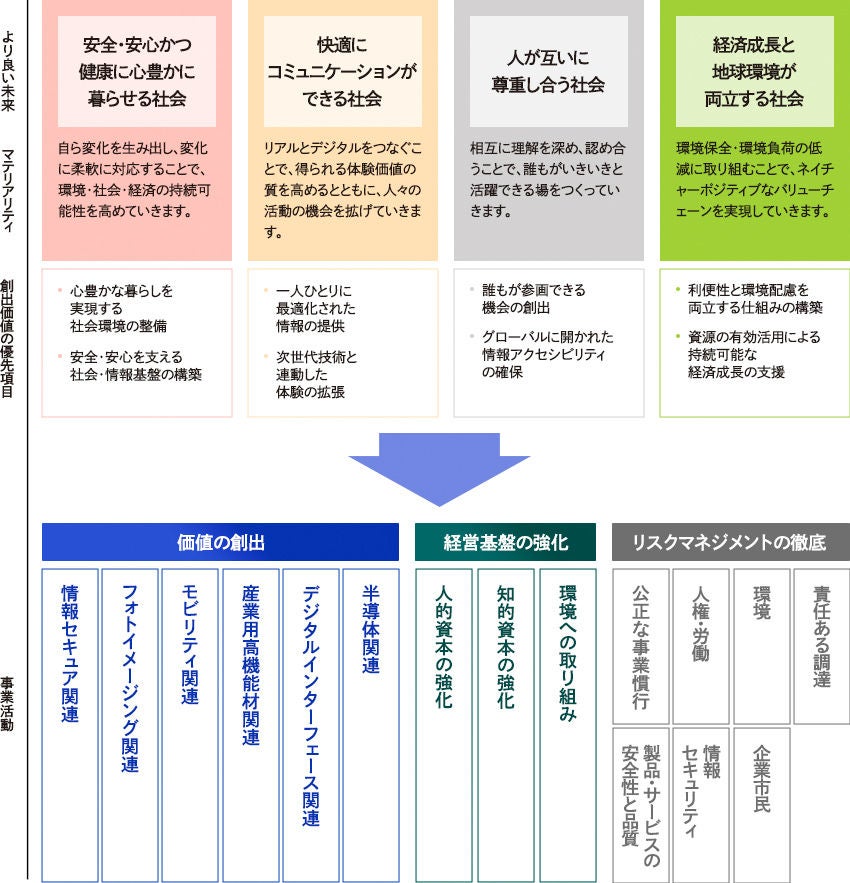
Process for Identifying Materiality
In identifying materiality, DNP comprehensively ascertains social issues and megatrends related to the environment, society and the economy, and evaluates and analyzes medium- to long-term risks (variable factors) and the impact of these on our business based on factors such as the impact on our own business activities, the value we can provide, and our strengths. Considering these external trends, DNP has specified the four types of societies that it aims for, and to realize these we have specified what DNP should do and the value it should provide and identified these as materiality.
Process for Identifying Materiality
Ascertaining social issues
DNP comprehensively ascertains social issues from the perspectives of market changes and megatrends and the materiality of these for each stakeholder as well as international frameworks such as SDGs, the GRI standards and ESG social evaluation items.
Related stakeholders
Employees, local communities, business partners,
shareholders/institutional investors,
education/research institutions, NPOs/NGOs, various organizations, etc.
International frameworks considered
SDGs, GRI Standards, SASB Standards,
United Nations Global Compact, TCFD, TNFD,
UN Guiding Principles on Business and Human Rights, etc.
Identifying and prioritizing social issues
Based on the relationship with our Corporate Philosophy and Business Strategy, identification of short-, medium- and long-term risks and opportunities and an assessment of the impact of these on management, DNP has specified the four societies it aims for as its “better future” and has outlined what it should do to realize this and the value it will provide.
Identifying materiality
DNP holds opinion exchanges with relevant internal divisions, external experts and outside directors. We identify DNP’s materiality after discussion with and approval by the Sustainability Committee, Management Committee and Board of Directors.
Business Activities Based on Materiality
As business activities based on materiality, we are promoting cross-company new value creation, primarily in our focus business areas, through the evolution and cultivation of the strengths of DNP’s unique Printing & Information (P&I). Concurrently, we are strengthening our business base and thoroughly managing risks as we minimize negative impacts from the dual perspectives of increasing corporate value and strengthening business competitiveness.
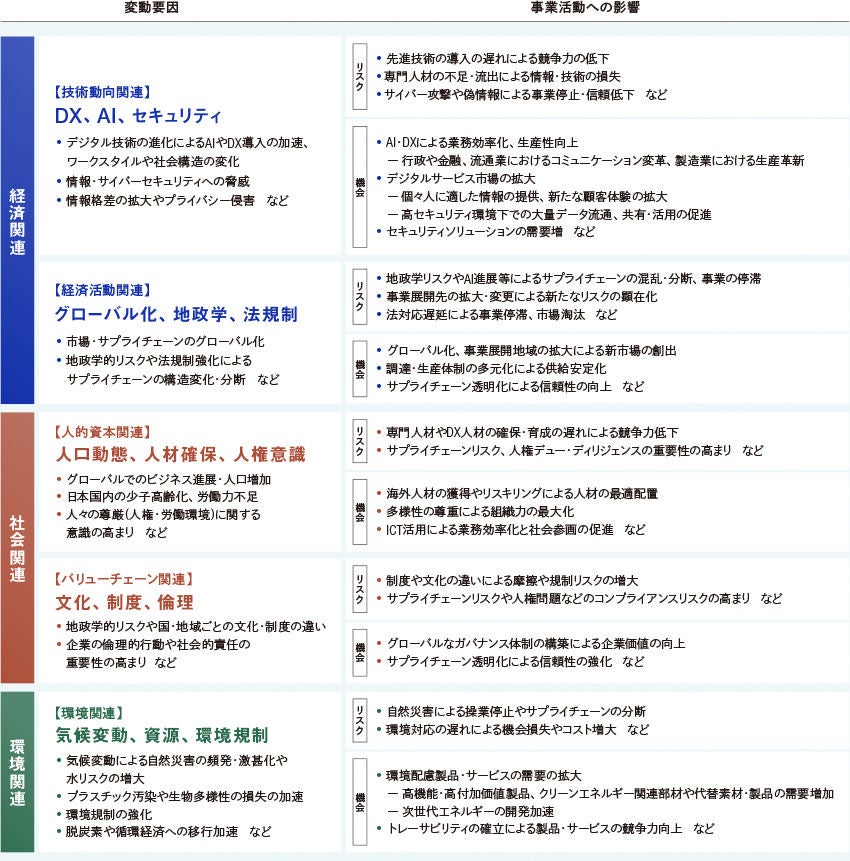
Identifying risks and opportunities
DNP believes that a healthy society and economy, as well as comfortable and well-being lives for people, can only be sustained on a sustainable earth. In recent years, rapid environmental, social and economic changes have created diverse management challenges. DNP recognizes the importance of accurately identifying these factors, evaluating associated risks, and incorporating them into medium- to long-term management strategies. By anticipating change and driving transformation, DNP seeks to turn risks into business opportunities, thereby advancing both corporate sustainability and the sustainability of society as a whole.

Identifying materiality
In March 2024, DNP identified its materiality—priority issues to be addressed—as key challenges for realizing the four interrelated societies that it envisions as a “better future.”
Based on this materiality, DNP has defined priority areas for value creation in its business activities from a global and long-term perspective.
To achieve both enhanced corporate value and strengthened competitiveness, DNP also focuses on strengthening its business base and thorough risk management, aiming to minimize potential negative impacts.