
Supply Chain Management
Basic Approach
In recent years, reflecting the expansion of global supply chains, the impacts of corporate activities on society and the environment that include social issues such as human rights and labor, bribery and corruption, and environmental issues such as climate change in particular, have become more significant than ever before. Against this background, it is becoming increasingly important to look at the entire supply chain, which includes raw materials procurement, production, usage, disposal and recycling, and strengthen management systems to ensure that issues are solved properly through the understanding and analysis of the possible risks.
At DNP, we seek to contribute to the realization of a sustainable society by accurately detecting risks throughout our supply chains, which are expanding globally, and solving a range of issues. With this in mind, we have been implementing our Responsible Procurement initiatives together with domestic and international suppliers and contractors (hereinafter our “business partners"). We will continue to fulfill our social responsibilities in our procurement activities.
Policies, Guidelines, and Requirements
Policy
DNP has formulated policies related to supply chain management and green purchasing of raw materials, and is promoting efforts to build a sustainable supply chain.
Guidelines
DNP has established sustainable procurement guidelines to enhance the effectiveness of supply chain management. Specific guidelines have been established for particularly important areas such as the purchase of printing and converting paper and chemical substances. These guidelines consist of matters that DNP and its business partners must address in order to fulfill their social responsibilities together.
Requirements
Promotion Structure
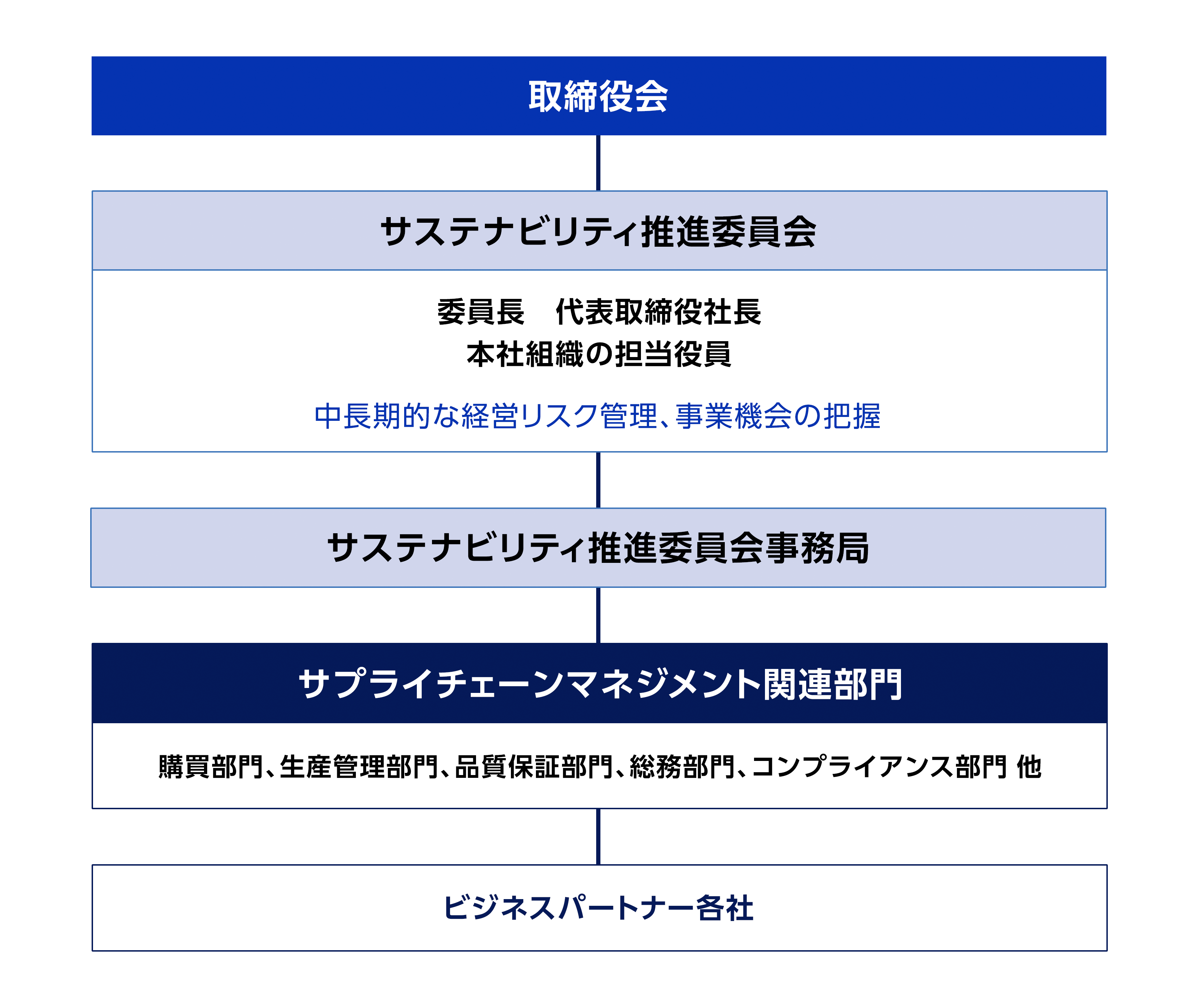
In a meeting of the Sustainability Committee chaired by the President, we confirmed our commitment to responsible procurement practices that take social and environmental issues such as human rights and climate change into account across the entire supply chain, and based on which, we have been formulating various types of guidelines and promoting a range of activities to raise the effectiveness of these guidelines.
Indicators/Goals
Based on our basic approach to supply chain management, DNP sets priority indicators and target values, thereby promoting ongoing activities.
We are promoting a variety of initiatives to increase the effectiveness of the DNP Group Sustainable Procurement Guidelines, etc. We inform our business partners of these guidelines and our related policies on human rights, labor, the environment, fair trade, ethics, etc., and we regularly survey and evaluate the status of their efforts and provide feedback on the results.
| Indicator | Targets | FY2024 Results |
|---|---|---|
1. Major suppliers 2. Procurement rate of products that Guidelines for Procurement of Paper for Printing and Converting *Applies to suppliers that account for 90% of annual purchases and to suppliers that are critical for business continuity (1) |
1. Average score of 90 or more by 2030 2. 100% acquisition rate by 2030 |
1. 83 points in Japan 2. 99.5% |
Strategy and Risk Management
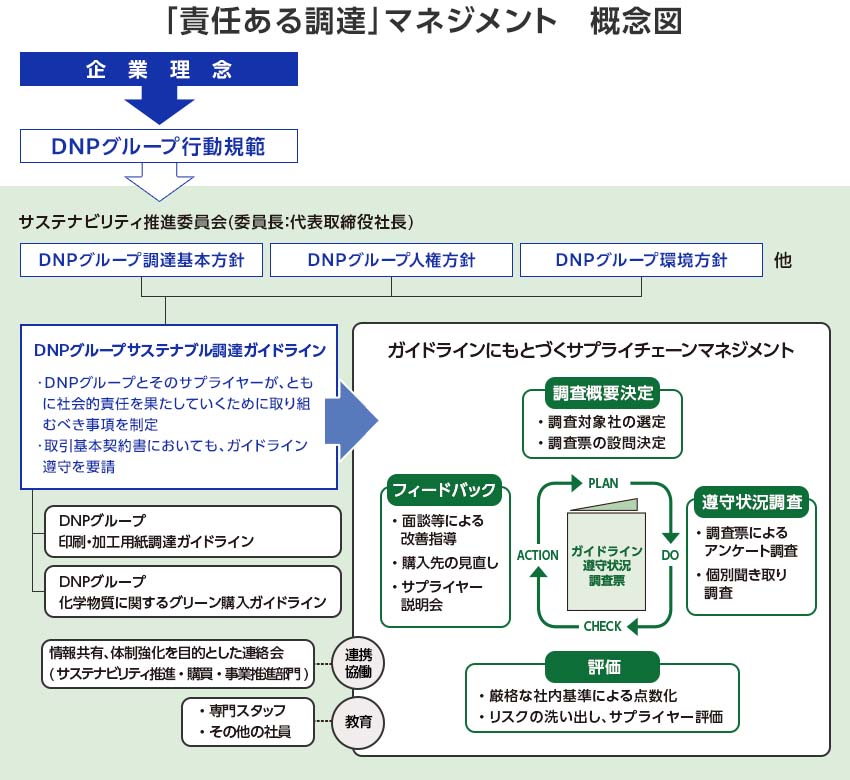
DNP works with its business partners to identify risks and implement improvements through management based on the DNP Group Sustainable Procurement Guidelines. We implement the PDCA cycle and are continually strengthening our supply chain management.
Supplier Engagement Program
Identifying risks and engaging in dialogue with suppliers
DNP has identified risks that are predicted to affect the supply chain, including compliance with laws and regulations, respect for international standards, human rights and labor, safety and health, the environment, fair trade and ethics, product safety and quality, information security, and business continuity plans, and has established the DNP Group Sustainable Procurement Guidelines as a set of issues that DNP and its business partners must address in order to achieve sustainable development.
To further increase their effectiveness, we notify business partners and others of these guidelines and our company's policies, and regularly survey and evaluate their compliance status. We also provide feedback on the results, hold individual interviews, and engage with them.
DNP Group Sustainable Procurement Guidelines compliance survey / Survey questions
| Items | Survey Questions | Details |
|---|---|---|
| Requests | Establishing a Management System | Management system, supply chain management |
| Matters to be complied with | Respecting the Laws and Internationally Recognized Standards | Compliance with laws and regulations |
| Human Rights and Labor | Forced labor, child labor, working hours, wages, discrimination, freedom of association, collective bargaining rights | |
| Health and Safety | Occupational safety, work-related injuries and illnesses, health and productivity management | |
| Environment | Greenhouse gas emissions reduction, biodiversity consideration, resource recycling, chemical substance management | |
| Fair Trading and Ethics | Anti-corruption, intellectual property, import-export management, responsible mineral procurement | |
| Quality and Safety | Quality management, provision of product and service information | |
| Information Security | Cyber attacks, personal information, confidential information management | |
| Business Continuity Planning | Business Continuity Plan Development | |
| Recommendations | Contribution to Society | Community and society |
Identifying important business partners
DNP conducts surveys and risk assessments of its key suppliers annually based on the DNP Group Sustainable Procurement Guidelines. These key suppliers account for 90% of the value of our annual procurement and those critical to business continuity. Regarding the suppliers we identify as being exposed to risks, we request improvement plans, provide document-based guidance and conduct individual interviews to identify issues and improvement measures. These findings are reflected in the next year's activities through our continuous management approach.
Initiatives to build a sustainable supply chain
Material Procurement BCP (Business Continuity Plan)
With a focus on keeping supply chains moving even in the event of an emergency, DNP has been working to hedge risks through a range of supply chain enhancement initiatives, including the facilitation of transparency and multi-sourcing in the supply chain and the securing of alternative products, while simultaneously keeping in mind the need to have tier 1 to tier 3 suppliers regarding the raw materials of mainstay products.
Initiatives for Responsible Minerals Procurement
Given the progress in the legislation on human rights due diligence, mainly in Europe and the United States, and the growing awareness of the need to respect human rights in Japan and abroad, companies are required to increase their efforts to manage risks and mitigate negative impacts throughout their supply chains. Especially regarding mineral resources, it is important to stay aware of the various types of risks, for example, human rights abuses including child labor in high-risk areas such as conflict zones, the financing of terrorists, complicity in conflicts, money laundering, illicit trade and environmental destruction.
DNP specified the Responsible Minerals Procurement policy in the DNP Group Sustainable Procurement Guidelines to ensure that we are not complicit in such human rights abuses. Under this policy, we have been working on the establishment of a management system and implementation of a range of measures*1 in line with the OECD Due Diligence Guidance for Responsible Supply Chains of Minerals from Conflict-Affected and High-Risk Areas.
In FY2021, we conducted a Survey of Suppliers on Human Rights Issues and Conflict Mineral Issues targeting major suppliers and conducted a survey on the origin of raw materials. By using the RMAP*2 conformity verification programs of the RMI*3, an organization that spearheads the responsible procurement of minerals, we identified smelters and mines for the five minerals (tin, tantalum, tungsten, gold, and cobalt) contained in raw materials and conducted risk assessments.
In FY2024, we conducted risk assessments using the RMI reporting template for six minerals, including mica, in addition to the above. In addition, since 2023, we have been conducting on-site inspections of relevant suppliers, including checking record documents, to promote efforts throughout the supply chain.
- DNP’s initiatives regarding the five steps of this guidance are presented in DNP’s Responsible Minerals Procurement Framework in the Description of DNP Group Sustainable Procurement Guidelines.
- Responsible Minerals Assurance Process (RMAP): A program that verifies compliance with responsible minerals procurement in conjunction with the management system and procurement practices of smelters and refineries based on the evaluations of independent third parties.
- Responsible Minerals Initiative (RMI): An organization that spearheads the responsible procurement of minerals. More than 500 companies / organizations from around the world are members.
Conflict Minerals Survey
| 2022 Survey *For tin, tantalum, tungsten, gold, cobalt, and mica |
2023 Survey *For tin, tantalum, tungsten, gold, cobalt, and mica |
2024 Survey *For tin, tantalum, tungsten, gold, cobalt, and mica |
|
|---|---|---|---|
| Number of survey respondents | 171 companies | 253 companies | 285 companies |
| Number of identified smelters | 414 locations | 393 locations | 370 locations |
| Number of RMAP-compliant smelters *Conformant certified |
260 locations | 255 locations | 232 locations |
Initiatives related to printing and converting paper
In 2012, DNP established the Printing and Converting Paper Procurement Guidelines to contribute to the sustainable use of forest resources, outlining the matters that must be observed when procuring printing and converting paper, the main raw material for printed materials. Furthermore, we are strengthening cooperation with suppliers, including paper manufacturers and sales companies, and are working to procure wood whose legality has been confirmed in accordance with these guidelines, ensure traceability, and increase the purchasing ratio of paper sourced from responsibly managed forests. A survey conducted in fiscal 2024 showed that the procurement rate for products that comply with these guidelines was 99.5%, maintaining a level that is very close to the target of 100%.
Chemical Substances Initiatives
In 2004, we formulated the DNP Group Chemical Substance Management Standards and have been promoting green purchasing with the aim of minimizing the environmental impact. Furthermore, in 2013, in response to strengthened regulations both in Japan and overseas, we redefined the nature of chemical substances and revised our guidelines to the DNP Group Green Procurement Guidelines for Chemical Substances in order to reduce the risks that chemical substances pose to human health and the environment.
We also hold supplier information sessions to inform relevant parties about the risks of chemical substances and the importance of responding throughout the supply chain. We have been working to continuously strengthen our management, including expanding the range of controlled substances in November 2021. In May 2025, we revised our guidelines to expand the range of target chemical substances and amend some of our management methods, managing chemical substances contained in products in line with global trends.
Strengthening communication with stakeholders
Customer communication
Through engagement with client companies, DNP strives to ensure that the entire supply chain practices socially and environmentally responsible procurement. In particular, for our core businesses of lithium-ion battery pouches and semiconductor photomasks, we promote initiatives based on the international standards* required by our client companies. Furthermore, we request that our primary and secondary suppliers also take part in these initiatives. To confirm the effectiveness of these initiatives, we undergo third-party audits once a year. By identifying issues together with client companies and making improvements, we work to further strengthen our management.
In other business areas as well, we exchange opinions with multiple client companies on issues such as responsible procurement, human rights, and the environment, striving to further strengthen management on both sides.
- OECD "Due Diligence Guidance for Responsible Supply Chains of Minerals from Conflict-Affected and High-Risk Areas" and RBA "Code of Conduct"
Communication with suppliers
Since 2006, DNP has been working with suppliers to promote socially and environmentally responsible procurement. In order to meet society's expectations at a higher level, we revised the name and content of our guidelines from the DNP Group CSR Procurement Guidelines to the DNP Group Sustainable Procurement Guidelines in 2024, with the aim of strengthening sustainable procurement efforts throughout the supply chain. In November 2024, we held an explanatory meeting for major suppliers regarding the revised guidelines to ensure their understanding and awareness.
DNP is strengthening due diligence regarding aluminum, a raw material used in battery pouches for lithium-ion batteries, one of its main products. We are increasing supply chain transparency through ongoing engagement with our suppliers. We conduct risk assessments of stakeholders in the supply chain, and for any risks of concern, we conduct additional investigations and work to correct or mitigate them. In fiscal 2024, we conducted 12 regular engagements, one of which included an on-site inspection at a manufacturing facility.
Communication with subcontractors
DNP informs its subcontractors of the DNP Group Sustainable Procurement Guidelines and its own policies, and regularly surveys and evaluates the status of their efforts. In fiscal 2024, a DNP Group Sustainable Procurement Guidelines Implementation Status Survey was conducted on 220 partner companies. Based on the survey results, on-site interviews were also conducted with three subcontractors to confirm the employment status of foreign workers, working environment, consideration for female and elderly workers, notification to authorities regarding environmental laws and regulations, and the status of manager selection.
DNP will continue to promote sustainable supply chain management together with stakeholders and fulfill its social responsibilities.
DNP Group Sustainable Procurement Guideline Compliance Survey: Survey Results
Interview results
| Survey results | FY2022 | FY2023 | FY2024 |
|---|---|---|---|
| Number of suppliers evaluated | 180 | 274 | 285 |
| Response rate (as of June 2025) | 87% | 75% | 78% |
- Survey conducted for suppliers that account for 90% of annual purchase value and those critical to business continuity.
- Based on the survey results, interviews and guidance will be conducted in the following fiscal year to improve the situation.
2024 survey evaluation ratings
| Rank | Criteria | Ratio |
|---|---|---|
| A | Appropriate level of implementation with no major issues identified | 68% |
| B | Generally implemented, but further improvement required | 23% |
| C | Insufficient implementation or areas of concern identified | 8% |
| D | Risk identified | 4% |
Follow-up on evaluation results
| FY2022 | FY2023 | FY2024 | |
|---|---|---|---|
| Number of suppliers provided with document-based guidance based on improvement plans | 44 | 92 | 36 |
| Number of suppliers provided with interview-based guidance among those provided with document-based guidance | 20 | 42 | 23 |
| Number of suppliers for which serious compliance violations were identified through surveys, document-based guidance, or interviews | 0 | 0 | 0 |
| Number of suppliers for which transactions were temporarily suspended based on interview results | 0 | 0 | 0 |
| Number of suppliers for which transactions were terminated based on interview results | 0 | 0 | 0 |
Average score by theme
| Average Score | FY2023 Results | FY2024 Results | |
|---|---|---|---|
| General *Recommendations excluded |
81 | 83 | |
| Requests | Building a management system | 75 | 68 |
| Compliance Requirements | Compliance with laws and regulations and respect for international standards | 82 | 86 |
| Human rights and labor | 87 | 94 | |
| Safety and health | 84 | 89 | |
| Environment | 74 | 80 | |
| Fair trade and ethics | 81 | 88 | |
| Product safety and quality | 82 | 83 | |
| Information security | 83 | 80 | |
| Recommendations | Social contribution | 78 | 84 |
Related Measures
Education and Awareness
DNP recognizes the importance of responding to risks throughout the supply chain. With regard to human rights risks that could have a serious impact on business, we are further promoting our efforts to respect human rights, encouraging employees and business partners to understand and agree with the DNP Group's human rights policy, environmental policy, and Sustainable Procurement Guidelines, and supporting their implementation.
We provide education both internally and externally to foster a deeper understanding of sustainability and translate that understanding into action. Internally for procurement staff, we conduct annual training programs on social and environmental issues, such as human rights and climate change, and the corporate responsibility to address these issues through sustainable procurement. Since FY2021, we have extended training on “business and human rights” to all employees. Externally, we organize study sessions for our key suppliers, with a total of 239 companies and 273 individuals attending since the CSR Procurement Guidelines were revised in FY2017. Through ongoing dialogue with our business partners, we have continued to address challenges related to the promotion of sustainability. Additionally, DNP has published and distributed explanatory materials on the DNP Group Sustainable Procurement Guidelines, which DNP places at the heart of its management of responsible procurement, in both Japanese and English, enhancing internal and external stakeholders’ understanding of the standards, terminology and context of the guidelines. By continuing to enhance these efforts going forward, DNP will continue to promote the Responsible Procurement initiative.
Training record for procurement staff
| Details | FY2023 Results | FY2024 Results |
|---|---|---|
| Business and Human Rights e-learning training completion rate | 84% | 81% |
External Evaluation (EcoVadis)
In 2025, DNP received a Gold rating, awarded to the top 5% of evaluated companies worldwide, in the sustainability assessment conducted by EcoVadis (France), an international assessment organization for corporate sustainability activities. EcoVadis evaluates a company's sustainability in four areas: the environment, labor and human rights, ethics, and sustainable material procurement.
We will continue to work towards realizing a sustainable society through activities throughout the entire supply chain.
Participation in Initiatives
DNP empathizes with the initiatives of the United Nations Global Compact’s local organization (Global Compact Network Japan, hereinafter referred to as GCNJ), which was launched in Japan in 2003, and we have been participating in various subcommittees. Notably, we have been participating in the Supply Chain Subcommittee since its inception in FY2008. DNP was also involved in compiling “A Vision of Desirable CSR Activity in the Supply Chain” (issued in 2013) and “An Introduction to Sustainable Procurement-Promoting CSR in the Supply Chain” (issued in 2016) and the creation of Japanese-English versions of “CSR / Sustainable Procurement Training Toolkit (Lecture & Game)” (issued in 2020). In FY2023, we were involved in the creation of the Tools for Checking the Level of Understanding of An Introduction to Sustainable Procurement, thereby contributing to the promotion of sustainable procurement.
Key Initiatives to Date
| 2006 | Formulated the DNP Group CSR Procurement Criteria *Started responsible procurement initiatives in collaboration with suppliers |
|---|---|
| 2009 | Established a Compliance Hotline |
| 2011 | Revised the DNP Group Green Purchasing Policy Revised the Basic Business Contract *Requested that primary suppliers undertake procurement management in accordance with the DNP Group CSR Procurement Criteria |
| 2012 | Formulated the DNP Group Guidelines for Procurement of Paper for Printing and Converting |
| 2013 | Formulated the DNP Group Green Procurement Guidelines for Chemical Substances |
| 2017 | Revised the DNP Group CSR Procurement Criteria into the DNP Group CSR Procurement Guidelines *Revised from procurement criteria focused on domestic business activities into guidelines reflecting international requirements, based on the Electronic Industry Citizenship Coalition (EICC) Code of Conduct (now the Responsible Business Alliance (RBA)) and the Japan Electronics and Information Technology Industries Association (JEITA) Supply Chain CSR Promotion Guidebook. *Expanded scope of application to suppliers and agents at all overseas bases *Expanded the scope of application to Group companies with independent purchasing functions |
| 2018 | Formulated the DNP Group Anti-Bribery Policy |
| 2020 | Formulated the DNP Group Human Rights Policy Formulated the DNP Group Environmental Vision 2050 Revised the DNP Group CSR Procurement Guidelines Revised Basic Business Contract *Aiming for net zero GHG emissions to address climate change and other challenges. *Revised to include not only primary suppliers but also second-tier suppliers and beyond *Requested the undertaking of management in accordance with the CSR Procurement Guidelines from second-tier suppliers and beyond *Strengthened human rights due diligence efforts in the supply chain for the procurement of raw materials |
| 2021 | Partially revised the DNP Group Anti-Bribery Policy |
| 2022 | Revised the DNP Group Environmental Policy *Committed to reducing environmental impact throughout the supply chain |
| 2024 | Revised the DNP Group CSR Procurement Guidelines into the DNP Group Sustainable Procurement Guidelines *Called for enhanced risk management throughout the supply chain |