
DNP Develops System to Grasp Daily Patient Behavior Quantitatively for Treatment and Guidance
Verification Tests implemented in Conjunction with Yokohama University of Pharmacy
Dai Nippon Printing Co., Ltd. (DNP) is pleased to announce the developmentof a system designed to help visualize patient behavior, including meals, sleep,along with the patient's medication status. The newly developed system is expectedto help healthcare workers, such as physicians, pharmacists and home nursingstaff, make diagnoses, prescribe medicines and provide appropriate guidance.Marketing activities will commence from this autumn.
[Background]
According to the Annual Report on the Aging Society 2015, issued by the JapaneseCabinet Office, based on information from the National Institute of Populationand Social Security Research, the over-65 senior population is forecast to increasefrom 33 million in 2014 to 36.57 million in 2025. Looking ahead, demands onmedical and nursing care are expected to increase. Against this backdrop, theMinistry of Health, Labour and Welfare is promoting the creation of an IntegratedCommunity Care System (ICCS) that will provide residential, medical, nursingcare, prevention and daily life support in a packaged format so as to allowthe elderly to continue living in their familiar surroundings even if they requireintensive nursing care.
Implementing ICCS requires a strengthening of the home healthcare system.Under such systems, in addition to preventing instances of patients forgettingto take their medicine, in order to help healthcare workers provide appropriatediagnoses and guidance, it is also important to be aware of changes in symptoms,and patient-specific lifestyles. In many cases, however, this information ispassed on orally, and it has been difficult to fully ascertain the necessarydata. At the same time, under ICCS multidisciplinary cooperation, the sharingof information across physicians, pharmacists and home nursing staff also becomesimportant.
In order to overcome these challenges DNP has developed a system that providesa quantitative understanding of changes in symptoms, and patient-specific lifestyles,and help healthcare workers provide appropriate guidance for patients.
[Overview and Properties of New System]
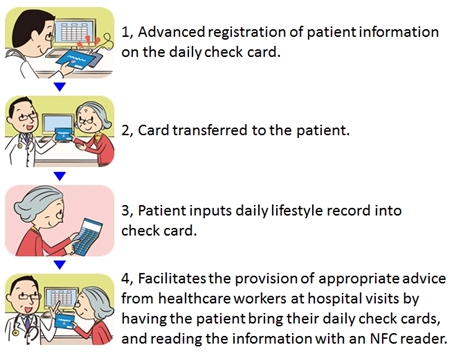
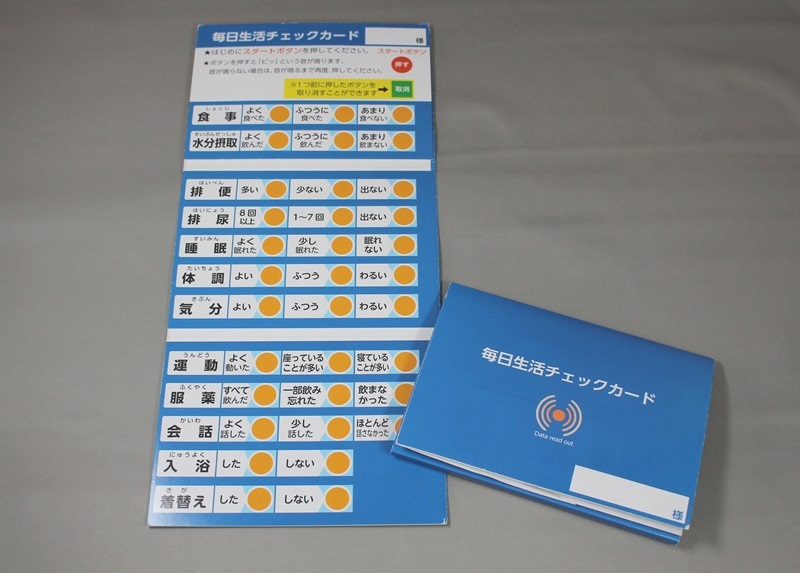
The newly developed system is comprised of a daily life check card with anin-built electronic module, a Near Field Communication (NFC) card reader forreading the information recorded on the card, and dedicated management software.The daily life check card records the status and time of activities underlyingpatient-specific lifestyle patterns, such as whether they have eaten, takenfluids or slept properly, by having each patient press a button on the cardnext to the appropriate topic. By passing this card over the NFC card reader,it is possible to view individual patient-based data via the management software.
- By helping to develop a quantitative time series-based understandingof the data, including medication status and patient lifestyles, it willbe possible to achieve early detection of changes in patient health andailments, helping healthcare workers provide appropriate guidance and treatment.
- The daily check card records information at the simple push of a button,meaning that even those seniors who otherwise shy away from digital equipment,such as smartphones, can easily use the cards.
- The recorded information is converted into a two-dimensional code withthe management software, and output as a label. And by reading this two-dimensionalcode with a laptop or phone-based camera it becomes possible to share patientinformation across multiple disciplines, without using the internet.
[Pricing]
Package sales price: from 200,000 yen
(Includes 10 daily check cards, a lap top integrating the dedicated softwaresuch as one for the card reader, the NFC reader-writer, a label printer anda user manual).
* It is also planned to market optional cards, and software developmentkits for developing the card reader software.
[Verification Tests in Conjunction with Yokohama University of Pharmacy]
Verification tests using the newly developed system, designed to gain anunderstanding of patient lifestyles of the elderly at home, were developed inconjunction with Yokohama University of Pharmacy.
Test period: December 2015 - January 2016
Test subjects: 20 patients aged 75 or more (10 on an out-patient basis, and10 on a home-visit basis)
Test contents: Patients required to press appropriate buttons on daily checkcards covering 12 items, including whether they have eaten, taken fluids orslept properly. In the case of out-patients, card to be presented to physicianat time of hospital visit, and physician to make diagnosis, draw up prescription,and provide advice based on the recorded information.
In the case of patients requiring home-visits, card information to be confirmedby nursing care operator, and to be used as a stimulus for communication. Appropriatereports to be made to physicians in instances of changes in health status ofpatient.
The following effects were noted: It was possible to gain a quantitativeunderstanding of the lifestyles of the elderly from medication status and lifestyle-basedrecords.
As the user interface is simply constructed around having the patient pressa button on a card, with no need to operate tablet terminals or smartphones,elderly patients were able to make records on an ongoing basis. Patients alsonoted that by making such record keeping a daily custom, the activity provideda stimulus for patients to pay more attention to their own health status.
[Looking Ahead]
DNP will market the newly developed system mainly to dispensing pharmacies,home visit nursing stations, medical clinics, and pharmaceutical companies,aiming for total sales of 1.0 billion yen by FY 2020.
* Product prices, specification and service contents mentioned in this newsrelease are current as of the date of publication. They may be changed at anytime without notice.
- Select location
-
- Category
-