Signature Pavilion: Four Perspectives on the “Playground of Life: Jellyfish Pavilion”
From April to October 2025, Expo 2025, Osaka, Kansai, Japan is bringing together 158 countries and regions alongside seven international organizations to Yumeshima Island for a diverse array of exhibitions and events. DNP is participating as a Gold Partner in the “Playground of Life: Jellyfish Pavilion,” one of the Expo’s eight Signature Pavilions, the theme of which is “Invigorating Lives.” Acting as a “hub of co-creation” with partners inside and outside the company, DNP has driven the planning and production of this project, delivering visitors a distinctive exhibition and immersive experience. We spoke with four key people who supported the project, each sharing behind-the-scenes stories and their own recommended highlights.
- Differences are not divisions; it is precisely because we are different that our connections grow stronger. This project brought that belief into sharp focus.
- There’s never just one way of seeing things. That’s why communication is so important.
- "Monozukuri" is about creating experiences. This valuable endeavor allowed me to return to this fundamental truth.
- Challenges beyond existing conventions brought many new insights.
Differences are not divisions; it is precisely because we are different that our connections grow stronger. This project brought that belief into sharp focus.
|
|---|
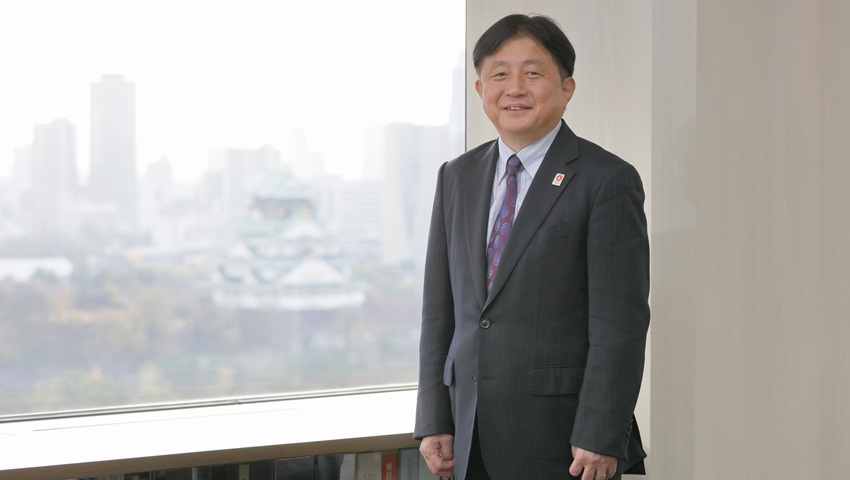
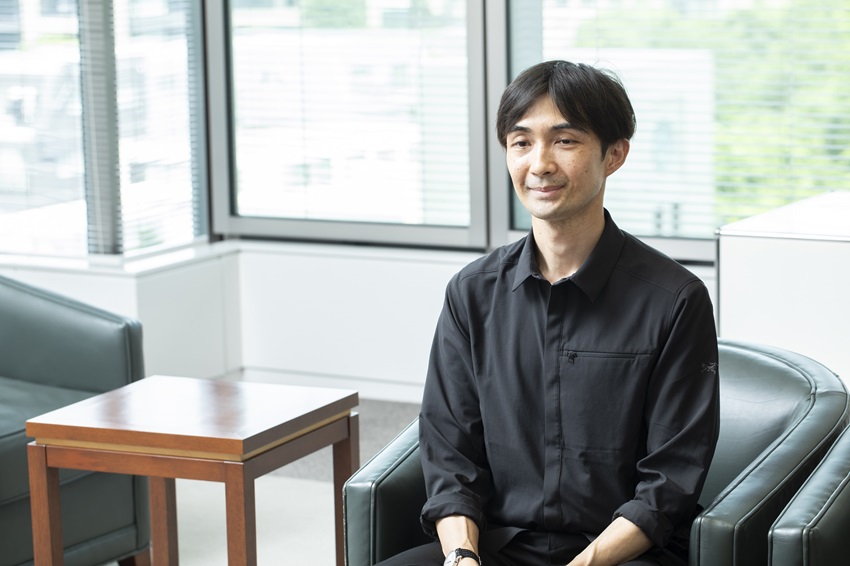
Shintaro Tai, Thematic Project Promotion Team Leader, Expo 2025 Osaka, Kansai, Japan Promotion Committee, Marketing Division
As project manager for the team in charge of the exhibits and experiences at the “Playground of Life: Jellyfish Pavilion,” produced by Sachiko Nakajima, Tai is widely regarded within DNP as “someone without whom we might never have reached the finish line.” His reason for joining the project began with a personal conviction.
“Ever since joining the company, I’ve been involved in designing experiences for museums and other venues, with a focus on the multifaceted nature of culture and the arts – how interpretations of works can vary depending on the era, the creator or the viewer. That perspective has been shaped by my own life: I have a physical disability affecting my limbs, and from a young age I’ve believed that differences are not divisions; it is precisely because we are different that our connections grow stronger. Designing experiences that embrace the multifaceted nature of culture and the arts has become something close to a lifelong mission for me.
In the summer of 2023, I decided to join the Expo project, which was already underway. My values resonated strongly with the concept of ‘democratizing creativity’ championed by Sachiko Nakajima. I also sensed new possibilities in the concept of ‘culture’ – not only from an artistic perspective but also through the fusion of music, mathematics and other viewpoints.”
Once Tai joined, the project for the “Playground of Life: Jellyfish Pavilion” gathered momentum toward the April 2025 Expo opening. What was the “co-creation” process, which involved more than 350 people from inside and outside the company – including Ms. Nakajima – actually like?
“People often say it must have been tough, but personally, I think I was more excited than anything else. It’s natural for people to have different perspectives on their roles, and I believe that the chemical reactions that arise there are the true value of co-creation. My guiding principle was always to consider the project as a whole and discuss everything thoroughly.”
Tai recalls two key turning points.
“When I joined, most of the exhibition ideas had already been proposed and the schedule required us to start locking things down. However, we still faced the challenge of how to convey ‘invigorating lives’ throughout the space, and how to embody the idea of ‘democratizing creativity’ through diverse people co-creating and co-performing. We explored an approach centering on the ‘Tree of Creation,’ designed by the architecture team, and proposed an overall spatial composition where the venue would be enveloped in sound and light, creating a shared space of co-creation and co-performance.
Later, the producers suggested bringing all the exhibits together around the Tree of Creation. This meant a major change from the exhibition and staging plans already in progress, but I felt it brought us closer to the ‘democratizing creativity’ concept and would make the sense of co-creation and co-performance easier for visitors to feel. So, we decided to take on the challenge and shift direction to make the Jellyfish Pavilion experience even better. The result is the current design, where touching certain exhibits around the Tree of Creation triggers the tree’s lights and sound to resonate in harmony.”
|
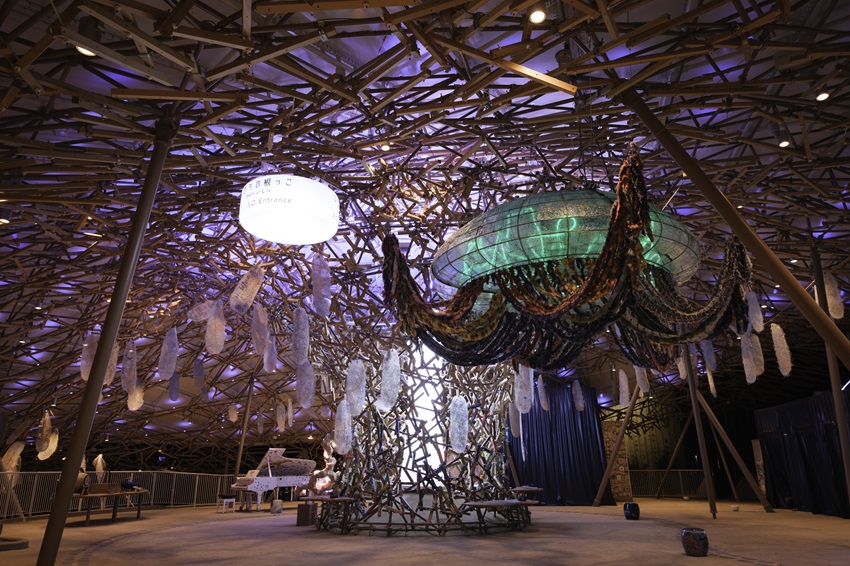
The Tree of Creation, symbolizing the vitality of all life, is built from beams of Yoshino cedar and shaped to resemble a jellyfish membrane using a slime mold algorithm to create complex, organic vibrations. It continually pulses, enveloping the entire venue in an ensemble of sound and light. Around it are installed exhibits such as Middle KURAGE: Umi-Tsuki, Co-Kurage, On-Shoku (Sound-Touch) and Kaku-Mei (Triangle of Life). When visitors touch these, the surrounding lights and sounds resonate in harmony. |
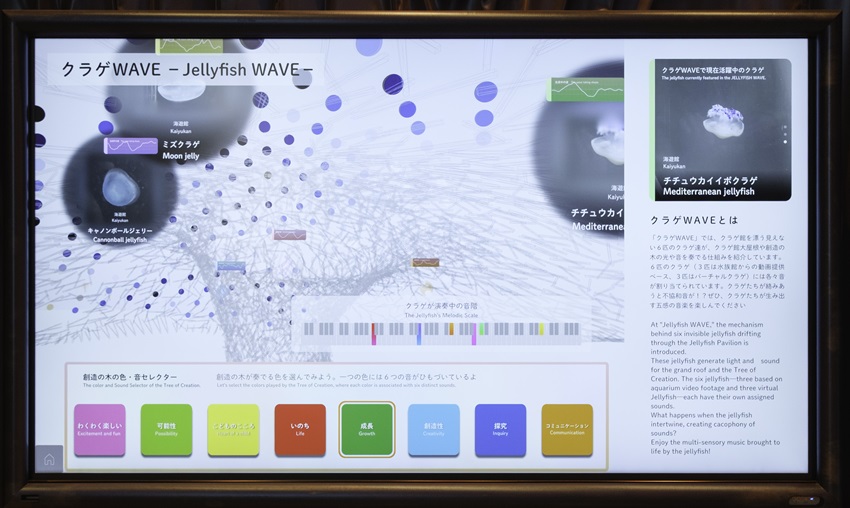
“The other turning point was introducing the monitor-based content Jellyfish WAVE. We received footage of three jellyfish from two aquariums in Japan*1 and combined them with three jellyfish generated with a program to create six jellyfish in total, rendered digitally to drift through the Jellyfish Pavilion. Their movements directly influence the real sound and light effects in the pavilion. We added this exhibition in November 2024, just before construction began. Visitors can watch the jellyfish on the monitor, enjoy the sound and light generated by their pulsations and movements, and even interact to alter the effects. This exhibit allowed us to create a new form of spatial communication where people, architecture, real exhibits and the digital realm resonate together through images, sound and light.”
-
*1 The two aquariums: Osaka Aquarium Kaiyukan and Kochi Prefectural Ashizuri Aquarium “SATOUMI,” both of which keep jellyfish.
|
On the Jellyfish WAVE screen, visitors can see where the digital jellyfish are drifting in the venue and what kind of waves of sound and light they are creating. |
“Within the company, we had repeated dialogues asking, ‘Is this truly the best way?’ If we had stopped discussions halfway through, the most exciting aspects of this project would never have emerged. It was only because we had members who kept engaging in in-depth discussions, despite time and budget constraints, that we could make this a reality.”
In this way, the Jellyfish Pavilion took shape, with ideas expanding and converging through the combined efforts of the project members. When asked what he most wanted to convey here, Tai replied:
“In the Jellyfish Pavilion, DNP is leveraging its expertise in experiential design to explore new forms of spatial communication and co-creation experiences. We hope that visitors will enjoy themselves and engage freely. There are no fixed answers to the experience, and each person will interpret it differently. Touch, participate, think and talk with someone – through these experiences, we hope people will sense the potential for ‘democratizing creativity’ for a richer society. DNP will continue to create spaces and experiences that connect diverse people.”
Although Tai speaks gently and calmly, he exudes a sense of deep conviction. His childhood belief that “differences are not divisions” may well have been essential to his role as project leader.
There’s never just one way of seeing things. That’s why communication is so important.
|
|---|
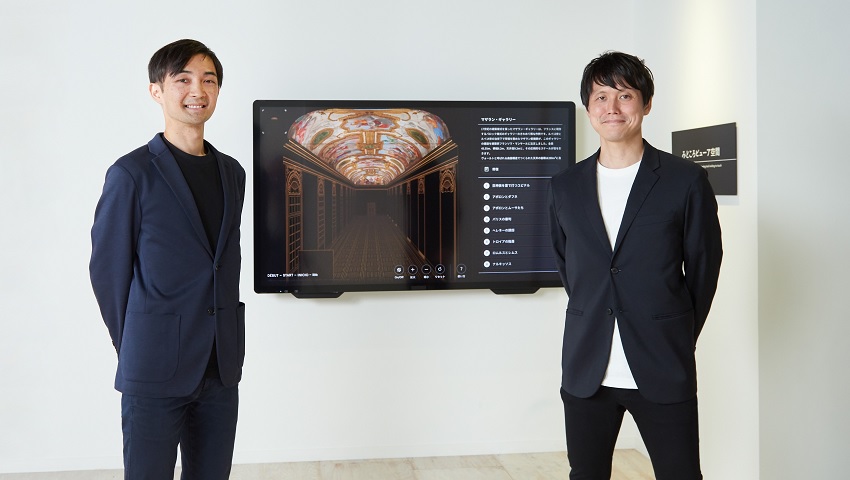
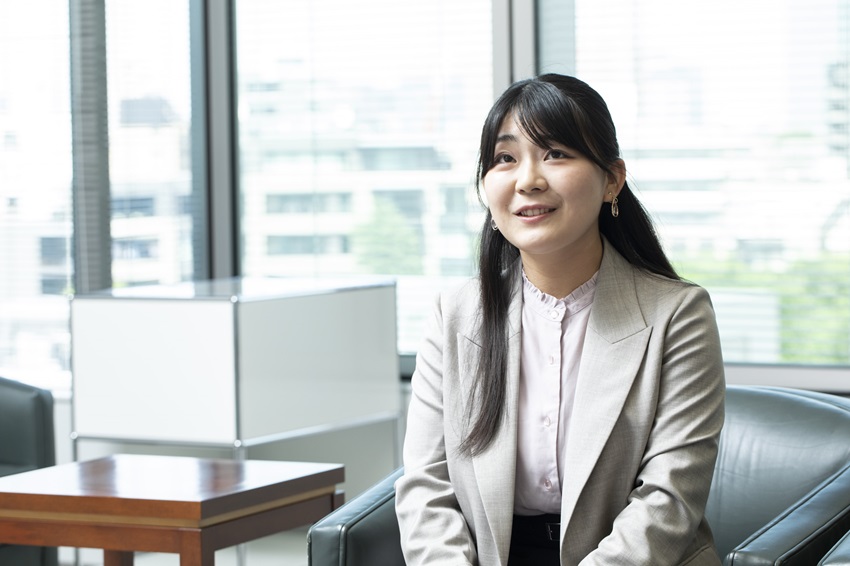
Ayano Hayashi, Co-Creation Business Design Unit, Marketing Division
Working in the same division as Tai, Hayashi served as a “bridge” between producer Nakajima’s concept and diverse teams inside and outside the company. When she joined the project, she was still in her first year at DNP. How did she approach this major responsibility?
“One of the most appealing, and challenging, aspects of our Pavilion was aiming to deliver both an ‘exhibition’ and an ‘experience.’ To achieve this, we needed close coordination with everyone involved in the Jellyfish Pavilion, as well as a constant focus on whether the final output truly embodied the concept. We held weekly meetings, often with Ms. Nakajima herself, to review and refine the exhibition and experience plans, and we also communicated closely outside of these sessions. Even so, subtle differences in nuance did arise from time to time.
When making adjustments with stakeholders, I always kept in mind the perspective of ‘What’s the best way to deliver a better experience?’ As a first-year employee, I’m not sure I always performed perfectly, but the entire team, led by Ms. Nakajima, fostered an environment where job titles and years of experience didn’t matter, and every opinion was heard and considered. That helped me enormously.”
During these discussions, Hayashi, who had done volunteer work related to inclusivity while in school, had a moment of realization.
“In the Inclusive Subcommittee*2, I had the chance to hear opinions from deaf individuals. Some of them held a negative view of their condition, while others did not. The latter group said, ‘We don’t want to be treated specially just because we can’t hear.’ In other words, I realized that there is never just one way of looking at something. This realization became a guiding principle for me in subsequent communications.
For example, in the underground space exhibit ‘Listen to Myself,’ visitors are invited to tune in to the sounds of various creatures and nature. We decided to add vibration devices to the benches so that people who are deaf or hard of hearing could also enjoy the experience. However, when we tested a prototype, the vibrations weren’t very pleasant. We kept refining the device, and the result…well, I hope you’ll experience it yourself at the pavilion!”
- *2 Inclusive Subcommittee: A working group aiming for an inclusive pavilion, where people with diverse characteristics, including visual, hearing, mobility, intellectual and internal disabilities, make proposals and conduct reviews on the architecture, exhibits and operations.
|
Listen to Myself, an exhibit located in the dimly lit space beneath the Tree of Creation, lets visitors sharpen their senses and feel sound throughout their bodies. The benches, designed to resemble tree roots, allow visitors to feel vibrations. Combined with immersive 3D sound, the experience changes depending on where you sit. |
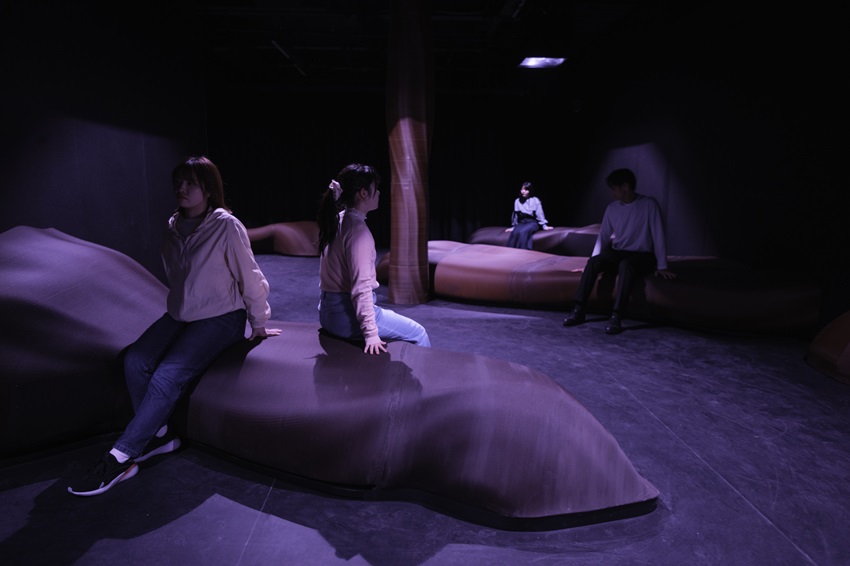
When asked about her happiest experience, Hayashi replied, “When I saw visitors enjoying the pavilion just as we had hoped.” Even after opening, she continues to make updates in response to on-site conditions.
"Monozukuri" is about creating experiences. This valuable endeavor allowed me to return to this fundamental truth.
|
|---|
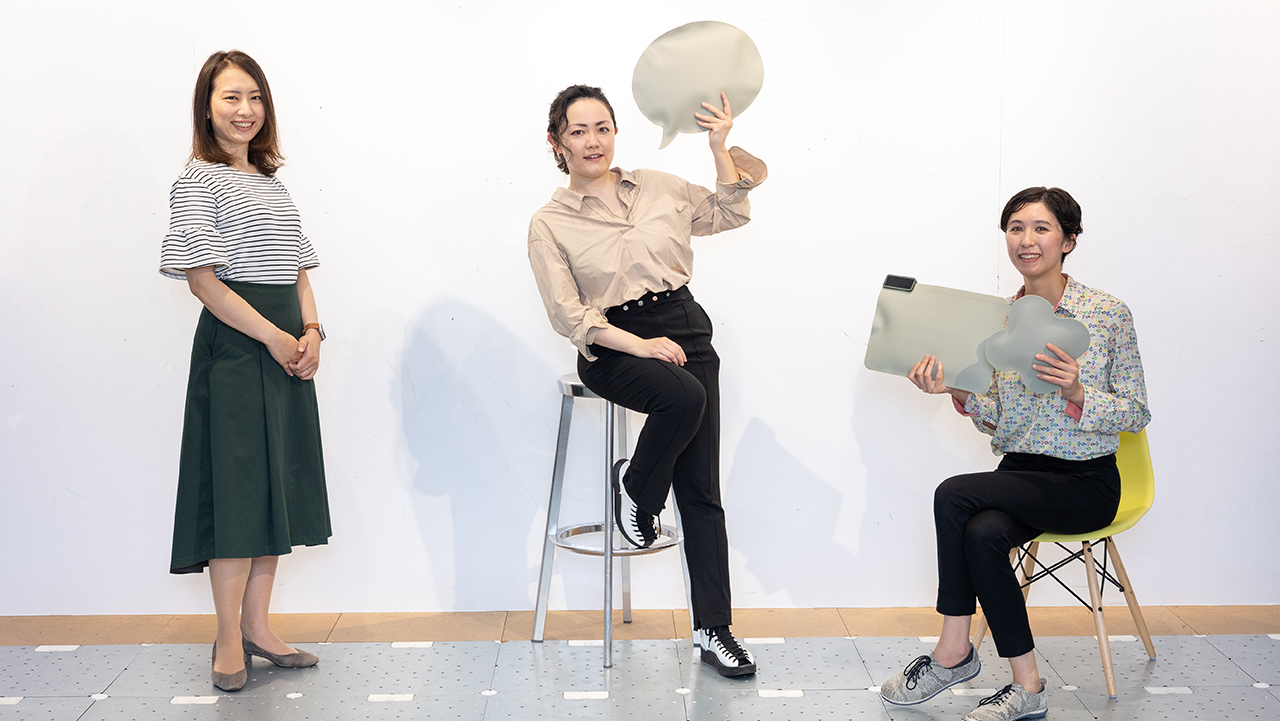
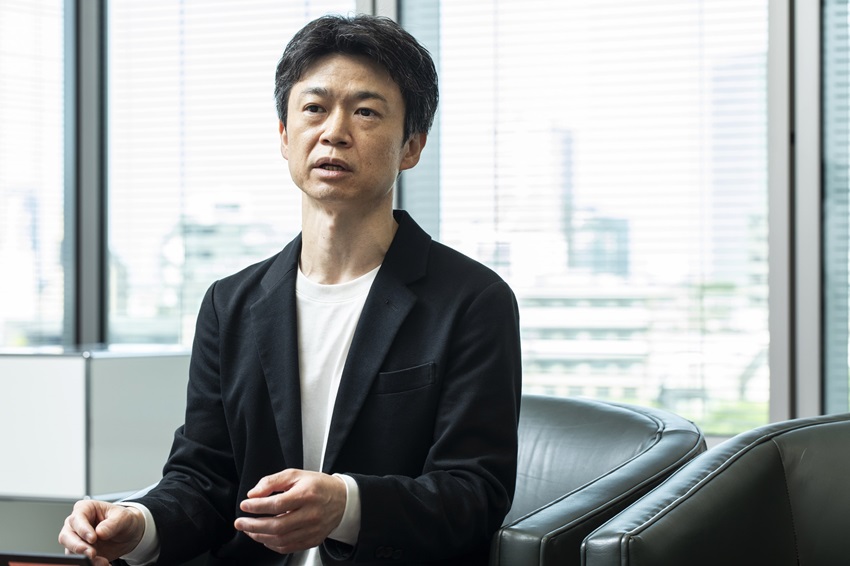
Go Sato, Information Innovation Operations Expo 2025 Center, Planning & Development Division Manager
As the director overseeing the production of exhibits and content for the Jellyfish Pavilion, Sato supervised the overall monozukuri (craftsmanship / creation process), collaborating with external partners and handling safety confirmations. At the “forefront of co-creation” that shaped the visions of producer Nakajima and Tai, Sato held one particular conviction.
“In advancing a project like the Expo pavilion, which was uncharted territory for me, I strived to involve the creators from the ground up, not just making things exactly as specified but starting with decisions on what to make. To realize this, I not only provided our company’s technology and expertise without hesitation but also focused on supporting and facilitating the realization of ideas from other companies.”
As one example of co-creation with partners, Sato highlights the exhibit and experience called the “Tree of Creation,” which Tai also referenced.
“In shaping the final design imagined by Ms. Nakajima, Tai and others, instead of the conventional flow where lighting and sound effects are added after the exhibit is completed, the architectural team and the exhibition / experience team exchanged ideas and progressed together from the design stage. During that process, the architecture team suggested using fabric made from recycled LAN cables for the material of ‘Co-Kurage,’ and our team’s proposed lighting system was adopted – realizing co-creation beyond corporate boundaries. There are countless examples like this, and I believe they resulted from a shared project-wide understanding to deliver a better experience.”
|
The narrow strips of fabric called “Co-Kurage" placed at the base of the Tree of Creation allow visitors to write their own thoughts or answers to eight questions such as “What can I do for a bright future?” The written Co-Kurage are hung on the Tree of Creation, multiplying throughout the exhibition period as the tree grows. |
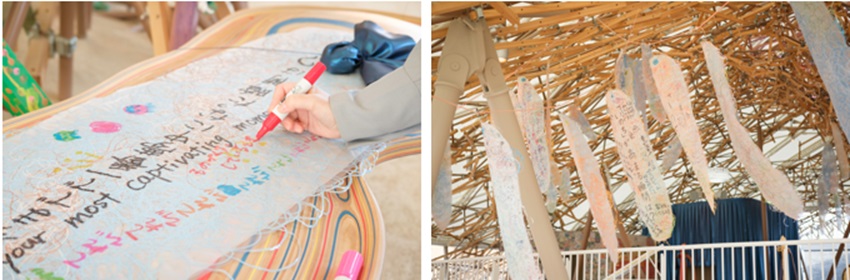
Sato comments, “In terms of challenging the unknown, various new initiatives were necessary throughout the process.” One such initiative was prototype testing by DNP facilities including at their headquarters in Ichigaya, Tokyo.
“Because it was an unprecedented, innovative form of monozukuri, it was necessary to verify the physical exhibits from the perspectives of quality control and service design, so that everyone would be convinced. For example, DNP produced and tested nearly all of the prototypes for the exhibition.
For instance, the material for the musical instruments called ‘On-Shoku’ placed around the Tree of Creation was initially planned as slime rather than gel, but testing revealed it got dirty easily, so we gave up on that. We tried dozens of materials including sponges and clay, ultimately adopting the idea of covering gel with a silicone sheet. Also, to incorporate these instruments into a lighting and sound performance that resonates, a highly precise program was needed in which light passes through the gel touched by users and changes the sound effects. We repeated testing until everyone was satisfied.”
|
“On-Shoku” (Sound-Touch) is a musical instrument that produces sound, light and vibration when its soft surface is pressed. It comes in various sizes and allows people who come together or happen to be nearby to play in an ensemble. |
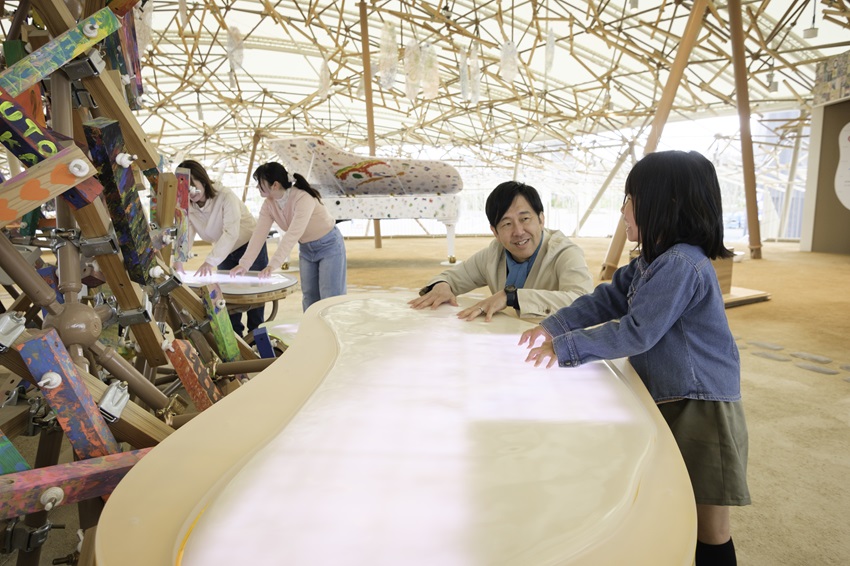
Sato continued to pursue an approach that pushed producer Nakajima’s vision to the limits in order to realize the concept. He summarizes: “It was an excellent opportunity to bring together our accumulated knowledge and technology and elevate it as a new experiential value.” The experience gained from this project is sure to broaden the range of value DNP will create going forward.
Challenges beyond existing conventions brought many new insights.
|
|---|
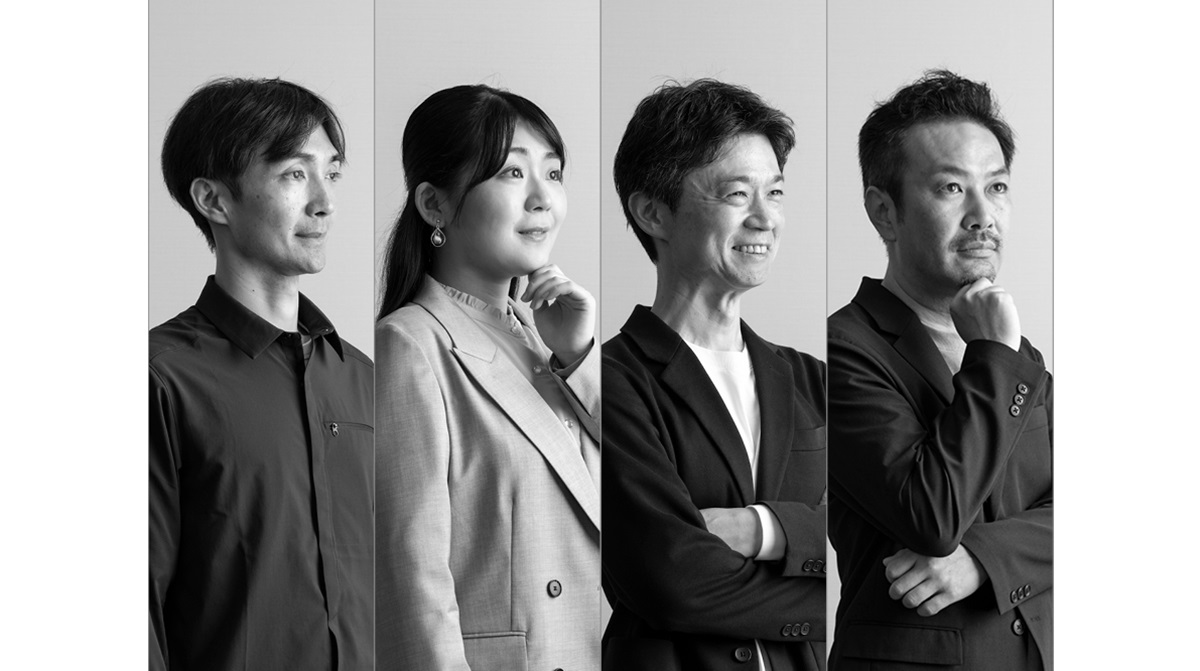
Mitsuaki Katano, Information Innovation Operations Expo 2025 Center, Planning & Development Division
Holding a First-Class Architect license, Katano worked alongside Sato in planning, designing and producing the exhibits, as well as coordinating with external architectural teams. He recalls, “In my career in architecture, I’ve rarely had the chance to be involved in something like a World Expo pavilion, so I was thrilled to take part.” That said, it seems there were also significant differences from his usual work.
“Unlike commissioned projects, the Jellyfish Pavilion required us to create standards from scratch that everyone could agree on, through dialogue with a large number of stakeholders. Normally, we are always striving for the highest level of safety in every project, but this time – given the nature of the Expo as a large-scale, long-running event – we needed to ensure safety from an even broader and more multifaceted perspective.”
In bringing to life the images envisioned by Ms. Nakajima and her team, Katano and his colleagues sought not only to pursue usability and artistry, but also to guarantee a high degree of safety. When asked which exhibit stood out most in his memory, Katano answers:
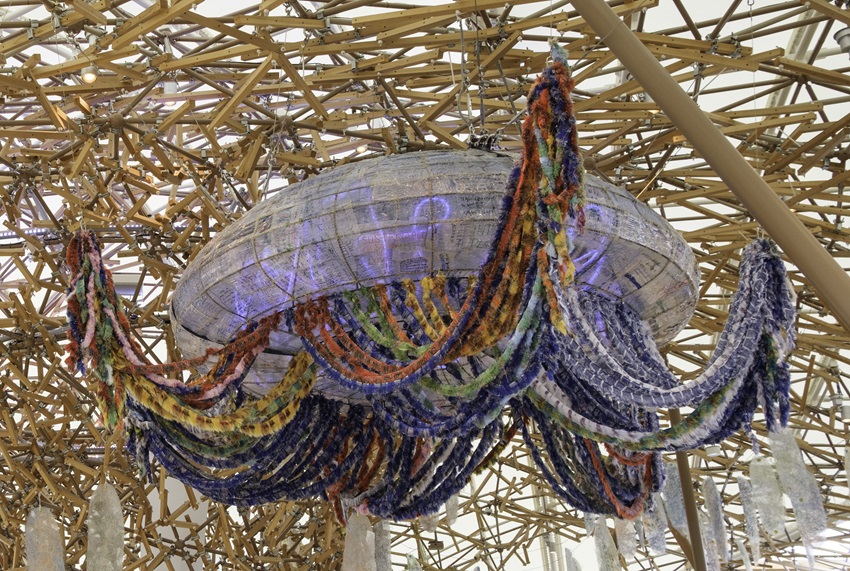
“The Middle KURAGE: Umi-Tsuki, a jellyfish-inspired piece hanging from the large roof. It’s a fascinating work born from a collaboration between artist Mago Nagasaka*3, producer Nakajima, and others, but from an architectural standpoint, it was actually an extremely challenging object.”
|
The art piece, Middle KURAGE Umi-Tsuki, a collaboration between artist Mago Nagasaka and producer Nakajima’s team, is made from PET bottle waste collected worldwide, with everyone involved writing their hopes, dreams and wishes for the future on it. |
- *3 Mago Nagasaka: Japanese social activist and artist from Fukui City, Fukui Prefecture; CEO of MAGO CREATION
“There were many safety-related challenges – how to suspend the piece from the swaying roof, how to ensure the roof wouldn’t be damaged by the weight of the exhibit, how to guard against strong winds and more. On the other hand, adding too much reinforcement would diminish the artistic quality. Under normal circumstances, I think it wouldn’t have been surprising for someone to say, ‘Why don’t we just skip hanging it altogether?’
But we didn’t give up. We engaged in repeated discussions with internal and external stakeholders, pushing to the limit to find a solution that would preserve the artistry while ensuring safety. I’m deeply grateful to the external architectural team who gave us so much advice on both design and structure, and to Mago Nagasaka, who understood our decision to have DNP produce the frame to guarantee safety.”
Another work Katano recommends “for the experience of the exhibit itself” is the “Celebrate Myself” installation, located in the underground space.
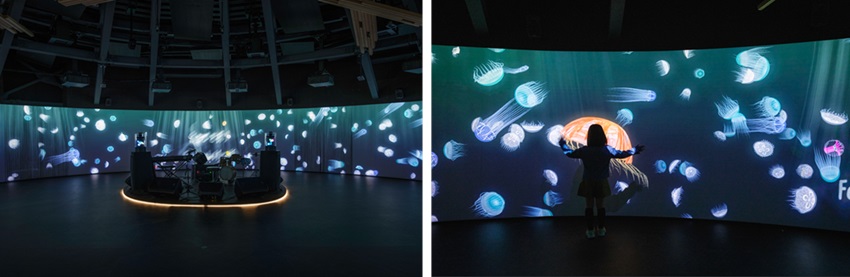
“This installation offers visitors an overwhelming sense of immersion in an audiovisual space completely surrounded by 360 screens. We built various innovations, for example, designing the acoustics so the soundtrack and live musicians’ performances wouldn’t clash; linking the visuals with sensors so that visitors’ movements interact with the presentation; and incorporating lighting effects that match each scene of the video. I encourage everyone to visit and experience it firsthand.”
|
From the softly lit antechamber Listen to Myself, where visitors pause to immerse themselves in sound, the experience shifts dramatically to Celebrate Myself. Here, a fully immersive production, blending video, music and lighting, expresses the wonder of life’s beginnings and the beauty of diverse individuality. |
Even after the pavilion opened, Katano continues to visit regularly for scheduled maintenance. “Sometimes, just from the condition of the exhibits, I can picture how much visitors enjoyed themselves. Moments like that are one of the real privileges of my job,” he says with a gentle smile.
Alongside Tai, Hayashi, Sato and Katano, many DNP employees from across different divisions also contributed to this project. Guided by the concept of “democratization of creativity,” each person reflected on the value of “difference” and “dialogue,” exploring new ways for people from diverse backgrounds to connect and create together.
Central to this vision were interactive systems that spanned sight, sound and touch, and experiences where visitors’ movements triggered responses from the exhibits. Through their own senses, visitors engage directly with the displays, their actions rippling out into the entire space, until they realize they are in a place where “people,” “architecture” and “exhibits” are resonating in harmony.
The Jellyfish Pavilion deliberately offers minimal guidance on routes and how to enjoy the exhibits. The aim is not for people to wait for instructions, but to stand in the space and discover their own insights through their senses.
The “democratization of creativity” initiative, developed by DNP in collaboration with producer Sachiko Nakajima, is more than just a concept: it underpins the entire experiential design of the Jellyfish Pavilion and serves as a guiding principle for co-creation. DNP remains committed to helping build a future society in which we “create together” and “live together.”
The very process of co-creation fostered with everyone at DNP may, in fact, be the first step toward the post-Expo era.

|
|---|
Sachiko Nakajima, Producer, Playground of Life: Jellyfish Pavilion
Events that truly move people are not defined by their scale or budget, but by the process – by who was involved and with what intentions. Those intentions are sharpened by drawing in many people and engaging in ongoing dialogue, eventually crystallizing into a powerful message that spreads through society.
The Playground of Life: Jellyfish Pavilion, which I had the honor of producing, was born of just such a process. It was never meant to be shaped by my vision alone. Instead, it took form gradually, through countless conversations in which companies, organizations and individuals brought together differing perspectives and values, challenged one another, and refined ideas. I sense a feeling of “family” with the colleagues who shared that journey, and I believe the presence of DNP, who served as the project’s communication hub, was especially significant.
Of course, those relationships weren’t built overnight. At the HANAZONO EXPO in 2023, we danced our way through the grounds wearing jellyfish-themed festival coats, played with exhibit prototypes and engaged in activities both in and beyond the meeting room. These experiences brought us closer and allowed us to communicate physically and wordlessly, a change I believe was crucial.
In that sense, the ability to create such a process for building a positive community may be our greatest contribution toward “Designing Future Society for Our Lives.” I’m very much looking forward to our next project together with DNP, which played such a central role in this endeavor.
-
*Please note that the information contained in this story was accurate as of the publication date.
September 18, 2025 by DNP Features Editorial Department